Ch. 1 - Equations and Inequalities
Lial - College Algebra 13th Edition
Lial13th EditionCollege AlgebraISBN: 9780136881063당신이 사용하는 게 아니라요?교과서 변경
2장, 문제 47

Which equation has two real, distinct solutions? Do not actually solve.
A. (3x-4)² = -9 B. (4-7x)² = 0 C. (5x-9)(5x-9) = 0 D. (7x+4)² = 11

검증된 단계별 안내
1
Recall that an equation of the form \( (ax + b)^2 = c \) will have two real, distinct solutions if and only if \( c > 0 \). This is because taking the square root of both sides yields two different values, \( \sqrt{c} \) and \( -\sqrt{c} \), when \( c \) is positive.
Analyze option A: \( (3x - 4)^2 = -9 \). Since the right side is negative, \( -9 < 0 \), there are no real solutions because a square cannot equal a negative number in the real number system.
Analyze option B: \( (4 - 7x)^2 = 0 \). Here, \( c = 0 \), so there is exactly one real solution (a repeated root), not two distinct solutions.
Analyze option C: \( (5x - 9)(5x - 9) = 0 \) is equivalent to \( (5x - 9)^2 = 0 \), which again means \( c = 0 \) and only one real solution (a repeated root).
Analyze option D: \( (7x + 4)^2 = 11 \). Since \( 11 > 0 \), this equation will have two real, distinct solutions because the square root of 11 is positive and negative, giving two different values for \( x \).

비슷한 문제에 대한 검증된 영상 답변:

이 영상 해법은 위 문제에 도움이 된다고 튜터들이 추천한 것입니다.
영상 길이:
3m
도움이 되었나요?

주요 개념

질문에 올바르게 답하기 위해 반드시 이해해야 하는 핵심 개념들은 다음과 같습니다.

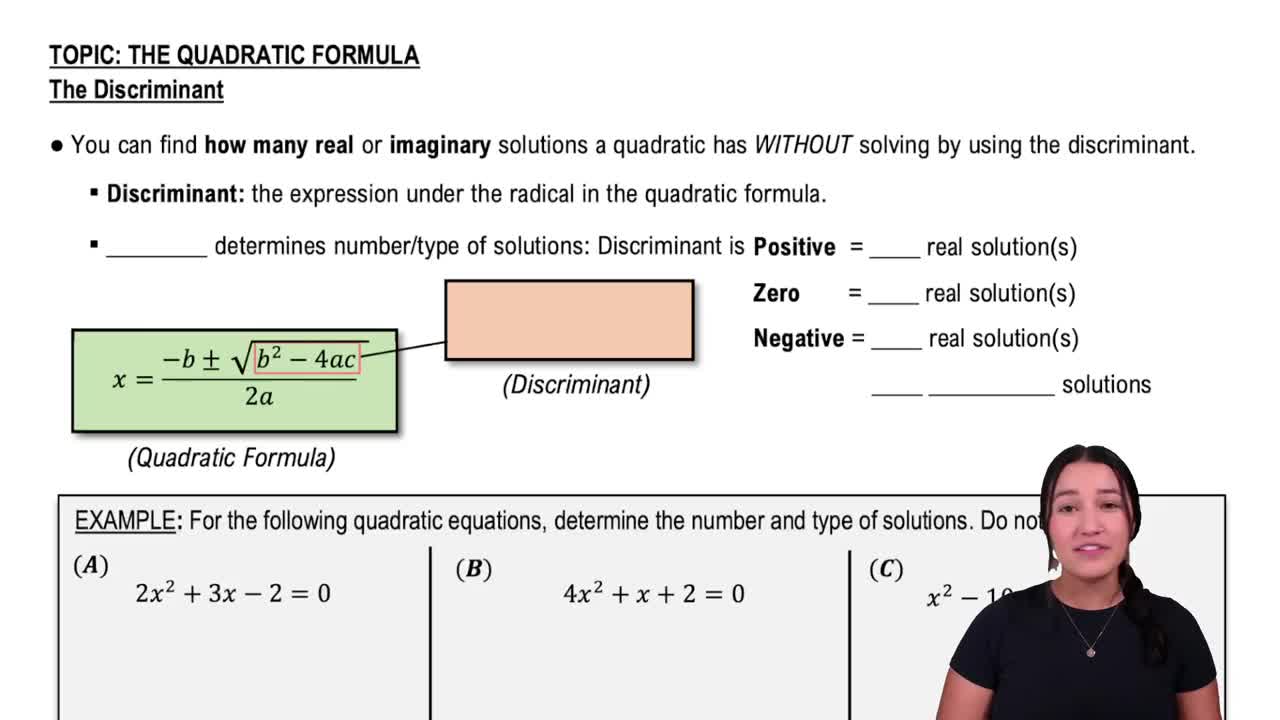
Discriminant and Nature of Solutions

The discriminant of a quadratic equation determines the number and type of solutions. If the discriminant is positive, there are two distinct real solutions; if zero, one real repeated solution; if negative, no real solutions. Understanding this helps identify equations with two real, distinct roots without solving.
추천 영상:
04:11
The Discriminant

Square of a Binomial and Its Properties

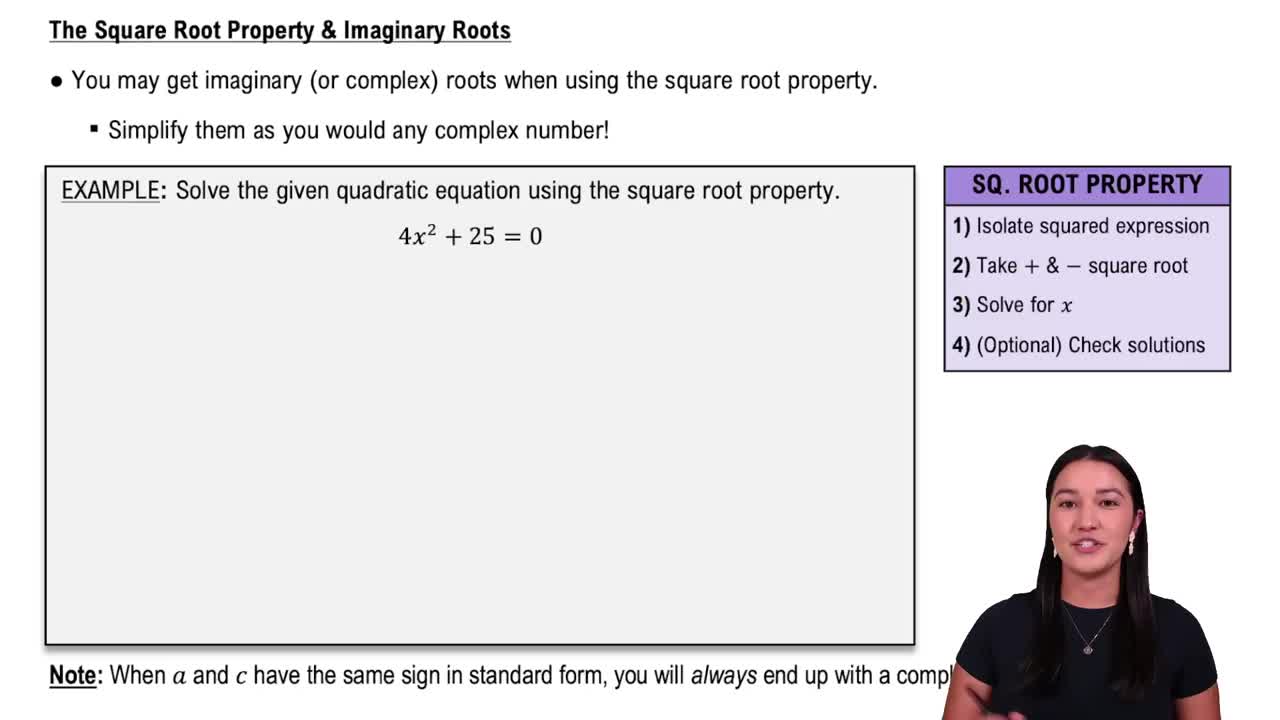
Expressions like (ax + b)² represent a perfect square trinomial, which equals zero only when the binomial itself is zero, leading to one repeated root. Recognizing this form helps determine if an equation has one or multiple solutions without expanding or solving.
추천 영상:
02:20
Imaginary Roots with the Square Root Property

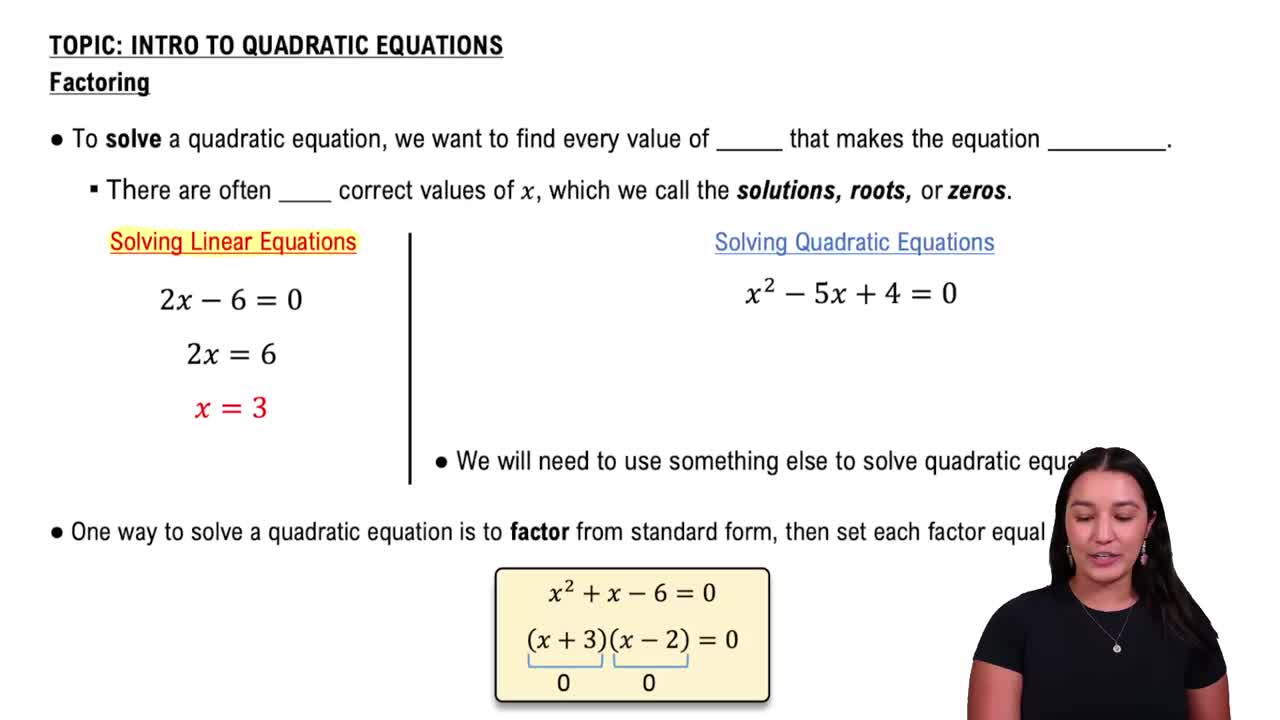
Solving Quadratic Equations by Inspection

Some quadratic equations can be analyzed by examining their structure, such as whether the squared term equals a positive, zero, or negative number. This approach allows quick assessment of the number and type of solutions based on the equation's form, avoiding full algebraic solving.
추천 영상:
06:08
Solving Quadratic Equations by Factoring