Ch. 2 - Graphs and Functions
Lial - College Algebra 13th Edition
Lial13th EditionCollege AlgebraISBN: 9780136881063당신이 사용하는 게 아니라요?교과서 변경
3장, 문제 51

For each function, find (a)ƒ(x+h), (b)ƒ(x+h)-ƒ(x), and (c)[ƒ(x+h)-ƒ(x)]/h. ƒ(x)=x2

검증된 단계별 안내
1
Start by finding \( f(x+h) \) for the function \( f(x) = x^2 \). This means you replace every \( x \) in the function with \( x+h \), so write \( f(x+h) = (x+h)^2 \).
Next, expand the expression \( (x+h)^2 \) using the binomial formula \( (a+b)^2 = a^2 + 2ab + b^2 \). So, \( (x+h)^2 = x^2 + 2xh + h^2 \).
Now, find \( f(x+h) - f(x) \) by subtracting \( f(x) = x^2 \) from the expanded \( f(x+h) \). This gives \( (x^2 + 2xh + h^2) - x^2 \).
Simplify the expression \( f(x+h) - f(x) \) by canceling out \( x^2 \), leaving you with \( 2xh + h^2 \).
Finally, find \( \frac{f(x+h) - f(x)}{h} \) by dividing the simplified difference \( 2xh + h^2 \) by \( h \). This results in \( \frac{2xh + h^2}{h} \).

비슷한 문제에 대한 검증된 영상 답변:

이 영상 해법은 위 문제에 도움이 된다고 튜터들이 추천한 것입니다.
영상 길이:
4m
도움이 되었나요?

주요 개념

질문에 올바르게 답하기 위해 반드시 이해해야 하는 핵심 개념들은 다음과 같습니다.

Function Notation and Evaluation

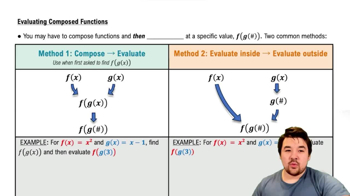
Function notation, such as ƒ(x), represents a rule that assigns each input x to an output value. Evaluating ƒ(x+h) means substituting x+h into the function in place of x, which helps analyze how the function behaves when its input changes by h.
추천 영상:
4:26
Evaluating Composed Functions

Difference of Function Values

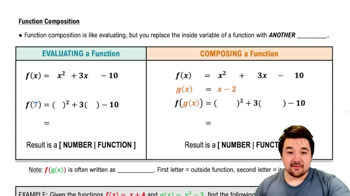
The expression ƒ(x+h) - ƒ(x) calculates the change in the function's output as the input changes from x to x+h. This difference is fundamental in understanding how the function varies over an interval and is a stepping stone toward concepts like average rate of change.
추천 영상:
4:56
Function Composition

Difference Quotient

The difference quotient, [ƒ(x+h) - ƒ(x)] / h, measures the average rate of change of the function over the interval from x to x+h. It is a key concept in calculus, representing the slope of the secant line, and is used to approximate derivatives.
추천 영상:
3:49
Product, Quotient, and Power Rules of Logs