
교과서 질문
Determine whether each equation has a graph that is symmetric with respect to the x-axis, the y-axis, the origin, or none of these.
771
views

 검증된 단계별 안내
 4:56
4:56
 3:51
3:51 05:21
05:21Determine whether each equation has a graph that is symmetric with respect to the x-axis, the y-axis, the origin, or none of these.
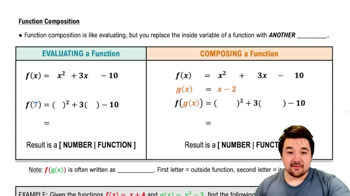
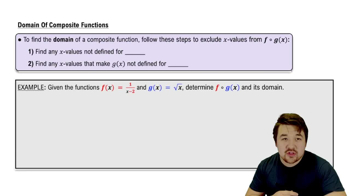
Given functions f and g, find (ƒ∘g)(x) and its domain. ƒ(x)=1/(x-2), g(x)=1/x
Given functions f and g, find (a)(ƒ∘g)(x) and its domain, and (b)(g∘ƒ)(x) and its domain. ƒ(x)=1/(x+4), g(x)=-(1/x)
Determine the largest open intervals of the domain over which each function is (c) constant. See Example 9.
Determine the largest open intervals of the domain over which each function is b) decreasing. See Example 9.
Determine the largest open intervals of the domain over which each function is (a) increasing. See Example 9.