For the points P and Q, find (a) the distance d(P, Q) and (b) the coordinates of the mid-point M of line segment PQ. P(6,-2), Q(4,6)
Ch. 2 - Graphs and Functions

3장, 문제 21
Graph each piecewise-defined function.
검증된 단계별 안내1
Step 1: Understand the piecewise function definition. The function f(x) is defined as two different expressions depending on the value of x: for x ≤ 1, f(x) = x + 4; for x > 1, f(x) = 5.
Step 2: Graph the first piece, f(x) = x + 4 for x ≤ 1. This is a linear function with slope 1 and y-intercept 4. Plot points for values of x less than or equal to 1, such as x = 0, x = 1, and connect them with a straight line extending to the left.
Step 3: Determine the point at x = 1 for the first piece. Calculate f(1) = 1 + 4 = 5. This point (1, 5) will be included in the graph of the first piece because the inequality is 'less than or equal to'.
Step 4: Graph the second piece, f(x) = 5 for x > 1. This is a constant function, so draw a horizontal line at y = 5 for all x values greater than 1. Use an open circle at (1, 5) if you want to indicate that this piece does not include x = 1, but since the first piece includes x = 1, the point at (1, 5) belongs to the first piece.
Step 5: Combine both pieces on the same coordinate plane. The graph will show a line with slope 1 up to and including x = 1, and a horizontal line at y = 5 for x values greater than 1. This completes the graph of the piecewise function.

비슷한 문제에 대한 검증된 영상 답변:
이 영상 해법은 위 문제에 도움이 된다고 튜터들이 추천한 것입니다.
영상 길이:
4m도움이 되었나요?
주요 개념
질문에 올바르게 답하기 위해 반드시 이해해야 하는 핵심 개념들은 다음과 같습니다.
Piecewise-Defined Functions
A piecewise-defined function is a function composed of different expressions depending on the input value's domain. Each piece applies to a specific interval, and the function's value changes according to these conditions. Understanding how to interpret and graph each piece separately is essential.
추천 영상:
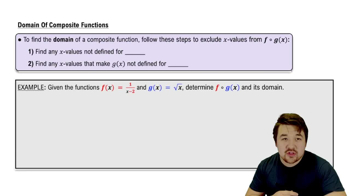
Domain Restrictions of Composed Functions
Graphing Functions with Domain Restrictions
When graphing piecewise functions, it is important to restrict each part of the function to its specified domain. This means plotting the function only where the condition (like x ≤ 1 or x > 1) holds true, and using open or closed points to indicate whether endpoints are included or excluded.
추천 영상:
Domain Restrictions of Composed Functions
Continuity and Discontinuity in Piecewise Functions
Piecewise functions may be continuous or have jumps at the points where the pieces meet. Checking the function values at boundary points helps determine if the graph connects smoothly or has a break, which affects the overall shape and interpretation of the function.
추천 영상:
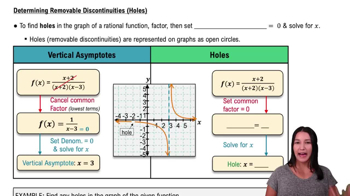
Determining Removable Discontinuities (Holes)
관련 실천
교과서 질문
631
views
교과서 질문
For each graph, determine whether y is a function of x. Give the domain and range of each relation.
1158
views
교과서 질문
Write an equation for each line described. Give answers in standard form for Exercises 11–20 and in slope-intercept form (if possible) for Exercises 21–32.
x-intercept (3,0), y-intercept (0,-2)
1114
views
교과서 질문
In the following exercises, (a) find the center-radius form of the equation of each circle described, and (b) graph it. center (√2, √2), radius √2
754
views
교과서 질문
For each graph, determine whether y is a function of x. Give the domain and range of each relation.
850
views
교과서 질문
Determine whether each relation defines a function, and give the domain and range. {(2,5),(3,7),(3,9),(5,11)}
875
views