Ch. 2 - Graphs and Functions
Lial - College Algebra 13th Edition
Lial13th EditionCollege AlgebraISBN: 9780136881063당신이 사용하는 게 아니라요?교과서 변경
3장, 문제 17

Let ƒ(x)=x2+3 and g(x)=-2x+6. Find each of the following. (ƒ/g)(-1)

검증된 단계별 안내
1
Understand that the notation (ƒ/g)(x) means the function ƒ(x) divided by the function g(x), so (ƒ/g)(x) = \(\frac{ƒ(x)}{g(x)}\).
Substitute the given functions into the expression: (ƒ/g)(x) = \(\frac{x^2 + 3}{-2x + 6}\).
Replace x with -1 in both the numerator and the denominator: numerator = (-1)^2 + 3, denominator = -2(-1) + 6.
Calculate the values inside the numerator and denominator separately: numerator = 1 + 3, denominator = 2 + 6.
Write the final expression as a fraction using these values: (ƒ/g)(-1) = \(\frac{1 + 3}{2 + 6}\).

비슷한 문제에 대한 검증된 영상 답변:

이 영상 해법은 위 문제에 도움이 된다고 튜터들이 추천한 것입니다.
영상 길이:
2m

주요 개념

질문에 올바르게 답하기 위해 반드시 이해해야 하는 핵심 개념들은 다음과 같습니다.

Function Notation and Evaluation

Function notation, such as ƒ(x), represents a rule that assigns each input x to an output value. Evaluating a function at a specific value means substituting that value into the function's expression and simplifying to find the output.
추천 영상:
4:26
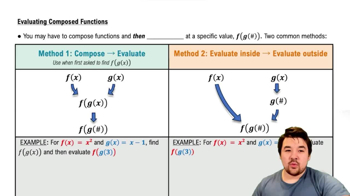
Evaluating Composed Functions

Function Division (Quotient of Functions)

The quotient of two functions (ƒ/g)(x) is defined as ƒ(x) divided by g(x), provided g(x) ≠ 0. To find (ƒ/g)(-1), evaluate both ƒ(-1) and g(-1) separately, then divide the results.
추천 영상:
7:24
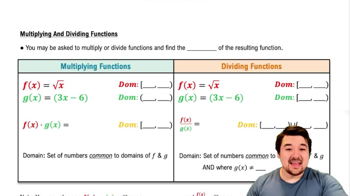
Multiplying & Dividing Functions

Domain Restrictions in Function Operations

When dividing functions, the domain excludes values where the denominator function equals zero, as division by zero is undefined. It's important to check g(x) ≠ 0 before evaluating (ƒ/g)(x) at a given point.
추천 영상:
3:51
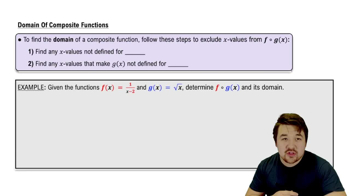
Domain Restrictions of Composed Functions