Ch. 2 - Graphs and Functions
Lial - College Algebra 13th Edition
Lial13th EditionCollege AlgebraISBN: 9780136881063당신이 사용하는 게 아니라요?교과서 변경
3장, 문제 14

Let ƒ(x)=x2+3ƒ(x)=x^2+3 and g(x)=2x+6g(x)=-2x+6. Find each of the following. See Example 1.
(ƒg)(4)(ƒ-g)(4)

검증된 단계별 안내
1
Understand that the expression (ƒ - g)(4) means you need to find the value of the function ƒ(x) minus the function g(x) when x = 4. In other words, (ƒ - g)(4) = ƒ(4) - g(4).
Calculate ƒ(4) by substituting x = 4 into the function ƒ(x) = x^2 + 3. This gives ƒ(4) = 4^2 + 3.
Calculate g(4) by substituting x = 4 into the function g(x) = -2x + 6. This gives g(4) = -2(4) + 6.
Subtract the value of g(4) from ƒ(4) to find (ƒ - g)(4). So, (ƒ - g)(4) = ƒ(4) - g(4).
Simplify the expression from the previous step to get the final value of (ƒ - g)(4).

비슷한 문제에 대한 검증된 영상 답변:

이 영상 해법은 위 문제에 도움이 된다고 튜터들이 추천한 것입니다.
영상 길이:
2m

주요 개념

질문에 올바르게 답하기 위해 반드시 이해해야 하는 핵심 개념들은 다음과 같습니다.

Function Notation and Evaluation

Function notation, such as ƒ(x), represents a rule that assigns each input x to an output value. Evaluating a function at a specific value means substituting that value into the function's expression and simplifying to find the output.
추천 영상:
4:26
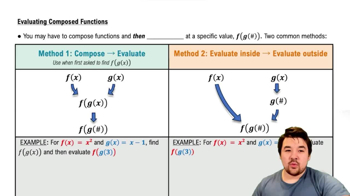
Evaluating Composed Functions

Function Operations (Difference of Functions)

The difference of two functions (ƒ - g)(x) is defined as ƒ(x) minus g(x). This operation creates a new function by subtracting the output of g from the output of ƒ for the same input x.
추천 영상:
7:24
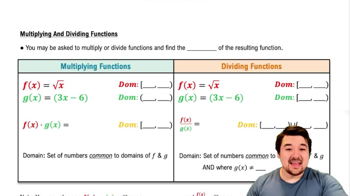
Multiplying & Dividing Functions

Substitution and Simplification

To find (ƒ - g)(4), substitute x = 4 into both ƒ(x) and g(x), then subtract the results. Simplifying the expressions after substitution yields the final numerical value.
추천 영상:
5:48
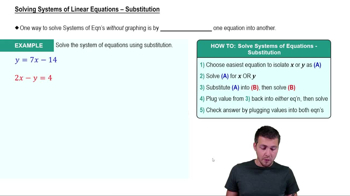
Solving Systems of Equations - Substitution