Ch. 2 - Graphs and Functions
Lial - College Algebra 13th Edition
Lial13th EditionCollege AlgebraISBN: 9780136881063당신이 사용하는 게 아니라요?교과서 변경
3장, 문제 1

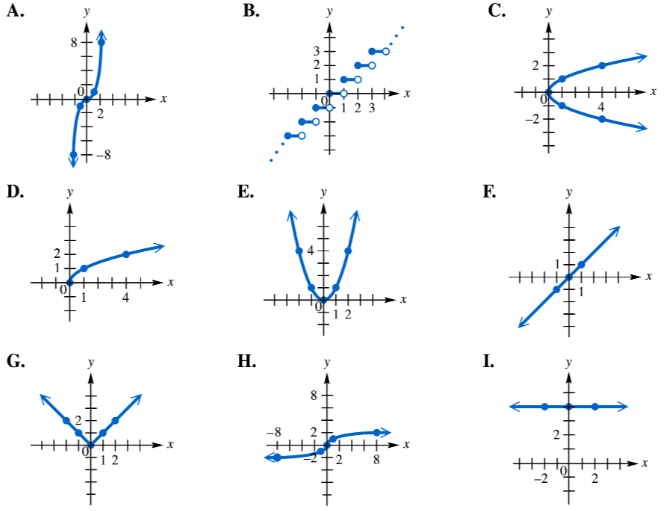
To answer each question, refer to the following basic graphs. Which one is the graph of ƒ(x)=x2? What is its domain?
Nine coordinate plane graphs labeled A to I showing various functions, including a parabola opening upward at E.

검증된 단계별 안내
1
Identify the function given: ƒ(x) = x^2 is a quadratic function, which graphs as a parabola opening upwards.
Recall the shape of the graph of ƒ(x) = x^2: it is a U-shaped curve with its vertex at the origin (0,0).
Look at the provided basic graphs and select the one that matches this U-shaped parabola with vertex at the origin.
Determine the domain of ƒ(x) = x^2: since you can input any real number for x and get a real output, the domain is all real numbers.
Express the domain in interval notation as \((-\infty, \infty)\), meaning x can be any real number.

비슷한 문제에 대한 검증된 영상 답변:

이 영상 해법은 위 문제에 도움이 된다고 튜터들이 추천한 것입니다.
영상 길이:
2m
도움이 되었나요?

주요 개념

질문에 올바르게 답하기 위해 반드시 이해해야 하는 핵심 개념들은 다음과 같습니다.

Quadratic Functions

A quadratic function is a polynomial function of degree two, typically written as f(x) = x². Its graph is a parabola that opens upwards, symmetric about the y-axis, with the vertex at the origin (0,0). Recognizing this shape helps identify the graph of f(x) = x².
추천 영상:
06:36
Solving Quadratic Equations Using The Quadratic Formula

Graph Interpretation

Graph interpretation involves analyzing the shape, position, and key features of a graph to match it with a given function. For f(x) = x², the graph is a U-shaped curve, and understanding these visual cues is essential to correctly identify the function's graph.
추천 영상:
가이드 코스
02:16
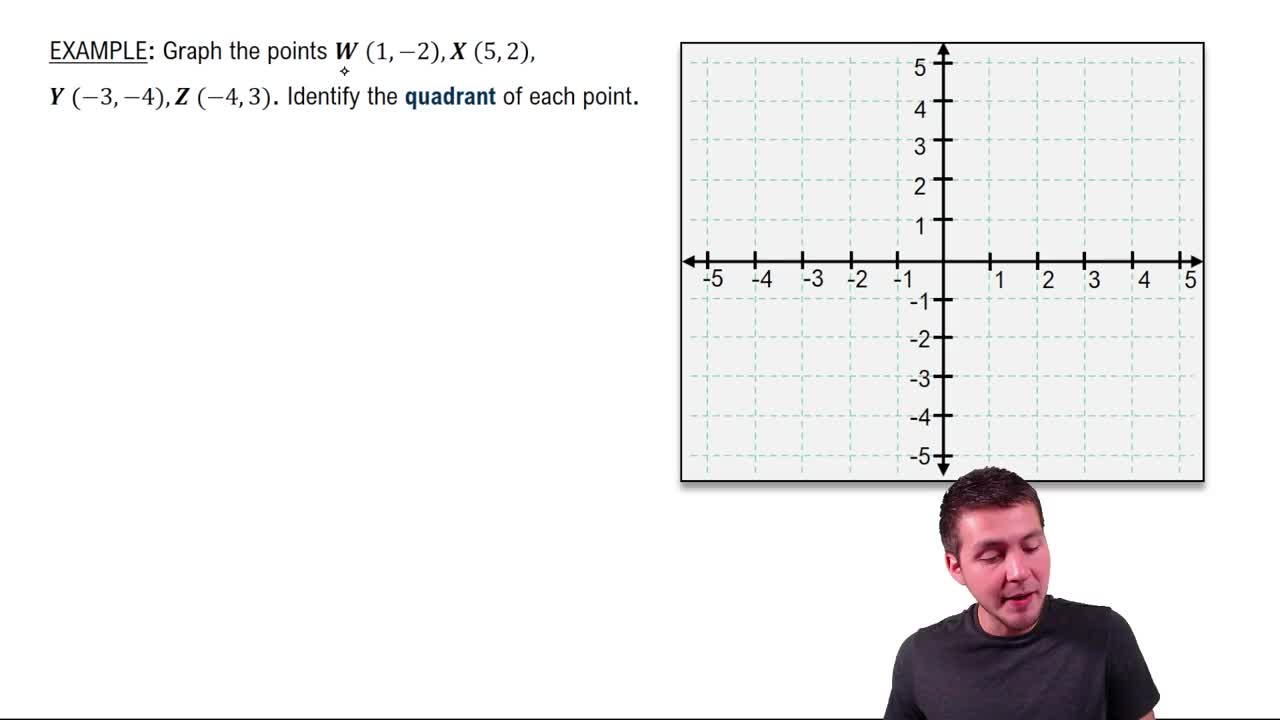
Graphs and Coordinates - Example

Domain of a Function

The domain of a function is the set of all possible input values (x-values) for which the function is defined. For f(x) = x², the domain is all real numbers since any real number can be squared without restriction.
추천 영상:
3:51
Domain Restrictions of Composed Functions