Ch. 2 - Graphs and Functions
Lial - College Algebra 13th Edition
Lial13th EditionCollege AlgebraISBN: 9780136881063당신이 사용하는 게 아니라요?교과서 변경
3장, 문제 119

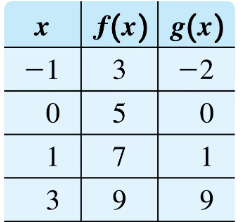
Use the table to evaluate each expression, if possible.
(ƒ+g)(1)(ƒ+g)(1)
(ƒ+g)(1)

검증된 단계별 안내
1
Identify the functions ƒ and g from the given table. The table should provide values of ƒ(x) and g(x) for various x, including x = 1.
Locate the value of ƒ(1) in the table by finding the row where x = 1 and noting the corresponding ƒ(x) value.
Locate the value of g(1) in the table by finding the row where x = 1 and noting the corresponding g(x) value.
Add the two values together to find (ƒ + g)(1), using the formula: \[(ƒ + g)(1) = ƒ(1) + g(1)\]
If either ƒ(1) or g(1) is not available in the table, then (ƒ + g)(1) cannot be evaluated.

비슷한 문제에 대한 검증된 영상 답변:

이 영상 해법은 위 문제에 도움이 된다고 튜터들이 추천한 것입니다.
영상 길이:
56s
도움이 되었나요?

주요 개념

질문에 올바르게 답하기 위해 반드시 이해해야 하는 핵심 개념들은 다음과 같습니다.

Function Notation and Evaluation

Function notation, such as f(x), represents the output of a function f for an input x. Evaluating a function at a specific value means substituting that value into the function to find the corresponding output. For example, f(1) means finding the value of f when x = 1.
추천 영상:
4:26
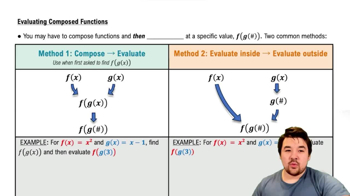
Evaluating Composed Functions

Operations on Functions

Operations on functions include addition, subtraction, multiplication, and division of two functions. For (f + g)(x), you add the outputs of f(x) and g(x) for the same input x. This means (f + g)(1) = f(1) + g(1), combining the values from each function at x = 1.
추천 영상:
7:24
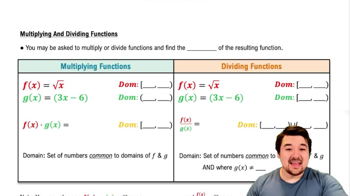
Multiplying & Dividing Functions

Using Tables to Evaluate Functions

When functions are given in table form, you find the function value by locating the input in the table and reading the corresponding output. To evaluate (f + g)(1), find f(1) and g(1) from the table, then add these values. If either value is missing, the expression cannot be evaluated.
추천 영상:
4:26
Evaluating Composed Functions