Graph each quadratic function. Give the (a) vertex, (b) axis, (c) domain, and (d) range. ƒ(x) = (x - 5)2 - 4
Ch. 3 - Polynomial and Rational Functions

4장, 문제 26
Find a polynomial function ƒ(x) of least degree with real coefficients having zeros as given. -2+√5, -2-√5, -2, 1
검증된 단계별 안내1
Identify the given zeros of the polynomial: \(-2 + \sqrt{5}\), \(-2 - \sqrt{5}\), \(-2\), and \(1\).
Since the polynomial has real coefficients, the conjugate pair \(-2 + \sqrt{5}\) and \(-2 - \sqrt{5}\) will form a quadratic factor. Write this factor as \(\left(x - (-2 + \sqrt{5})\right)\left(x - (-2 - \sqrt{5})\right)\).
Simplify the quadratic factor by multiplying the conjugate binomials: \(\left(x + 2 - \sqrt{5}\right)\left(x + 2 + \sqrt{5}\right)\), which can be expressed using the difference of squares formula.
Write the factors corresponding to the other zeros as linear factors: \(\left(x - (-2)\right) = (x + 2)\) and \(\left(x - 1\right)\).
Form the polynomial function \(f(x)\) by multiplying all factors together: the quadratic factor from step 3 times the linear factors from step 4, resulting in a polynomial of least degree with real coefficients.

비슷한 문제에 대한 검증된 영상 답변:
이 영상 해법은 위 문제에 도움이 된다고 튜터들이 추천한 것입니다.
영상 길이:
7m도움이 되었나요?
주요 개념
질문에 올바르게 답하기 위해 반드시 이해해야 하는 핵심 개념들은 다음과 같습니다.
Polynomial Zeros and Factors
Each zero of a polynomial corresponds to a factor of the form (x - zero). To construct a polynomial with given zeros, multiply the factors associated with each zero. For example, a zero at c gives a factor (x - c).
추천 영상:
가이드 코스
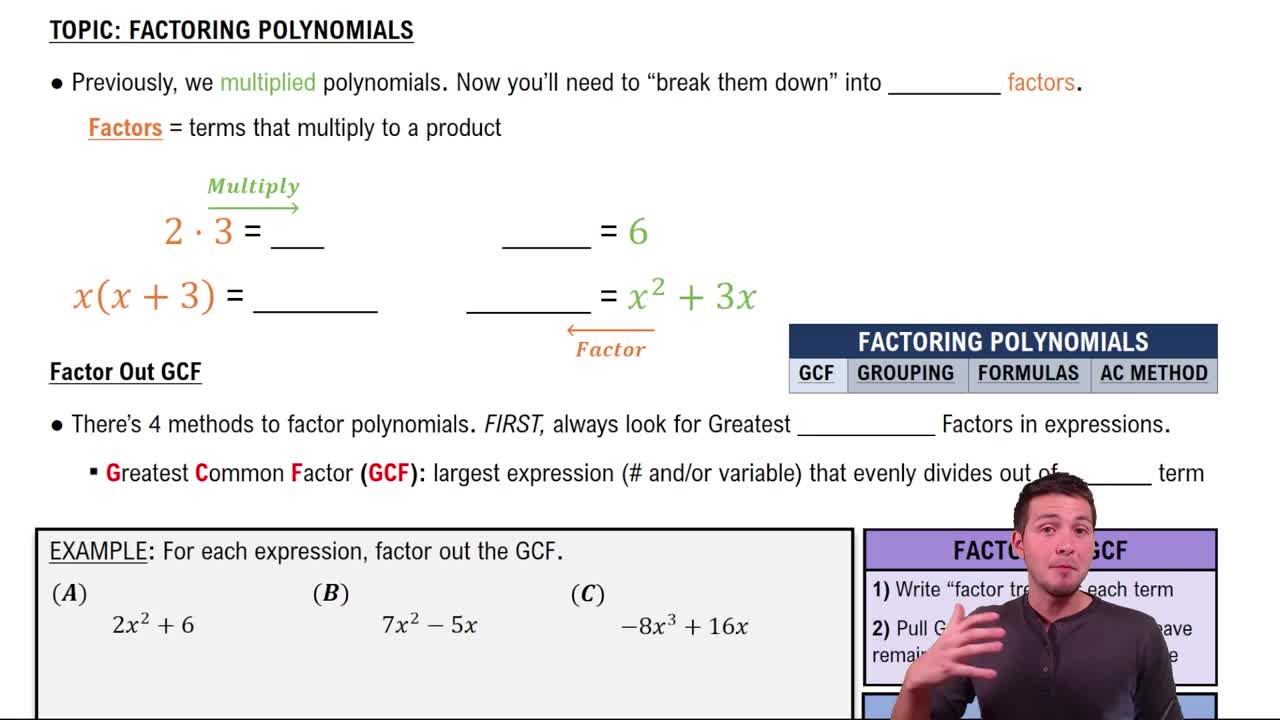
Introduction to Factoring Polynomials
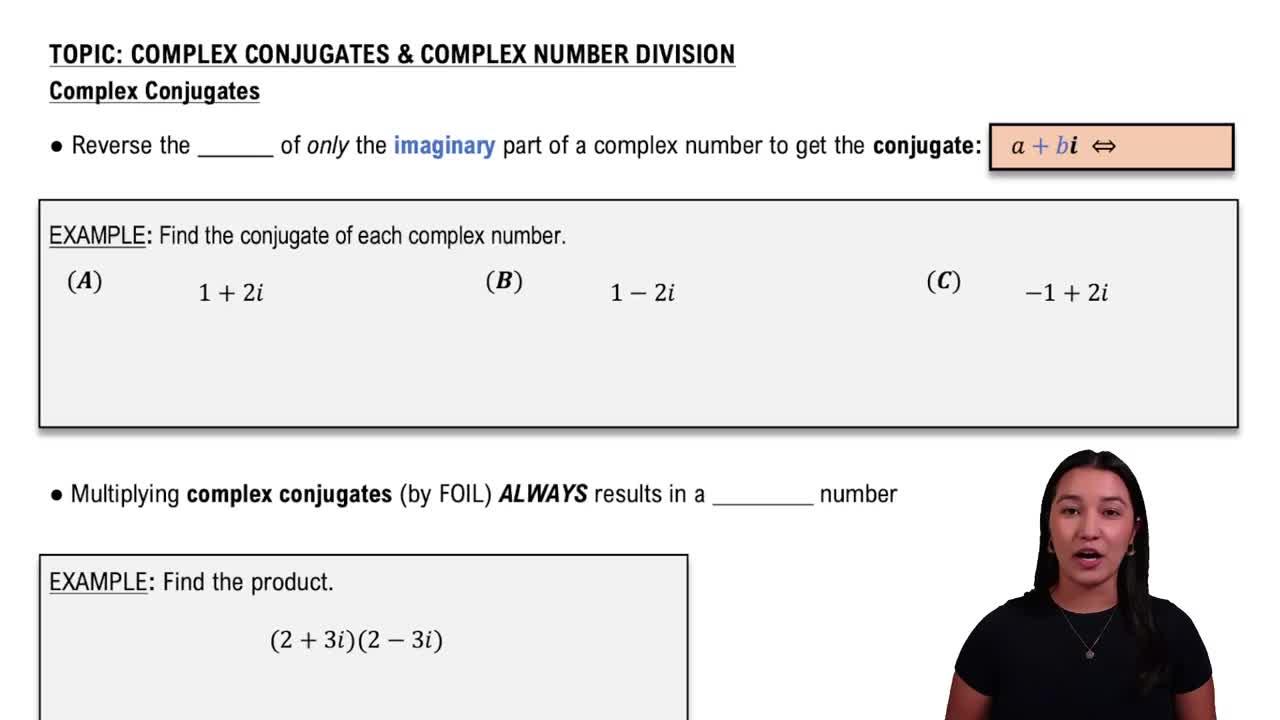
Complex Conjugate Root Theorem
For polynomials with real coefficients, non-real or irrational roots occur in conjugate pairs. Since -2 + √5 and -2 - √5 are conjugates, both must be included to ensure the polynomial has real coefficients.
추천 영상:
Complex Conjugates
Constructing the Polynomial of Least Degree
The polynomial of least degree with given zeros is formed by multiplying the linear factors corresponding to each zero exactly once. This ensures the polynomial has the smallest possible degree while including all specified roots.
추천 영상:
가이드 코스
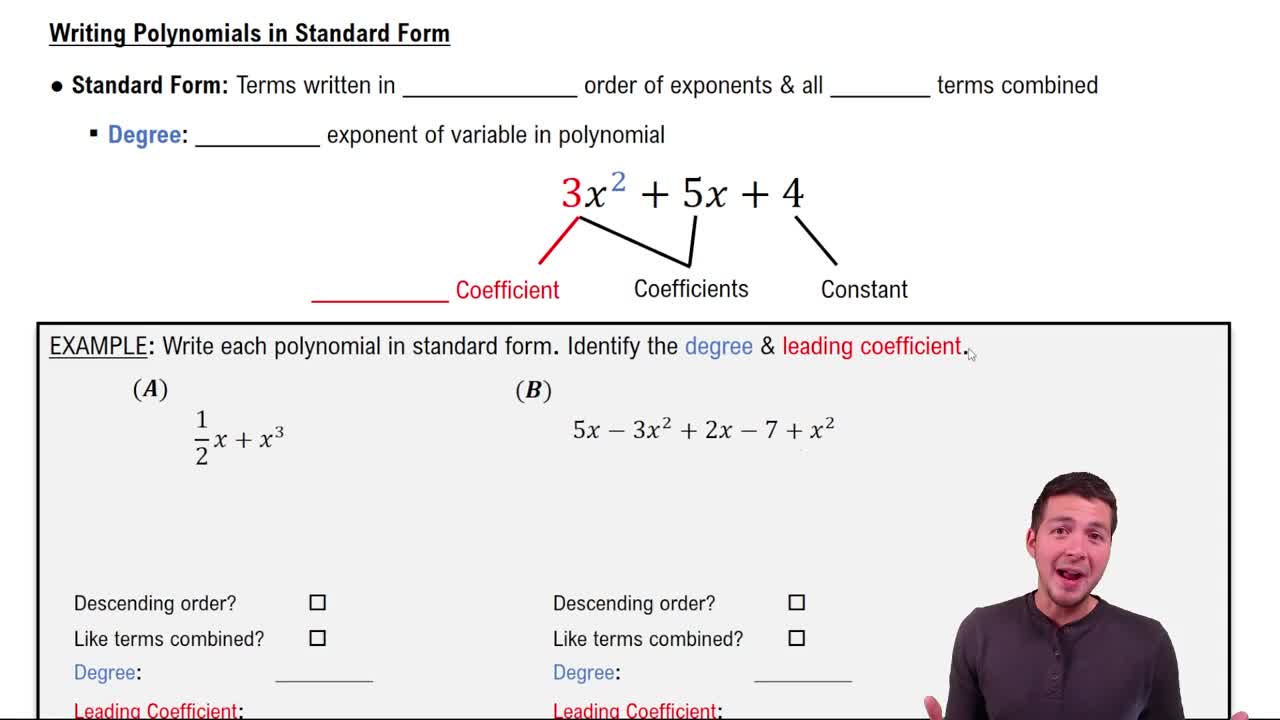
Standard Form of Polynomials
관련 실천
교과서 질문
1055
views
교과서 질문
Solve each polynomial inequality. Give the solution set in interval notation. (x - 4)(2x + 3)(3x - 1) ≥ 0
471
views
교과서 질문
Use an end behavior diagram, as shown below, to describe the end behavior of the graph of each polynomial function. ƒ(x)=9x6-3x4+x2-2
1304
views
교과서 질문
Use an end behavior diagram, as shown below, to describe the end behavior of the graph of each polynomial function. ƒ(x)=3+2x-4x2-5x10
1040
views
교과서 질문
Use an end behavior diagram, as shown below, to describe the end behavior of the graph of each polynomial function. ƒ(x)=10x6-x5+2x-2
928
views
교과서 질문
Use synthetic division to divide ƒ(x) by x-k for the given value of k. Then express ƒ(x) in the form ƒ(x) = (x-k) q(x) + r. ƒ(x) = 2x3 + 3x2 - 16x+10; k = -4
479
views