Find all complex zeros of each polynomial function. Give exact values. List multiple zeros as necessary.* ƒ(x)=5x3-9x2+28x+6
Ch. 3 - Polynomial and Rational Functions

4장, 문제 107
Find a rational function ƒ having a graph with the given features.
x-intercepts: (-1, 0) and (3, 0)
y-intercept: (0, -3)
vertical asymptote: x=1
horizontal asymptote: y=1
검증된 단계별 안내1
Identify the zeros of the rational function from the x-intercepts. Since the function has x-intercepts at (-1, 0) and (3, 0), the numerator must have factors \( (x + 1) \) and \( (x - 3) \). So, the numerator can be written as \( a(x + 1)(x - 3) \), where \( a \) is a constant to be determined.
Determine the denominator using the vertical asymptote. The vertical asymptote at \( x = 1 \) means the denominator must have a factor \( (x - 1) \). So, the denominator can be written as \( (x - 1) \) or possibly a higher degree polynomial with \( (x - 1) \) as a factor, but start with \( (x - 1) \) for simplicity.
Use the horizontal asymptote to relate the degrees and leading coefficients. Since the horizontal asymptote is \( y = 1 \), the degrees of numerator and denominator must be the same, and the ratio of the leading coefficients must be 1. Currently, numerator is degree 2 and denominator is degree 1, so to have the same degree, multiply denominator by a linear factor \( (x + b) \) to make it degree 2: \( (x - 1)(x + b) \).
Set up the function as \( f(x) = \frac{a(x + 1)(x - 3)}{(x - 1)(x + b)} \). Use the y-intercept \( (0, -3) \) to find constants \( a \) and \( b \) by substituting \( x = 0 \) and \( f(0) = -3 \). This gives the equation \( -3 = \frac{a(0 + 1)(0 - 3)}{(0 - 1)(0 + b)} = \frac{a(1)(-3)}{(-1)(b)} = \frac{-3a}{-b} = \frac{3a}{b} \).
Solve the equation \( -3 = \frac{3a}{b} \) for one variable in terms of the other, then use the horizontal asymptote condition (leading coefficients ratio equals 1) to find the values of \( a \) and \( b \). This will give the explicit form of the rational function \( f(x) \).

비슷한 문제에 대한 검증된 영상 답변:
이 영상 해법은 위 문제에 도움이 된다고 튜터들이 추천한 것입니다.
영상 길이:
10m도움이 되었나요?
주요 개념
질문에 올바르게 답하기 위해 반드시 이해해야 하는 핵심 개념들은 다음과 같습니다.
Rational Functions and Their Graphs
A rational function is a ratio of two polynomials. Its graph can have intercepts, asymptotes, and discontinuities. Understanding how the numerator and denominator affect the shape and key features of the graph is essential for constructing a function with given intercepts and asymptotes.
추천 영상:
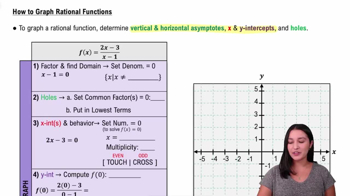
How to Graph Rational Functions
Intercepts of a Rational Function
x-intercepts occur where the numerator equals zero (and the denominator is nonzero), while the y-intercept is found by evaluating the function at x=0. These points help determine the factors of the numerator and the constant term in the function.
추천 영상:
How to Graph Rational Functions
Asymptotes of Rational Functions
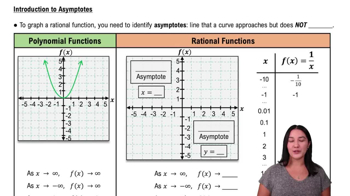
Vertical asymptotes occur where the denominator is zero and the numerator is nonzero, indicating values excluded from the domain. Horizontal asymptotes describe the end behavior of the function and depend on the degrees of numerator and denominator polynomials.
추천 영상:
Introduction to Asymptotes
관련 실천
교과서 질문
500
views
교과서 질문
Find all complex zeros of each polynomial function. Give exact values. List multiple zeros as necessary.* ƒ(x)=x4+4x3+6x2+4x+1
662
views
교과서 질문
Find a rational function ƒ having a graph with the given features.
x-intercepts: (1, 0) and (3, 0)
y-intercept: none
vertical asymptotes: x=0 and x=2
horizontal asymptote: y=1
668
views
교과서 질문
Find all complex zeros of each polynomial function. Give exact values. List multiple zeros as necessary.* ƒ(x)=x4+2x2+1
318
views
교과서 질문
Find all complex zeros of each polynomial function. Give exact values. List multiple zeros as necessary.* ƒ(x)=4x3+3x2+8x+6
420
views
교과서 질문
Find all complex zeros of each polynomial function. Give exact values. List multiple zeros as necessary.
382
views