Ch. 3 - Polynomial and Rational Functions
Lial - College Algebra 13th Edition
Lial13th EditionCollege AlgebraISBN: 9780136881063당신이 사용하는 게 아니라요?교과서 변경
4장, 문제 101

Find all complex zeros of each polynomial function. Give exact values. List multiple zeros as necessary.* ƒ(x)=x5-6x4+14x3-20x2+24x-16

검증된 단계별 안내
1
Start by examining the polynomial function \(f(x) = x^5 - 6x^4 + 14x^3 - 20x^2 + 24x - 16\) to look for possible rational roots using the Rational Root Theorem. The possible rational roots are factors of the constant term (\(\pm1, \pm2, \pm4, \pm8, \pm16\)) divided by factors of the leading coefficient (which is 1), so the candidates are \(\pm1, \pm2, \pm4, \pm8, \pm16\).
Test these possible roots by substituting them into \(f(x)\) or by using synthetic division to see if any of them yield zero. Finding a root means you have found a factor of the polynomial.
Once a root \(r\) is found, use polynomial division (either long division or synthetic division) to divide \(f(x)\) by \((x - r)\) to reduce the polynomial to a quartic (degree 4) polynomial.
Repeat the process of finding roots for the reduced polynomial. If the quartic can be factored further, continue factoring until you reach quadratic or linear factors. For quadratic factors, use the quadratic formula \(x = \frac{-b \pm \sqrt{b^2 - 4ac}}{2a}\) to find complex or real zeros.
Collect all roots found from the linear factors and solutions from the quadratic factors. These roots are the complex zeros of the original polynomial. Make sure to list multiple zeros if any root has multiplicity greater than one.

비슷한 문제에 대한 검증된 영상 답변:

이 영상 해법은 위 문제에 도움이 된다고 튜터들이 추천한 것입니다.
영상 길이:
8m
도움이 되었나요?

주요 개념

질문에 올바르게 답하기 위해 반드시 이해해야 하는 핵심 개념들은 다음과 같습니다.

Complex Zeros of Polynomial Functions

Complex zeros are the values of x, possibly including imaginary numbers, that make the polynomial equal to zero. According to the Fundamental Theorem of Algebra, a polynomial of degree n has exactly n complex zeros, counting multiplicities. Finding these zeros involves solving the polynomial equation ƒ(x) = 0.
추천 영상:
05:33
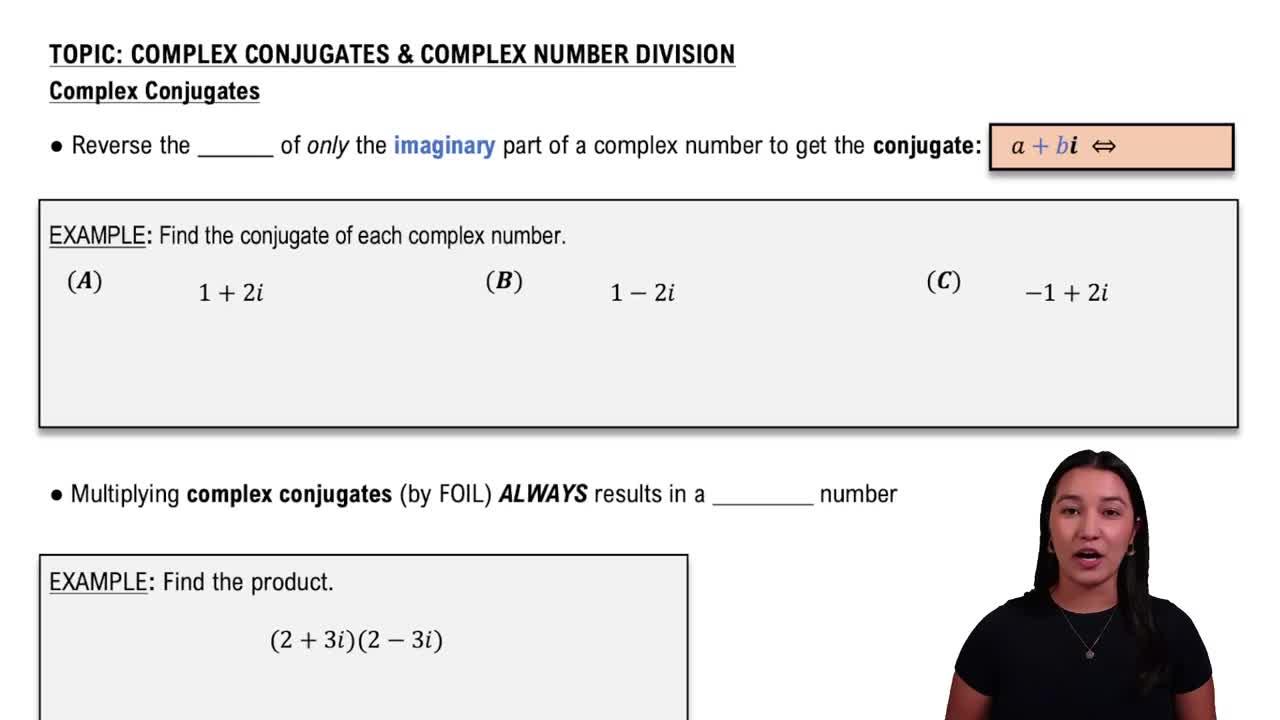
Complex Conjugates

Polynomial Division and Factoring

Factoring polynomials or using polynomial division helps break down higher-degree polynomials into simpler factors. Techniques like synthetic division or long division can test possible roots and reduce the polynomial's degree, making it easier to find all zeros step-by-step.
추천 영상:
가이드 코스
07:30
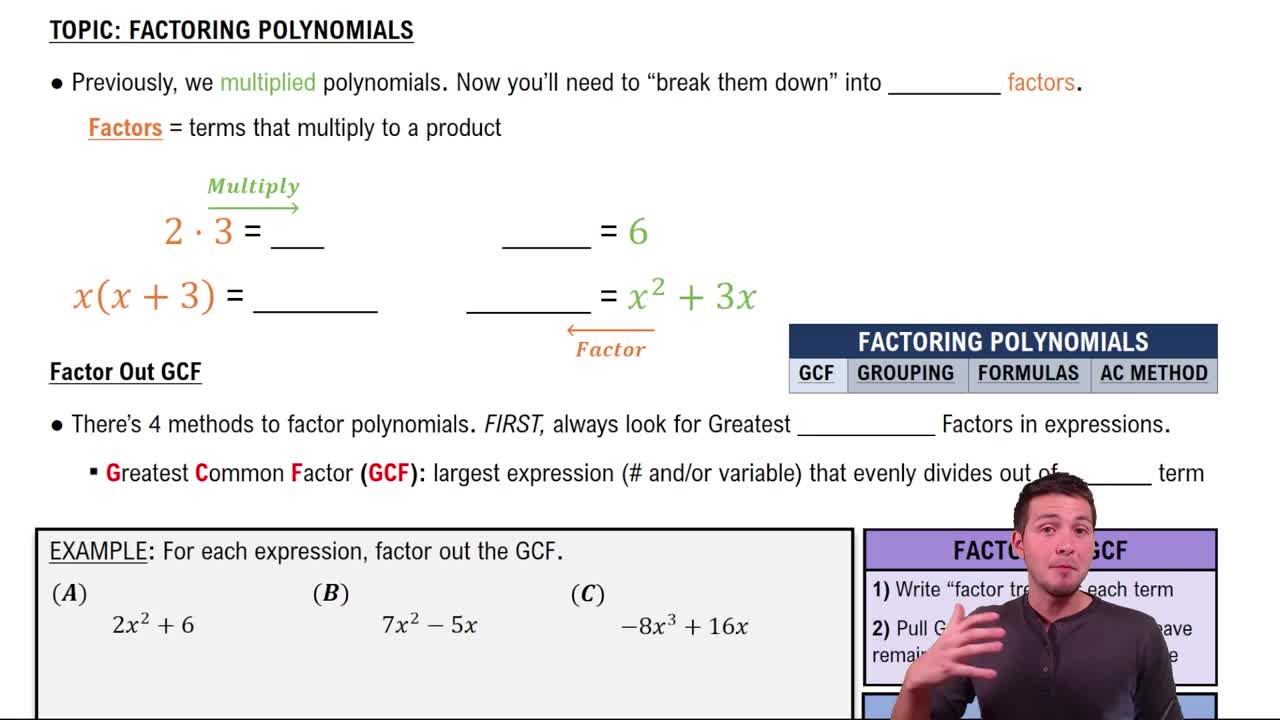
Introduction to Factoring Polynomials

Use of the Rational Root Theorem and Root Multiplicity

The Rational Root Theorem provides a list of possible rational zeros based on factors of the constant term and leading coefficient. Identifying multiple zeros (roots with multiplicity greater than one) is important, as they affect the shape of the graph and must be listed accordingly.
추천 영상:
02:20
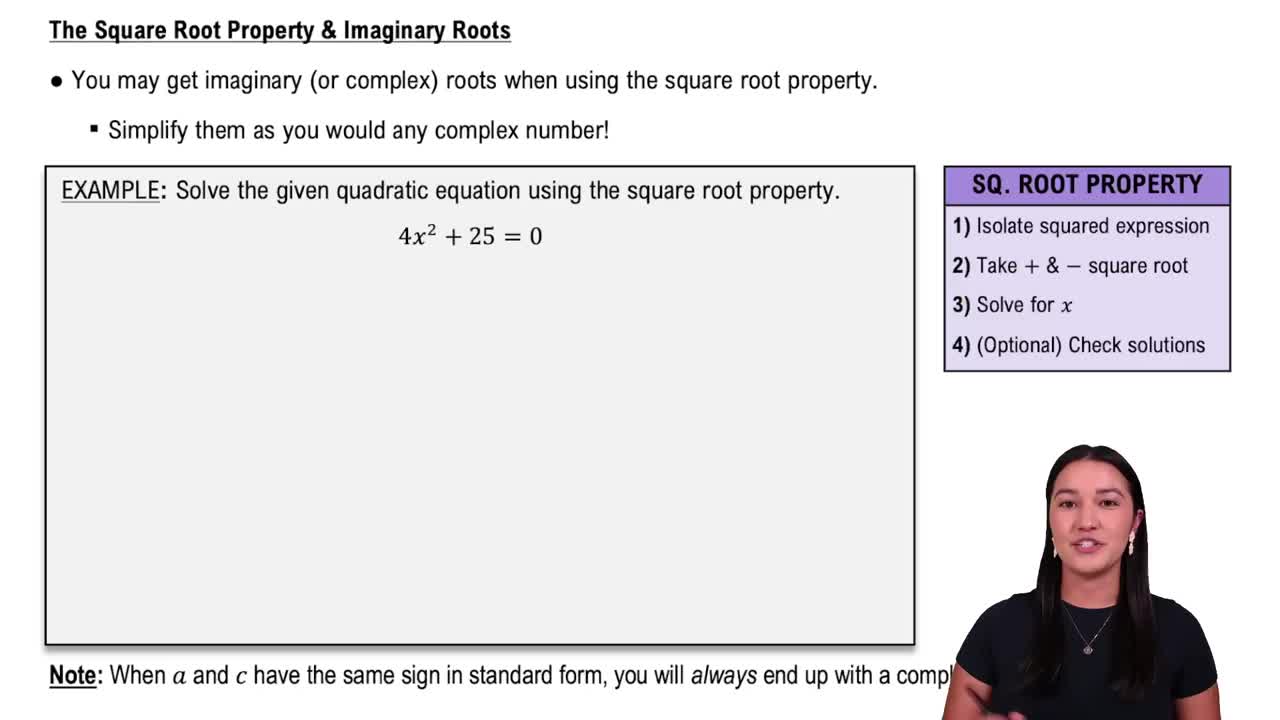
Imaginary Roots with the Square Root Property