Ch. 3 - Polynomial and Rational Functions
Lial - College Algebra 13th Edition
Lial13th EditionCollege AlgebraISBN: 9780136881063당신이 사용하는 게 아니라요?교과서 변경
4장, 문제 37

For each polynomial function, one zero is given. Find all other zeros. ƒ(x)=x45x24;iƒ(x)=-x^4-5x^2-4; -i

검증된 단계별 안내
1
Identify the given polynomial function: \(f(x) = -x^{4} - 5x^{2} - 4\) and the given zero: \(-i\).
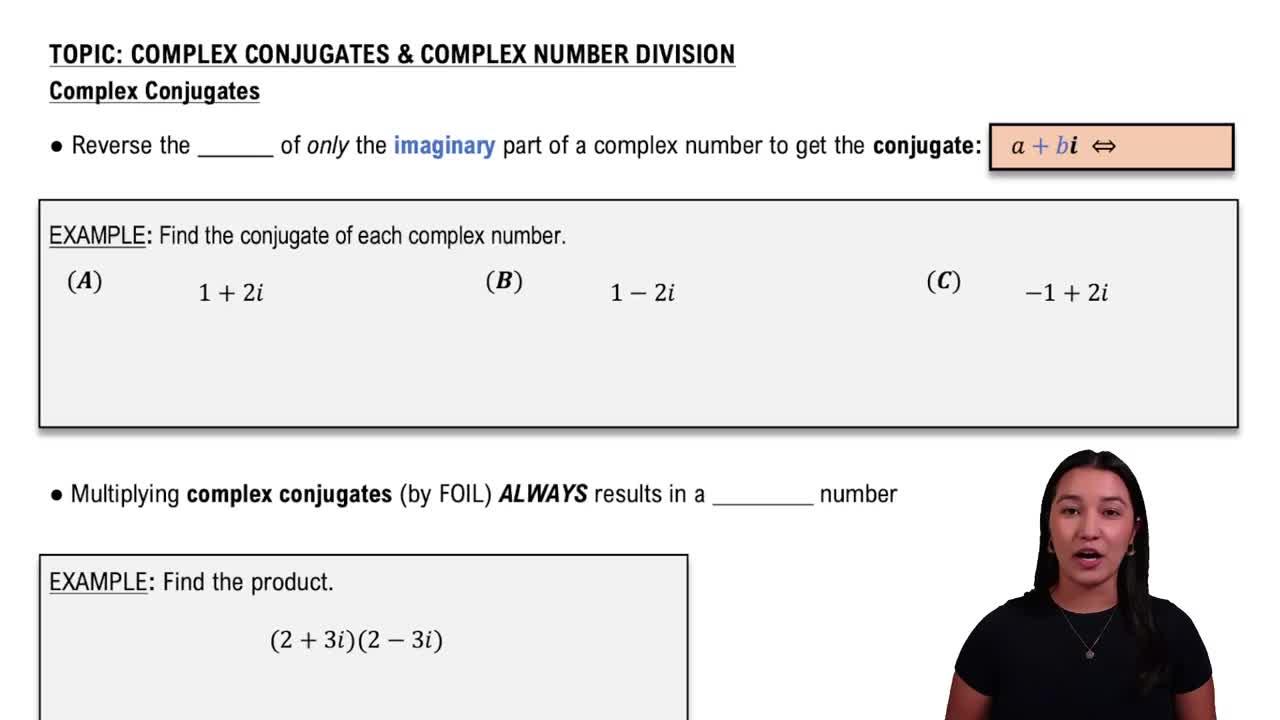
Recall that for polynomials with real coefficients, complex zeros come in conjugate pairs. Since \(-i\) is a zero, its conjugate \(i\) is also a zero.
Use the fact that \(x = i\) and \(x = -i\) are zeros to form a quadratic factor: \((x - i)(x + i) = x^{2} + 1\).
Divide the original polynomial \(f(x)\) by the quadratic factor \(x^{2} + 1\) using polynomial division or synthetic division to find the other quadratic factor.
Set the resulting quadratic factor equal to zero and solve for \(x\) to find the remaining zeros of the polynomial.

비슷한 문제에 대한 검증된 영상 답변:

이 영상 해법은 위 문제에 도움이 된다고 튜터들이 추천한 것입니다.
영상 길이:
11m
도움이 되었나요?

주요 개념

질문에 올바르게 답하기 위해 반드시 이해해야 하는 핵심 개념들은 다음과 같습니다.

Complex Conjugate Root Theorem

This theorem states that if a polynomial has real coefficients and a complex number a + bi is a root, then its conjugate a - bi is also a root. Since -i is given as a zero, its conjugate i must also be a zero of the polynomial.
추천 영상:
05:33
Complex Conjugates

Factoring Polynomials Using Known Roots

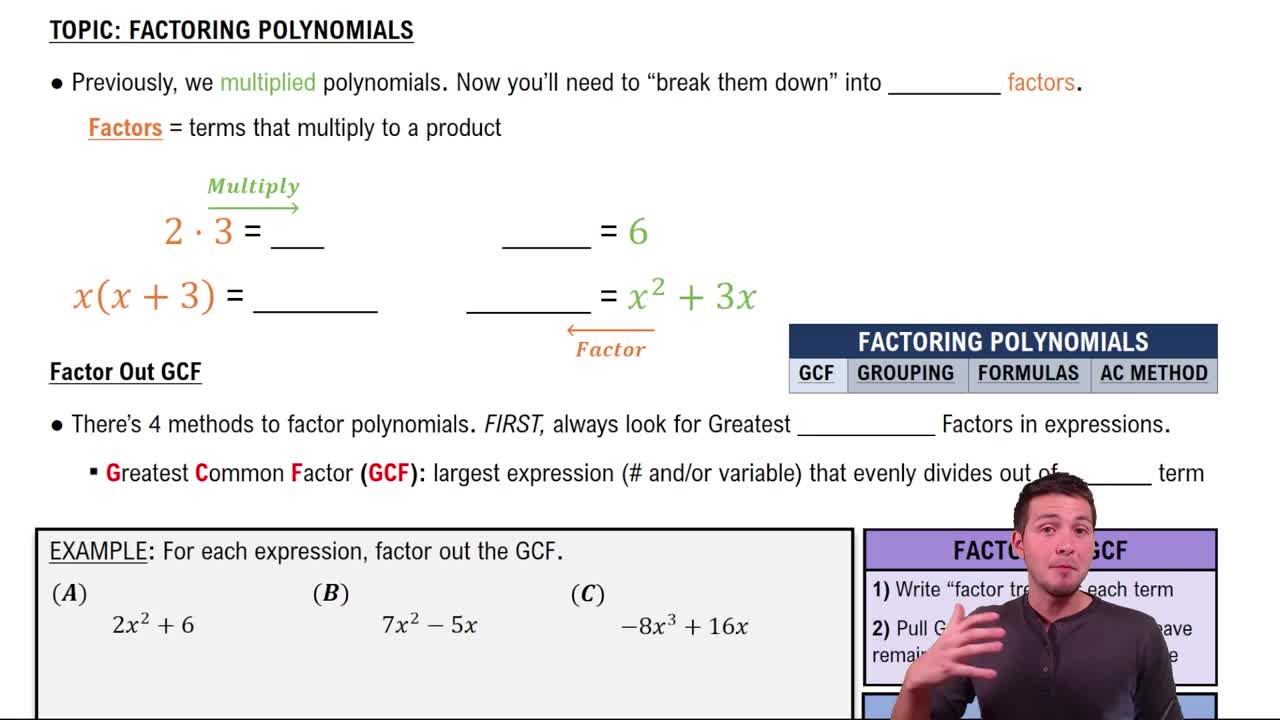
Once a root is known, the polynomial can be divided by the corresponding factor (x - root) to reduce its degree. Repeated use of this process helps find all zeros by factoring the polynomial completely.
추천 영상:
가이드 코스
07:30
Introduction to Factoring Polynomials

Polynomial Division and Synthetic Division

Polynomial division, including synthetic division, is a method to divide polynomials by linear factors. It simplifies the polynomial after factoring out known roots, making it easier to find remaining zeros.
추천 영상:
가이드 코스
07:30
Introduction to Factoring Polynomials