Solve each polynomial inequality. Give the solution set in interval notation. x4 - x3 - 10x2 - 8x < 0
Ch. 3 - Polynomial and Rational Functions

4장, 문제 41
Give the equations of any vertical, horizontal, or oblique asymptotes for the graph of each rational function. ƒ(x)=(x2-1)/(x+3)
검증된 단계별 안내1
Identify the rational function given: \(f(x) = \frac{x^2 - 1}{x + 3}\).
Find the vertical asymptotes by setting the denominator equal to zero and solving for \(x\): solve \(x + 3 = 0\) to find values where the function is undefined.
Determine the horizontal or oblique asymptotes by comparing the degrees of the numerator and denominator polynomials. Here, the numerator degree is 2 and the denominator degree is 1.
Since the numerator degree is greater than the denominator degree by exactly 1, perform polynomial long division of \(x^2 - 1\) by \(x + 3\) to find the oblique asymptote.
Write the oblique asymptote as the quotient from the division (ignoring the remainder), and summarize the vertical asymptote(s) found in step 2.

비슷한 문제에 대한 검증된 영상 답변:
이 영상 해법은 위 문제에 도움이 된다고 튜터들이 추천한 것입니다.
영상 길이:
8m도움이 되었나요?
주요 개념
질문에 올바르게 답하기 위해 반드시 이해해야 하는 핵심 개념들은 다음과 같습니다.
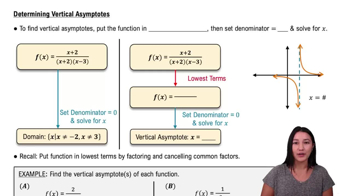
Vertical Asymptotes
Vertical asymptotes occur where the denominator of a rational function equals zero, causing the function to approach infinity or negative infinity. To find them, set the denominator equal to zero and solve for x, ensuring these values do not cancel with factors in the numerator.
추천 영상:
Determining Vertical Asymptotes
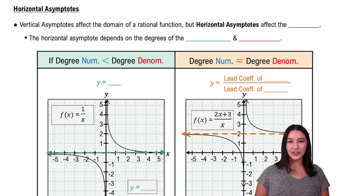
Horizontal Asymptotes
Horizontal asymptotes describe the behavior of a function as x approaches infinity or negative infinity. For rational functions, compare the degrees of the numerator and denominator: if the numerator's degree is less, the asymptote is y=0; if equal, it's the ratio of leading coefficients.
추천 영상:
Determining Horizontal Asymptotes
Oblique (Slant) Asymptotes
Oblique asymptotes occur when the degree of the numerator is exactly one more than the denominator. They are found by performing polynomial division of numerator by denominator; the quotient (without the remainder) gives the equation of the slant asymptote.
추천 영상:
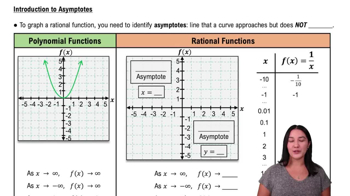
Introduction to Asymptotes
관련 실천
교과서 질문
481
views
교과서 질문
For each polynomial function, use the remainder theorem to find ƒ(k). ƒ(x) = x2 + 4; k = 2i
614
views
교과서 질문
Determine the largest open interval of the domain (a) over which the function is increasing and (b) over which it is decreasing. ƒ(x) = x2 - 4x + 3
1006
views
교과서 질문
Graph each polynomial function. Factor first if the polynomial is not in factored form. See Examples 3 and 4.
543
views
교과서 질문
Simple Interest Simple interest varies jointly as principal and time. If \$1000 invested for 2 yr earned \$70, find the amount of interest earned by \$5000 invested for 5 yr.
537
views
교과서 질문
Give the equations of any vertical, horizontal, or oblique asymptotes for the graph of each rational function. ƒ(x)=(2x+6)/(x-4)
699
views
