
교과서 질문
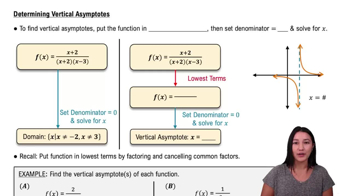
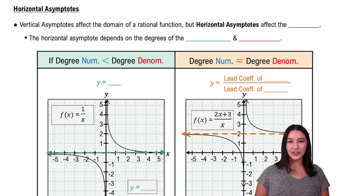
Give the equations of any vertical, horizontal, or oblique asymptotes for the graph of each rational function. ƒ(x)=(4x2+25)/(x2+9)
609
views

 검증된 단계별 안내
 3:12
3:12
 4:48
4:48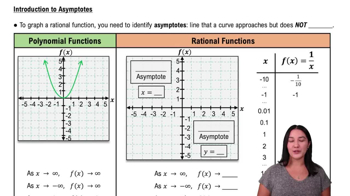 6:24
6:24Give the equations of any vertical, horizontal, or oblique asymptotes for the graph of each rational function. ƒ(x)=(4x2+25)/(x2+9)
Graph each polynomial function. Factor first if the polynomial is not in factored form. ƒ(x)=x4+3x3-3x2-11x-6
Period of a Pendulum The period of a pendulum varies directly as the square root of the length of the pendulum and inversely as the square root of the acceleration due to gravity. Find the period when the length is 121 cm and the acceleration due to gravity is 980 cm per second squared, if the period is 6π seconds when the length is 289 cm and the acceleration due to gravity is 980 cm per second squared.
If the given term is the dominating term of a polynomial function, what can we conclude about each of the following features of the graph of the function? (a) domain (b) range (c) end behavior (d) number of zeros (e) number of turning points -9x6
Several graphs of the quadratic function ƒ(x) = ax2 + bx + c are shown below. For the given restrictions on a, b, and c, select the corresponding graph from choices A–F. (Hint: Use the discriminant.) a < 0; b2 - 4ac = 0
For each polynomial function, use the remainder theorem to find ƒ(k). ƒ(x) = 6x4 + x3 - 8x2 + 5x+6; k=1/2