If the given term is the dominating term of a polynomial function, what can we conclude about each of the following features of the graph of the function? (a) domain (b) range (c) end behavior (d) number of zeros (e) number of turning points 10x7
Ch. 3 - Polynomial and Rational Functions

4장, 문제 45
Graph each polynomial function. Factor first if the polynomial is not in factored form. ƒ(x)=3x4-7x3-6x2+12x+8
검증된 단계별 안내1
Start by writing down the polynomial function: \(f(x) = 3x^4 - 7x^3 - 6x^2 + 12x + 8\).
Attempt to factor the polynomial. Since it is a quartic (degree 4), try factoring by grouping or use the Rational Root Theorem to find possible roots.
Use the Rational Root Theorem to list possible rational roots: factors of the constant term (8) over factors of the leading coefficient (3), which gives possible roots \(\pm1, \pm2, \pm4, \pm8, \pm\frac{1}{3}, \pm\frac{2}{3}, \pm\frac{4}{3}, \pm\frac{8}{3}\).
Test these possible roots by substituting them into \(f(x)\) or by using synthetic division to find which values make the polynomial equal to zero, thus identifying factors.
Once a root is found, factor out the corresponding binomial (e.g., \((x - r)\)) and continue factoring the resulting polynomial until it is fully factored or cannot be factored further; then use the factored form to analyze and graph the function.

비슷한 문제에 대한 검증된 영상 답변:
이 영상 해법은 위 문제에 도움이 된다고 튜터들이 추천한 것입니다.
영상 길이:
11m도움이 되었나요?
주요 개념
질문에 올바르게 답하기 위해 반드시 이해해야 하는 핵심 개념들은 다음과 같습니다.
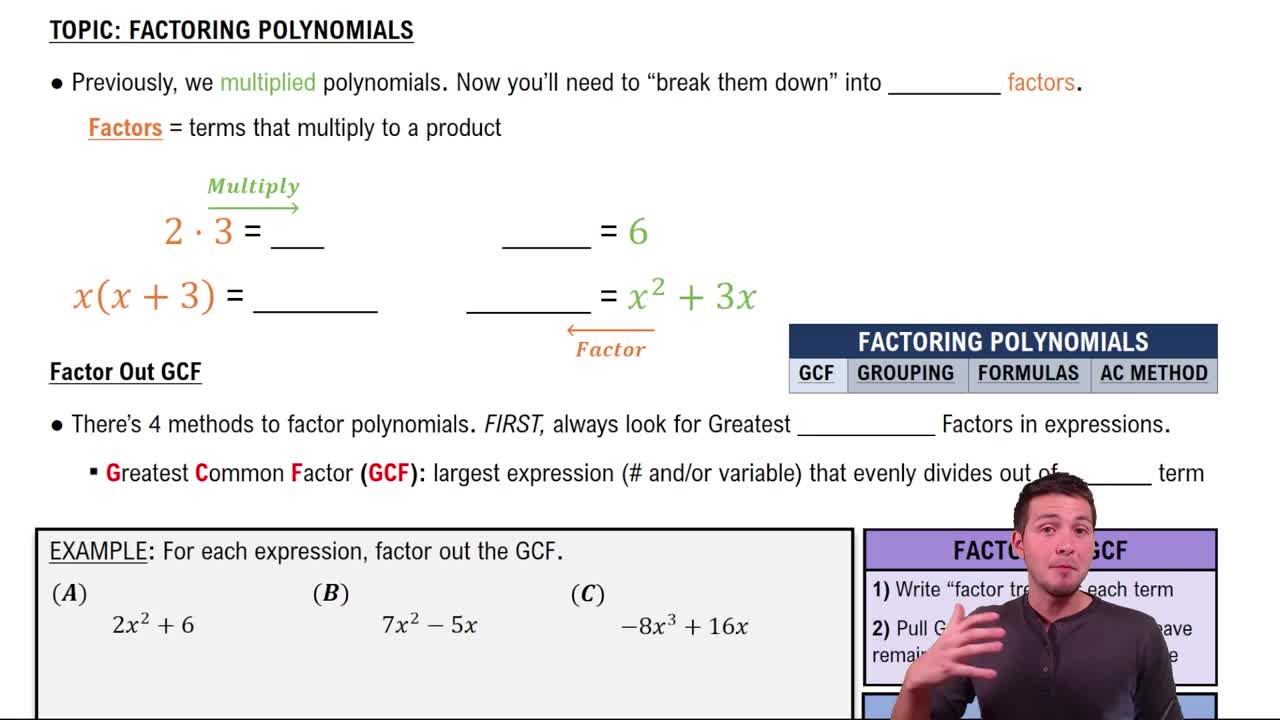
Polynomial Factoring
Factoring a polynomial involves rewriting it as a product of simpler polynomials, which helps identify its roots and simplifies graphing. Techniques include factoring out the greatest common factor, grouping, or using special formulas like difference of squares or sum/difference of cubes.
추천 영상:
Introduction to Factoring Polynomials
Finding Roots of a Polynomial
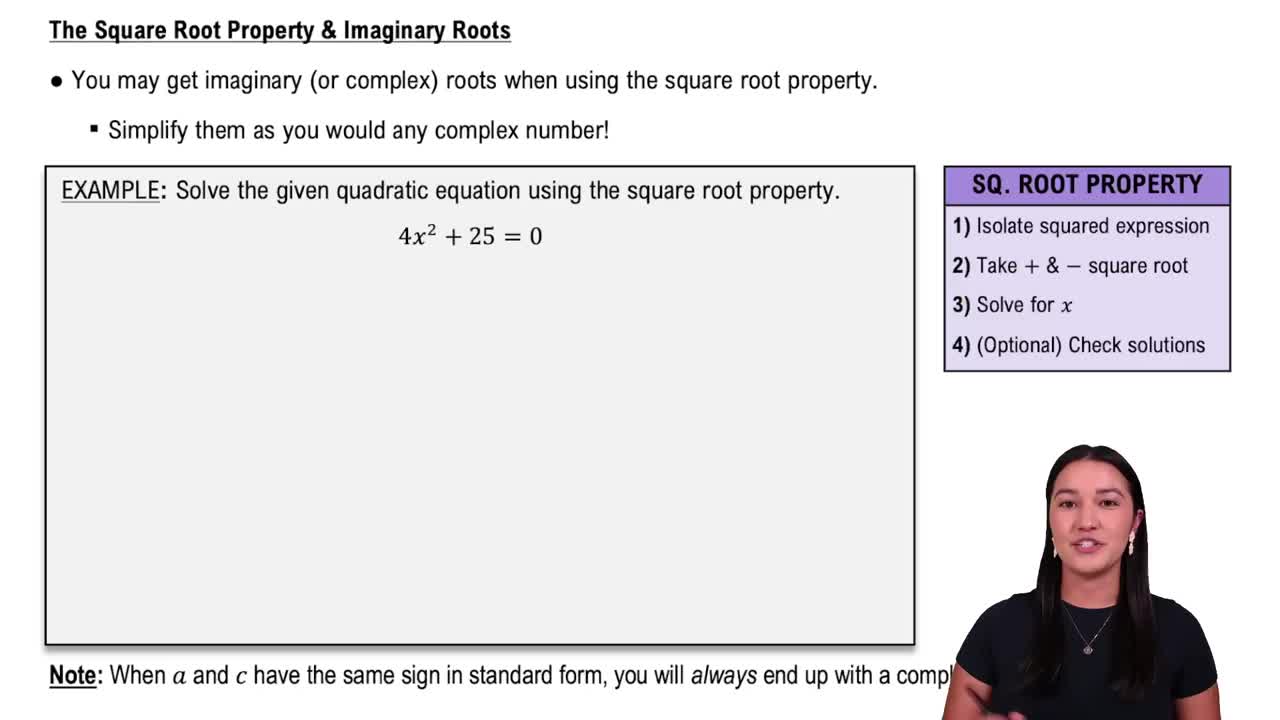
Roots (or zeros) are the values of x where the polynomial equals zero. After factoring, setting each factor equal to zero gives the roots, which correspond to x-intercepts on the graph. Knowing roots helps in sketching the polynomial's graph accurately.
추천 영상:
Imaginary Roots with the Square Root Property
Graphing Polynomial Functions
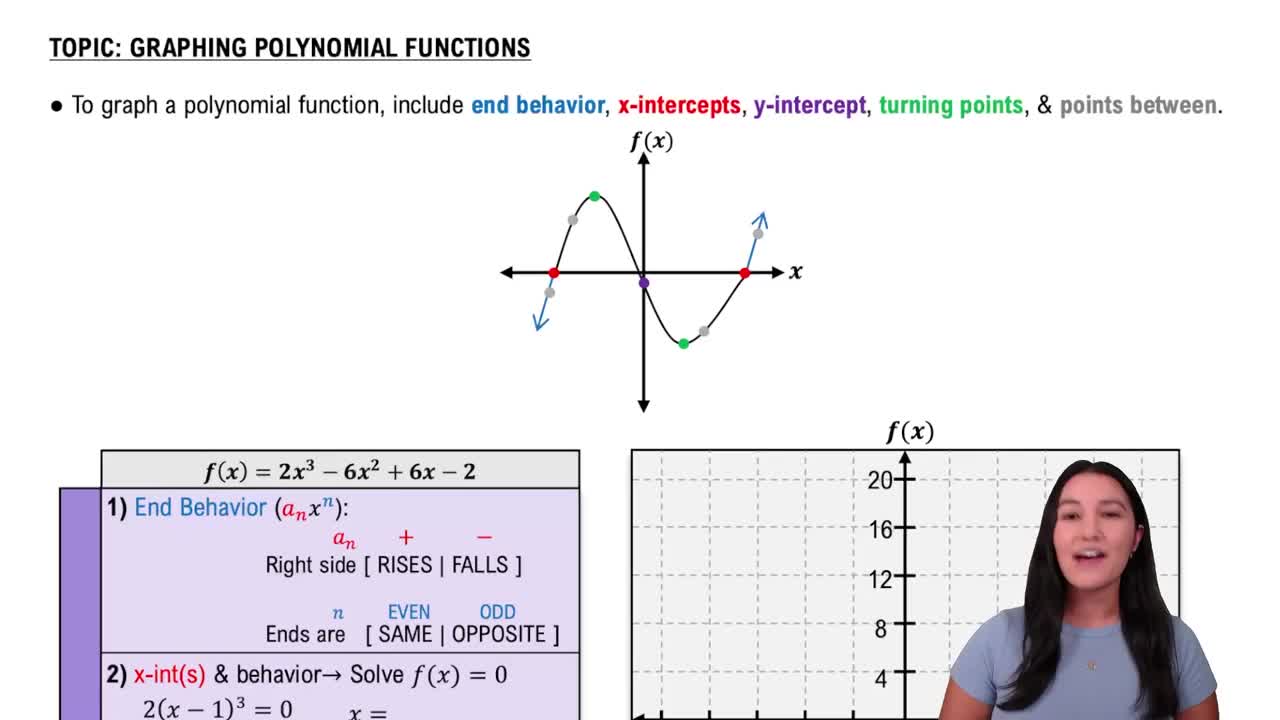
Graphing involves plotting key points such as roots, y-intercept, and analyzing end behavior based on the leading term. The degree and leading coefficient determine the shape and direction of the graph, while multiplicity of roots affects how the graph touches or crosses the x-axis.
추천 영상:
Graphing Polynomial Functions
관련 실천
교과서 질문
859
views
교과서 질문
Give the equations of any vertical, horizontal, or oblique asymptotes for the graph of each rational function. ƒ(x)=(x2+1)/(x2+9)
1154
views
교과서 질문
Determine the largest open interval of the domain (a) over which the function is increasing and (b) over which it is decreasing. ƒ(x) = -3x2 + 18x + 1
803
views
교과서 질문
Several graphs of the quadratic function ƒ(x) = ax2 + bx + c are shown below. For the given restrictions on a, b, and c, select the corresponding graph from choices A–F. (Hint: Use the discriminant.) a < 0; b2 - 4ac = 0
1072
views
교과서 질문
Solve each polynomial inequality. Give the solution set in interval notation. x5 + x2 + 2 ≥ x4 + x3 + 2x
489
views
교과서 질문
For each polynomial function, use the remainder theorem to find ƒ(k). ƒ(x) = 6x4 + x3 - 8x2 + 5x+6; k=1/2
501
views
