Match the rational function in Column I with the appropriate description in Column II. Choices in Column II can be used only once. ƒ(x)=(x2-16)/(x+4)
Ch. 3 - Polynomial and Rational Functions

4장, 문제 33a
Show that each polynomial function has a real zero as described in parts (a) and (b). In Exercises 31 and 32, also work part (c). ƒ(x)=6x^4+13x^3-11x^2-3x+5 no zero greater than 1
검증된 단계별 안내1
First, understand that the problem asks to show that the polynomial function \(f(x) = 6x^4 + 13x^3 - 11x^2 - 3x + 5\) has a real zero, and specifically that there is no zero greater than 1.
Evaluate the polynomial at \(x = 1\) by substituting 1 into the function: calculate \(f(1) = 6(1)^4 + 13(1)^3 - 11(1)^2 - 3(1) + 5\) to determine the sign of the function at 1.
Evaluate the polynomial at another value less than 1, for example at \(x = 0\), by calculating \(f(0) = 6(0)^4 + 13(0)^3 - 11(0)^2 - 3(0) + 5\) to check the sign of the function at 0.
Use the Intermediate Value Theorem, which states that if a continuous function changes sign over an interval, then it must have at least one zero in that interval. Since polynomials are continuous everywhere, if \(f(0)\) and \(f(1)\) have opposite signs, there is at least one zero between 0 and 1.
To show there is no zero greater than 1, analyze the behavior of \(f(x)\) for \(x > 1\). You can check the sign of \(f(2)\) or consider the end behavior of the polynomial (leading term \$6x^4\( dominates for large \)x\(), which tends to positive infinity, and verify that \)f(x)\( does not cross zero for \)x > 1$.

비슷한 문제에 대한 검증된 영상 답변:
이 영상 해법은 위 문제에 도움이 된다고 튜터들이 추천한 것입니다.
영상 길이:
2m도움이 되었나요?
주요 개념
질문에 올바르게 답하기 위해 반드시 이해해야 하는 핵심 개념들은 다음과 같습니다.
Polynomial Functions and Their Zeros
A polynomial function is an expression involving variables raised to whole-number exponents with coefficients. The zeros of a polynomial are the values of x for which the function equals zero. Understanding how to find or estimate these zeros is essential for analyzing the behavior of the polynomial.
추천 영상:
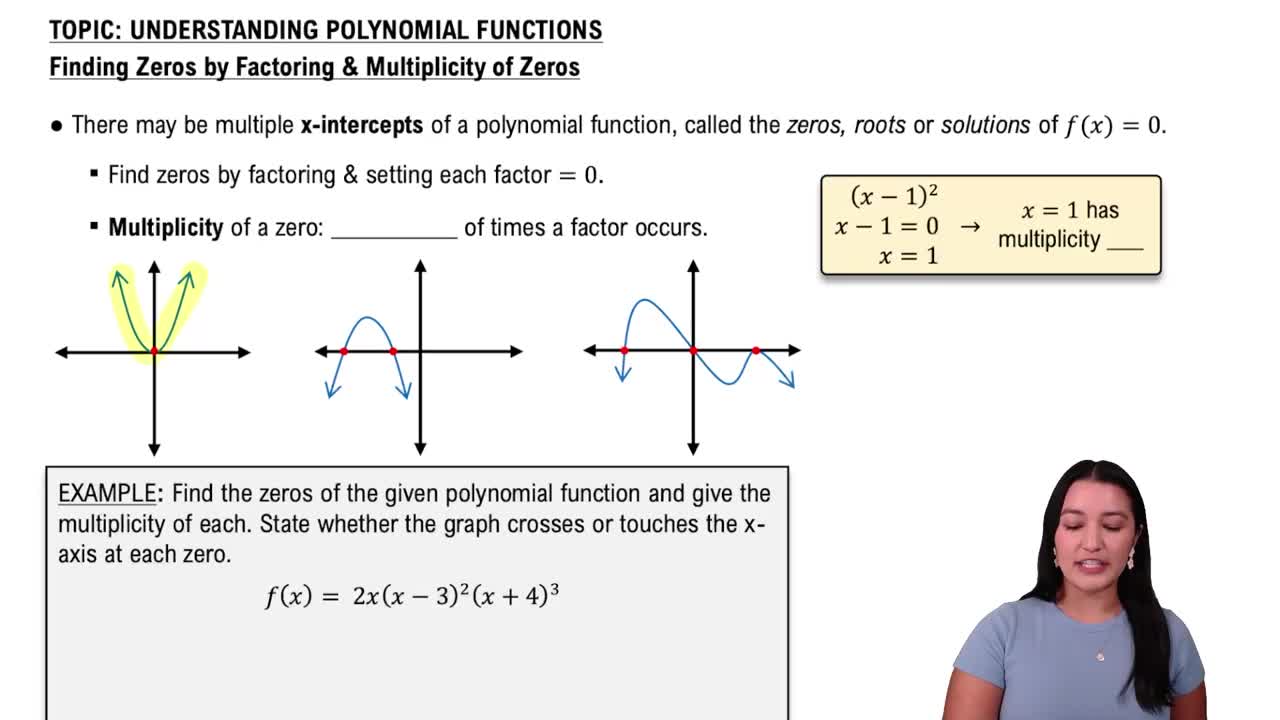
Finding Zeros & Their Multiplicity
Bounds on Zeros of Polynomials
Bounds on zeros help determine intervals where the real zeros of a polynomial can lie. Techniques like the Upper and Lower Bound Theorems or the use of synthetic division can show that no zeros exist beyond certain values, such as proving no zero is greater than 1.
추천 영상:
Finding Zeros & Their Multiplicity
Synthetic Division
Synthetic division is a shortcut method for dividing a polynomial by a linear factor of the form (x - c). It is useful for testing possible zeros and verifying bounds by checking the sign and remainder, which helps confirm whether a given number is a zero or an upper/lower bound.
추천 영상:
Higher Powers of i
관련 실천
교과서 질문
864
views
교과서 질문
Hooke's Law for a Spring Hooke's law for an elastic spring states that the distance a spring stretches varies directly as the force applied. If a force of 15 lb stretches a certain spring 8 in., how much will a force of 30 lb stretch the spring?
595
views
교과서 질문
For each polynomial function, use the remainder theorem to find ƒ(k). ƒ(x) = x2 + 5x+6; k = -2
442
views
교과서 질문
Solve each problem. Use Descartes' rule of signs to determine the different possibilities for the numbers of positive, negative, and nonreal complex zeros of .
597
views
교과서 질문
For each polynomial function, one zero is given. Find all other zeros.
573
views
교과서 질문
Show that each polynomial function has a real zero as described in parts (a) and (b). In Exercises 31 and 32, also work part (c). ƒ(x)=6x^4+13x^3-11x^2-3x+5 no zero less than -3
420
views