Ch. 3 - Polynomial and Rational Functions
Lial - College Algebra 13th Edition
Lial13th EditionCollege AlgebraISBN: 9780136881063당신이 사용하는 게 아니라요?교과서 변경
4장, 문제 57

Show that the real zeros of each polynomial function satisfy the given conditions. ƒ(x)=x4-x3+3x2-8x+8; no real zero greater than 2

검증된 단계별 안내
1
First, understand the problem: we need to show that any real zero \( r \) of the polynomial \( f(x) = x^4 - x^3 + 3x^2 - 8x + 8 \) satisfies the condition \( r \leq 2 \), meaning there are no real zeros greater than 2.
Evaluate the polynomial at \( x = 2 \) to check the value of \( f(2) \). This helps us understand the behavior of the polynomial at that point.
Next, analyze the polynomial for values greater than 2. One way is to consider the sign of \( f(x) \) for \( x > 2 \). If \( f(x) > 0 \) for all \( x > 2 \), then there are no zeros greater than 2.
To confirm this, you can use the fact that if \( f(2) \) is positive and the polynomial does not cross the x-axis after 2, then no zeros exist beyond 2. Alternatively, use the Intermediate Value Theorem and test values greater than 2 to see if the polynomial changes sign.
Another approach is to use polynomial division or synthetic division to factor \( f(x) \) by \( (x - 2) \) and analyze the quotient polynomial to check if any zeros lie beyond 2.

비슷한 문제에 대한 검증된 영상 답변:

이 영상 해법은 위 문제에 도움이 된다고 튜터들이 추천한 것입니다.
영상 길이:
5m
도움이 되었나요?

주요 개념

질문에 올바르게 답하기 위해 반드시 이해해야 하는 핵심 개념들은 다음과 같습니다.

Polynomial Functions and Their Zeros

A polynomial function is an expression involving variables raised to whole-number exponents with coefficients. The zeros (or roots) of a polynomial are the values of x that make the function equal to zero. Understanding how to find and interpret these zeros is essential for analyzing the behavior of the function.
추천 영상:
03:42
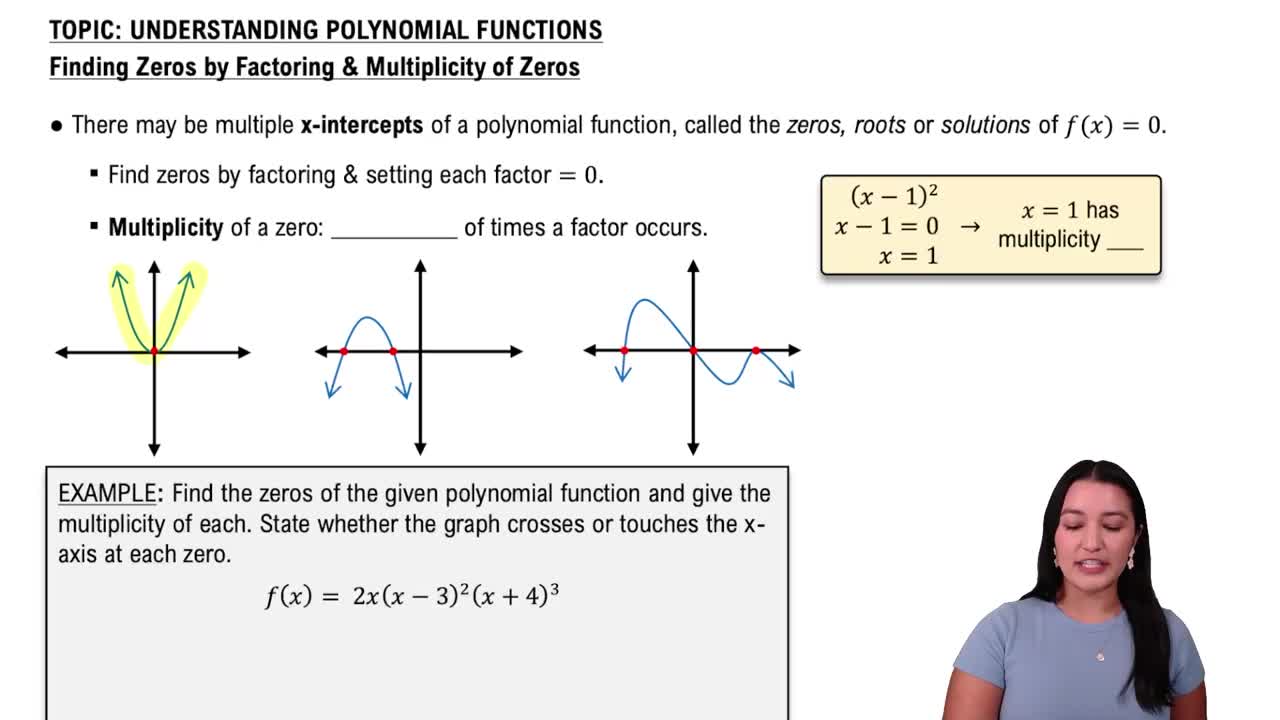
Finding Zeros & Their Multiplicity

Evaluating Polynomial Functions at Specific Points

Evaluating a polynomial at a given value means substituting that value for the variable and calculating the result. This helps determine whether a number is a zero (if the result is zero) or to check the sign of the function at certain points, which is useful for bounding the location of zeros.
추천 영상:
02:44
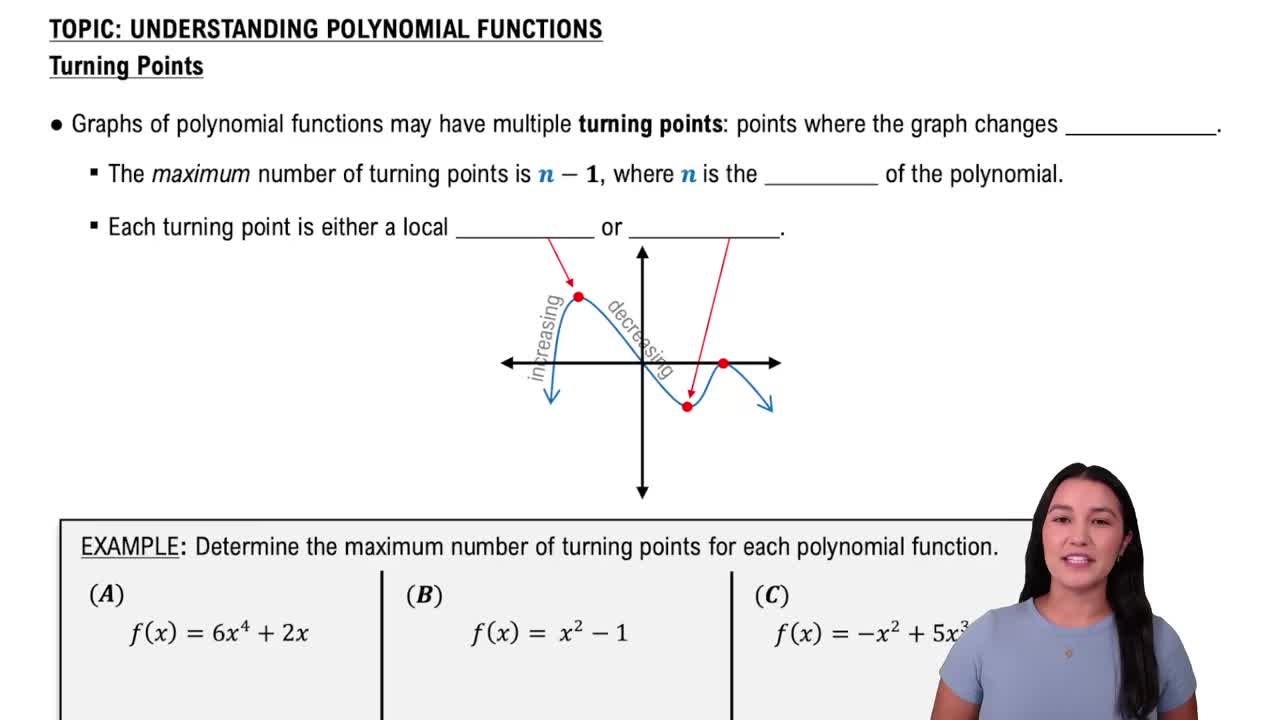
Maximum Turning Points of a Polynomial Function

Using the Intermediate Value Theorem and Inequalities to Bound Zeros

The Intermediate Value Theorem states that if a continuous function changes sign over an interval, it must have a zero within that interval. By evaluating the polynomial at strategic points and analyzing inequalities, one can show that no zeros exist beyond a certain value, such as proving no real zero is greater than 2.
추천 영상:
가이드 코스
3:21
Nonlinear Inequalities