Use the technique described in Exercises 87–90 to solve each inequality. Write the solution set in interval notation. x2 - 9x + 20 < 0
Ch. 3 - Polynomial and Rational Functions

4장, 문제 90
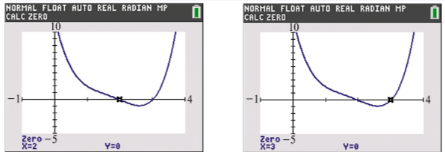
Solve each problem. A comprehensive graph of ƒ(x)=x4-7x3+18x2-22x+12 is shown in the two screens, along with displays of the two real zeros. Find the two remaining nonreal complex zeros.

검증된 단계별 안내1
Identify the given polynomial function: \(f(x) = x^4 - 7x^3 + 18x^2 - 22x + 12\).
Since the problem states there are two real zeros already found, use these real zeros to factor the polynomial partially. Express \(f(x)\) as the product of \((x - r_1)(x - r_2)\) and a quadratic polynomial, where \(r_1\) and \(r_2\) are the real zeros.
Perform polynomial division or synthetic division to divide \(f(x)\) by the quadratic factor formed from the two real zeros, resulting in a quadratic polynomial \(q(x)\).
Set the quadratic polynomial \(q(x)\) equal to zero: \(q(x) = 0\), and prepare to solve for the remaining zeros.
Use the quadratic formula \(x = \frac{-b \pm \sqrt{b^2 - 4ac}}{2a}\) on \(q(x)\) to find the two nonreal complex zeros, noting that the discriminant will be negative, indicating complex roots.

비슷한 문제에 대한 검증된 영상 답변:
이 영상 해법은 위 문제에 도움이 된다고 튜터들이 추천한 것입니다.
영상 길이:
7m도움이 되었나요?
주요 개념
질문에 올바르게 답하기 위해 반드시 이해해야 하는 핵심 개념들은 다음과 같습니다.
Polynomial Zeros and the Fundamental Theorem of Algebra
The Fundamental Theorem of Algebra states that a polynomial of degree n has exactly n roots in the complex number system, counting multiplicities. For a quartic polynomial like ƒ(x), there are four zeros total, which can be real or complex. Understanding this helps in knowing that after finding the real zeros, the remaining zeros must be complex.
추천 영상:
가이드 코스
Introduction to Algebraic Expressions
Polynomial Division and Factoring
Once the real zeros are known, polynomial division (such as synthetic or long division) is used to divide the original polynomial by the factors corresponding to these zeros. This reduces the polynomial to a quadratic, which can then be analyzed to find the remaining zeros. Factoring simplifies the problem and isolates the complex roots.
추천 영상:
가이드 코스
Introduction to Factoring Polynomials
Complex Zeros and the Quadratic Formula
When the reduced polynomial is quadratic and does not factor nicely over the reals, the quadratic formula is used to find its roots. If the discriminant is negative, the solutions are complex conjugates. This concept is essential to identify and express the nonreal complex zeros of the polynomial.
추천 영상:
Solving Quadratic Equations Using The Quadratic Formula
관련 실천
교과서 질문
465
views
교과서 질문
Determine the different possibilities for the numbers of positive, negative, and nonreal complex zeros of each function.
393
views
교과서 질문
Determine the different possibilities for the numbers of positive, negative, and nonreal complex zeros of each function. See Example 7. ƒ(x)=11x5-x3+7x-5
425
views
교과서 질문
Use a graphing calculator to find the coordinates of the turning points of the graph of each polynomial function in the given domain interval. Give answers to the nearest hundredth. ƒ(x)=x4-7x3+13x2+6x-28; [-1, 0]
1884
views
교과서 질문
Determine the different possibilities for the numbers of positive, negative, and nonreal complex zeros of each function.
554
views
교과서 질문
Use the technique described in Exercises 87–90 to solve each inequality. Write the solution set in interval notation. x2 - x - 6 < 0
493
views