Ch. 4 - Inverse, Exponential, and Logarithmic Functions
Lial - College Algebra 13th Edition
Lial13th EditionCollege AlgebraISBN: 9780136881063당신이 사용하는 게 아니라요?교과서 변경
5장, 문제 116c

Concept Check. If ƒ(x) = ax and ƒ(3) = 27, determine each function value. ƒ(2)

검증된 단계별 안내
1
Identify the given function: \(f(x) = a^x\), where \(a\) is the base we need to find.
Use the given information \(f(3) = 27\) to set up the equation: \(a^3 = 27\).
Solve for \(a\) by taking the cube root of both sides: \(a = \sqrt[3]{27}\).
Once you find the value of \(a\), substitute it back into the function to find \(f(2)\): \(f(2) = a^2\).
Calculate \(a^2\) using the value of \(a\) found in step 3 to determine \(f(2)\).

비슷한 문제에 대한 검증된 영상 답변:

이 영상 해법은 위 문제에 도움이 된다고 튜터들이 추천한 것입니다.
영상 길이:
3m
도움이 되었나요?

주요 개념

질문에 올바르게 답하기 위해 반드시 이해해야 하는 핵심 개념들은 다음과 같습니다.

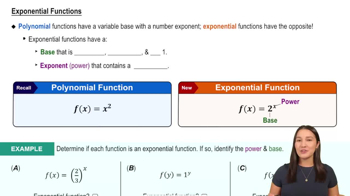
Exponential Functions

An exponential function has the form f(x) = a^x, where the base a is a positive constant and the exponent x is a variable. These functions model growth or decay processes and have unique properties such as always being positive and increasing or decreasing depending on the base.
추천 영상:
6:13
Exponential Functions

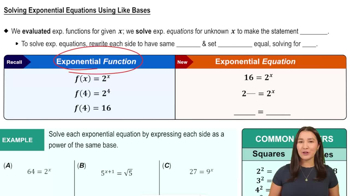
Using Given Function Values to Find the Base

When a function value is given, such as f(3) = 27, you can substitute x = 3 into f(x) = a^x to form an equation a^3 = 27. Solving this equation helps determine the base a, which is essential for evaluating the function at other points.
추천 영상:
4:46
Solving Exponential Equations Using Like Bases

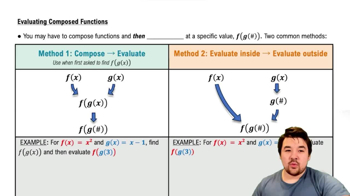
Evaluating the Function at a Specific Input

Once the base a is known, you can find the function value at any input by substituting that input into f(x) = a^x. For example, to find f(2), calculate a^2 using the previously determined base, which gives the function value at x = 2.
추천 영상:
4:26
Evaluating Composed Functions