Ch. 4 - Inverse, Exponential, and Logarithmic Functions
Lial - College Algebra 13th Edition
Lial13th EditionCollege AlgebraISBN: 9780136881063당신이 사용하는 게 아니라요?교과서 변경
5장, 문제 51

Find each value. If applicable, give an approximation to four decimal places. ln 28

검증된 단계별 안내
1
Recognize that \( \ln 28 \) means the natural logarithm of 28, which is the power to which \( e \) (Euler's number, approximately 2.71828) must be raised to get 28.
Recall the definition: \( \ln x = y \) means \( e^y = x \). So here, \( \ln 28 = y \) means \( e^y = 28 \).
To find \( \ln 28 \), you can use a calculator with a natural logarithm function or logarithm tables.
Enter 28 into the calculator and press the \( \ln \) button to get the value of \( \ln 28 \).
If required, round the result to four decimal places to provide the approximation.

비슷한 문제에 대한 검증된 영상 답변:

이 영상 해법은 위 문제에 도움이 된다고 튜터들이 추천한 것입니다.
영상 길이:
1m
도움이 되었나요?

주요 개념

질문에 올바르게 답하기 위해 반드시 이해해야 하는 핵심 개념들은 다음과 같습니다.

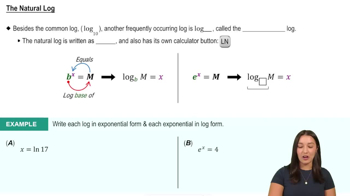
Natural Logarithm (ln)

The natural logarithm, denoted as ln, is the logarithm to the base e, where e ≈ 2.71828. It answers the question: to what power must e be raised to get a given number? For example, ln(28) finds the exponent x such that e^x = 28.
추천 영상:
2:51
The Natural Log

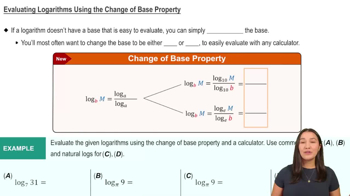
Properties of Logarithms

Logarithms have properties that simplify calculations, such as ln(ab) = ln(a) + ln(b) and ln(a^b) = b ln(a). These properties help break down complex expressions or approximate values by using known logarithms.
추천 영상:
5:36
Change of Base Property

Approximation and Rounding

When exact values are difficult to find, logarithms are often approximated using calculators. The problem requests rounding the answer to four decimal places, which means limiting the decimal digits to four after the decimal point for precision.
추천 영상:
4:20
Graph Hyperbolas at the Origin