Ch. 4 - Inverse, Exponential, and Logarithmic Functions
Lial - College Algebra 13th Edition
Lial13th EditionCollege AlgebraISBN: 9780136881063당신이 사용하는 게 아니라요?교과서 변경
5장, 문제 57

Graph each function. Give the domain and range. See Example 3. ƒ(x) = (1/3)-x

검증된 단계별 안내
1
Rewrite the function to a more familiar form by using the property of exponents: \(f(x) = \left(\frac{1}{3}\right)^{-x} = 3^x\). This will make it easier to analyze and graph.
Identify the domain of the function. Since \$3^x$ is an exponential function defined for all real numbers, the domain is \((-\infty, \infty)\).
Determine the range of the function. Because \$3^x\( is always positive for any real \)x$, the range is \((0, \infty)\).
Plot key points to help graph the function, such as \(f(0) = 3^0 = 1\), \(f(1) = 3^1 = 3\), and \(f(-1) = 3^{-1} = \frac{1}{3}\). These points show the exponential growth behavior.
Sketch the graph using the points and the knowledge that the function approaches zero but never touches the x-axis (horizontal asymptote at \(y=0\)), and increases rapidly as \(x\) increases.

비슷한 문제에 대한 검증된 영상 답변:

이 영상 해법은 위 문제에 도움이 된다고 튜터들이 추천한 것입니다.
영상 길이:
8m
도움이 되었나요?

주요 개념

질문에 올바르게 답하기 위해 반드시 이해해야 하는 핵심 개념들은 다음과 같습니다.

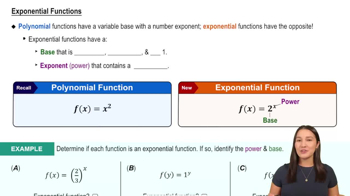
Exponential Functions

An exponential function has the form f(x) = a^x, where the base a is a positive real number not equal to 1. In this problem, the function involves a negative exponent, which affects the graph by reflecting it across the y-axis. Understanding how the base and exponent influence the shape is essential for graphing.
추천 영상:
6:13
Exponential Functions

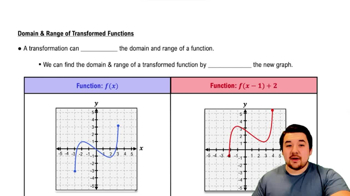
Domain and Range of Functions

The domain is the set of all possible input values (x-values) for the function, while the range is the set of all possible output values (f(x)). For exponential functions like f(x) = (1/3)^-x, the domain is all real numbers, and the range is all positive real numbers, since exponential functions never output zero or negative values.
추천 영상:
4:22
Domain & Range of Transformed Functions

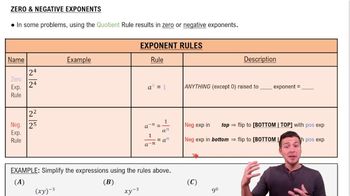
Negative Exponents and Their Properties

A negative exponent indicates the reciprocal of the base raised to the positive exponent, i.e., a^{-x} = 1 / a^x. This property transforms the function and affects its graph, often reflecting it or changing its growth behavior. Recognizing this helps in rewriting and graphing the function accurately.
추천 영상:
가이드 코스
6:37
Zero and Negative Rules