Ch. 4 - Inverse, Exponential, and Logarithmic Functions
Lial - College Algebra 13th Edition
Lial13th EditionCollege AlgebraISBN: 9780136881063당신이 사용하는 게 아니라요?교과서 변경
5장, 문제 62

Graph each function. Give the domain and range. ƒ(x) = (log1/2 x) - 2

검증된 단계별 안내
1
Identify the base of the logarithm function. Here, the function is \(f(x) = \log_{\frac{1}{2}} x - 2\), where the base is \(\frac{1}{2}\), which is between 0 and 1, indicating a decreasing logarithmic function.
Determine the domain of the function. Since logarithms are only defined for positive arguments, set the inside of the log greater than zero: \(x > 0\). Thus, the domain is \((0, \infty)\).
Analyze the vertical shift caused by the \(-2\) outside the logarithm. This shifts the entire graph down by 2 units, affecting the range but not the domain.
Find the range of the function. The logarithmic function \(\log_{\frac{1}{2}} x\) can take any real value from \(-\infty\) to \(\infty\), so after shifting down by 2, the range remains \((-\infty, \infty)\).
Sketch the graph by plotting key points such as when \(x=1\) (since \(\log_{b} 1 = 0\) for any base \(b\)), which gives \(f(1) = 0 - 2 = -2\). Also, note the behavior as \(x\) approaches 0 from the right (function goes to \(\infty\)) and as \(x\) approaches infinity (function goes to \(-\infty\)) due to the base being less than 1.

비슷한 문제에 대한 검증된 영상 답변:

이 영상 해법은 위 문제에 도움이 된다고 튜터들이 추천한 것입니다.
영상 길이:
3m
도움이 되었나요?

주요 개념

질문에 올바르게 답하기 위해 반드시 이해해야 하는 핵심 개념들은 다음과 같습니다.

Logarithmic Functions

A logarithmic function is the inverse of an exponential function and is written as f(x) = log_b(x), where b is the base. It answers the question: to what power must the base b be raised to get x? Understanding the properties of logarithms, especially with bases between 0 and 1, is essential for graphing and analyzing the function.
추천 영상:
5:26
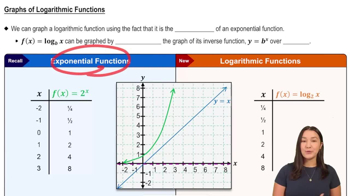
Graphs of Logarithmic Functions

Domain and Range of Logarithmic Functions

The domain of a logarithmic function f(x) = log_b(x) consists of all positive real numbers because the logarithm of zero or negative numbers is undefined. The range is all real numbers since logarithmic functions can produce any real output. Shifts and transformations affect these sets and must be considered when determining domain and range.
추천 영상:
4:22
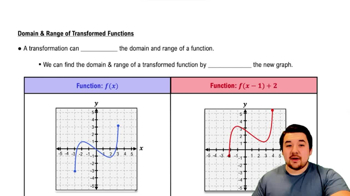
Domain & Range of Transformed Functions

Transformations of Functions

Transformations include shifts, reflections, stretches, and compressions applied to the parent function. For f(x) = log_(1/2)(x) - 2, subtracting 2 shifts the graph downward by 2 units. Understanding how these changes affect the graph helps in accurately plotting the function and identifying its domain and range.
추천 영상:
4:22
Domain & Range of Transformed Functions