Use the various properties of exponential and logarithmic functions to evaluate the expressions in parts (a)–(c). Given ƒ(x) = log2 x, find ƒ(22 log_2 2)
Ch. 4 - Inverse, Exponential, and Logarithmic Functions

5장, 문제 97
Solve each equation for the indicated variable. Use logarithms with the appropriate bases. A = P (1 + r/n)tn, for t
검증된 단계별 안내1
Identify the given formula: \(A = P (1 + \frac{r}{n})^{tn}\), where \(A\) is the amount, \(P\) is the principal, \(r\) is the interest rate, \(n\) is the number of times interest is compounded per year, and \(t\) is the time in years. We need to solve for \(t\).
Start by isolating the exponential term. Divide both sides of the equation by \(P\) to get: \(\frac{A}{P} = (1 + \frac{r}{n})^{tn}\).
To solve for \(t\), take the logarithm of both sides. Since the base of the exponent is \(1 + \frac{r}{n}\), use the logarithm with this base: \(\log_{(1 + \frac{r}{n})} \left( \frac{A}{P} \right) = \log_{(1 + \frac{r}{n})} \left( (1 + \frac{r}{n})^{tn} \right)\).
Apply the logarithmic identity \(\log_b (b^x) = x\) to simplify the right side: \(\log_{(1 + \frac{r}{n})} \left( \frac{A}{P} \right) = tn\).
Finally, solve for \(t\) by dividing both sides by \(n\): \(t = \frac{1}{n} \log_{(1 + \frac{r}{n})} \left( \frac{A}{P} \right)\).

비슷한 문제에 대한 검증된 영상 답변:
이 영상 해법은 위 문제에 도움이 된다고 튜터들이 추천한 것입니다.
영상 길이:
3m도움이 되었나요?
주요 개념
질문에 올바르게 답하기 위해 반드시 이해해야 하는 핵심 개념들은 다음과 같습니다.
Exponential Equations
Exponential equations involve variables in the exponent, such as (1 + r/n)^(tn). Solving for a variable in the exponent requires techniques like logarithms to rewrite the equation in a solvable form.
추천 영상:
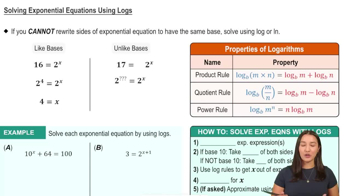
Solving Exponential Equations Using Logs
Logarithms and Their Properties
Logarithms are the inverse operations of exponentials and allow us to solve equations where the variable is an exponent. Understanding properties like log_b(a^c) = c log_b(a) is essential for isolating variables in exponential expressions.
추천 영상:
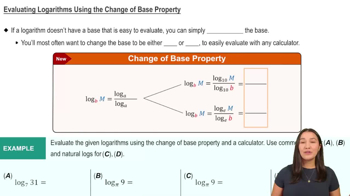
Change of Base Property
Compound Interest Formula
The formula A = P(1 + r/n)^(tn) calculates compound interest, where A is the amount, P is the principal, r is the interest rate, n is the number of compounding periods per year, and t is time. Recognizing this formula helps identify which variable to solve for.
추천 영상:
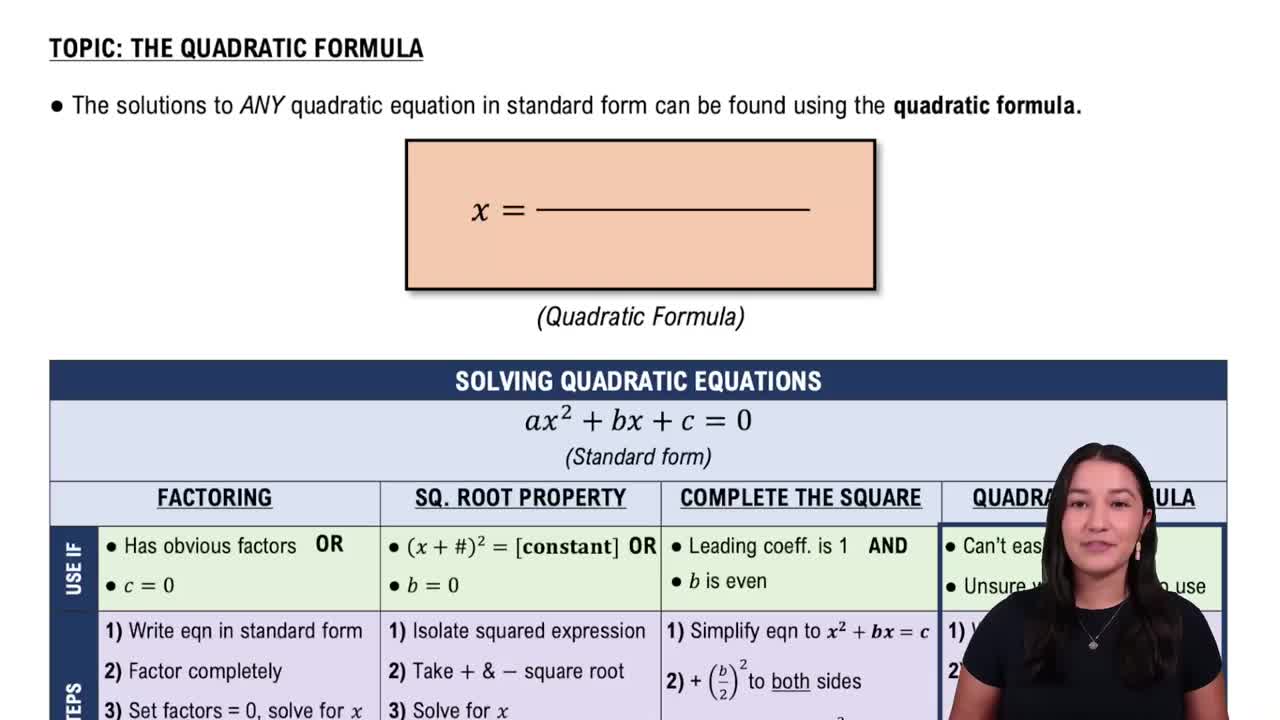
Solving Quadratic Equations Using The Quadratic Formula
관련 실천
교과서 질문
693
views
교과서 질문
Use the various properties of exponential and logarithmic functions to evaluate the expressions in parts (a)–(c). Given ƒ(x) = log2 x, find ƒ(2log_2 2)
730
views
교과서 질문
Use the various properties of exponential and logarithmic functions to evaluate the expressions in parts (a)–(c). Given ƒ(x) = log2 x, find ƒ(27)
749
views
교과서 질문
Use the various properties of exponential and logarithmic functions to evaluate the expressions in parts (a)–(c). Given ƒ(x) = 3x, find ƒ(log3 (ln 3))
761
views
교과서 질문
Use the various properties of exponential and logarithmic functions to evaluate the expressions in parts (a)–(c). Given ƒ(x) = 3x, find ƒ(log3 (2 ln 3))
811
views
교과서 질문
Given that log10 2 ≈ 0.3010 and log10 3 ≈ 0.4771, find each logarithm without using a calculator. log10 9/4
881
views