Ch. 4 - Inverse, Exponential, and Logarithmic Functions
Lial - College Algebra 13th Edition
Lial13th EditionCollege AlgebraISBN: 9780136881063당신이 사용하는 게 아니라요?교과서 변경
5장, 문제 21

Solve each equation. In Exercises 11–34, give irrational solutions as decimals correct to the nearest thousandth. In Exercises 35-40, give solutions in exact form. ex2=100e^{x^2} = 100

검증된 단계별 안내
1
Recognize that the equation is given as \(e^{x^2} = 100\). Our goal is to solve for \(x\).
Apply the natural logarithm (ln) to both sides of the equation to undo the exponential function. This gives us \(\ln\left(e^{x^2}\right) = \ln(100)\).
Use the logarithmic identity \(\ln\left(e^a\right) = a\) to simplify the left side, resulting in \(x^2 = \ln(100)\).
Solve for \(x\) by taking the square root of both sides: \(x = \pm \sqrt{\ln(100)}\).
Since the problem asks for decimal approximations correct to the nearest thousandth, calculate the numerical value of \(\sqrt{\ln(100)}\) and express both positive and negative roots as decimals.

비슷한 문제에 대한 검증된 영상 답변:

이 영상 해법은 위 문제에 도움이 된다고 튜터들이 추천한 것입니다.
영상 길이:
3m
도움이 되었나요?

주요 개념

질문에 올바르게 답하기 위해 반드시 이해해야 하는 핵심 개념들은 다음과 같습니다.

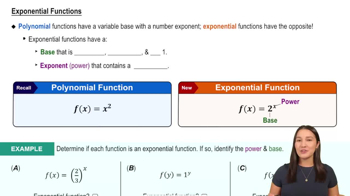
Exponential Functions

An exponential function has the form f(x) = a^x, where the variable is in the exponent. In this problem, e^(x^2) means the base e (approximately 2.718) is raised to the power of x squared. Understanding how to work with exponential functions is essential to isolate the variable.
추천 영상:
6:13
Exponential Functions

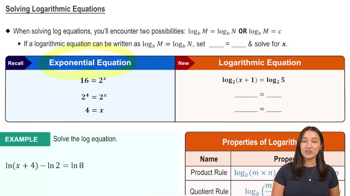
Solving Equations Using Logarithms

Logarithms are the inverse operations of exponentials and are used to solve equations where the variable is in the exponent. Applying the natural logarithm (ln) to both sides of e^(x^2) = 100 allows you to rewrite the equation as x^2 = ln(100), simplifying the process of solving for x.
추천 영상:
5:02
Solving Logarithmic Equations

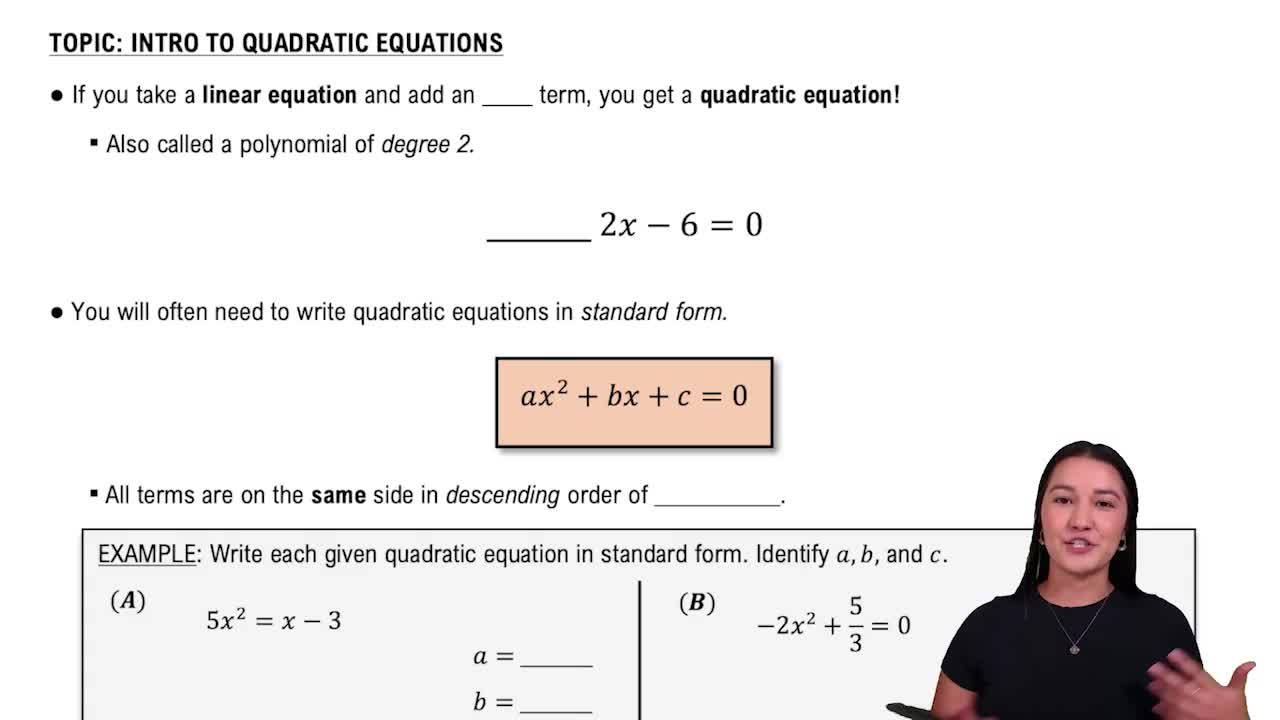
Handling Quadratic Equations

After applying logarithms, the equation becomes quadratic in form (x^2 = constant). Solving for x involves taking the square root of both sides, which yields two solutions: positive and negative roots. Understanding how to solve quadratic equations and interpret their solutions is crucial here.
추천 영상:
05:35
Introduction to Quadratic Equations