Ch. 4 - Inverse, Exponential, and Logarithmic Functions
Lial - College Algebra 13th Edition
Lial13th EditionCollege AlgebraISBN: 9780136881063당신이 사용하는 게 아니라요?교과서 변경
5장, 문제 83

Solve each equation. See Examples 4–6. x2/3 = 4

검증된 단계별 안내
1
Start with the given equation: \(x^{2/3} = 4\).
To isolate \(x\), raise both sides of the equation to the reciprocal of the exponent \(\frac{2}{3}\), which is \(\frac{3}{2}\). This gives: \(\left(x^{2/3}\right)^{3/2} = 4^{3/2}\).
Simplify the left side using the power of a power property: \(x^{(2/3) \times (3/2)} = x^1 = x\).
Rewrite the right side \(4^{3/2}\) as \(\left(4^{1/2}\right)^3\), which means take the square root of 4 and then cube the result.
Calculate the right side step-by-step (square root of 4 is 2, then cube 2) to find the value of \(x\).

비슷한 문제에 대한 검증된 영상 답변:

이 영상 해법은 위 문제에 도움이 된다고 튜터들이 추천한 것입니다.
영상 길이:
2m
도움이 되었나요?

주요 개념

질문에 올바르게 답하기 위해 반드시 이해해야 하는 핵심 개념들은 다음과 같습니다.

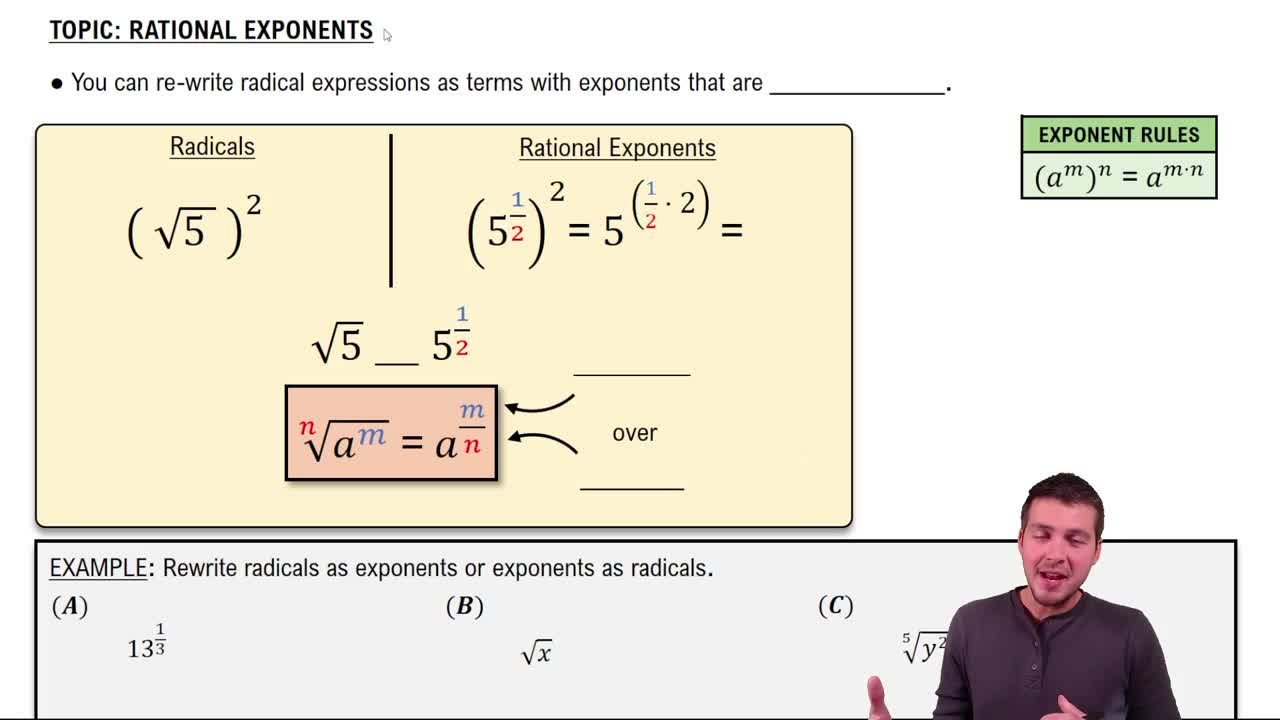
Rational Exponents

Rational exponents represent roots and powers simultaneously. For example, x^(2/3) means the cube root of x squared, or (x^2)^(1/3). Understanding how to manipulate and interpret these exponents is essential for solving equations involving fractional powers.
추천 영상:
가이드 코스
04:06
Rational Exponents

Isolating the Variable

To solve equations, isolate the term containing the variable by performing inverse operations. In this case, you want to isolate x^(2/3) before applying further steps, which simplifies the process of solving for x.
추천 영상:
가이드 코스
05:28
Equations with Two Variables

Solving Radical Equations

Equations with rational exponents often require rewriting the expression as a radical and then raising both sides to an appropriate power to eliminate the root. This step helps to solve for the variable and check for extraneous solutions.
추천 영상:
5:02
Solving Logarithmic Equations