Ch. 5 - Systems and Matrices
Lial - College Algebra 13th Edition
Lial13th EditionCollege AlgebraISBN: 9780136881063당신이 사용하는 게 아니라요?교과서 변경
6장, 문제 1

Answer each question. By what expression should we multiply each side of 5/((3x(2x + 1)) = A/(3x) + B/(2x + 1) so that there are no fractions in the equation?

검증된 단계별 안내
1
Identify the denominators in the equation: the denominators are \$3x\( and \)(2x + 1)$.
To eliminate the fractions, multiply both sides of the equation by the least common denominator (LCD) of all the denominators involved.
The LCD is the product of the distinct factors in the denominators, which is \(3x(2x + 1)\).
Multiply each term on both sides of the equation by \(3x(2x + 1)\) to clear the fractions.
After multiplying, the equation will no longer have fractions, allowing you to work with a polynomial equation.

비슷한 문제에 대한 검증된 영상 답변:

이 영상 해법은 위 문제에 도움이 된다고 튜터들이 추천한 것입니다.
영상 길이:
3m
도움이 되었나요?

주요 개념

질문에 올바르게 답하기 위해 반드시 이해해야 하는 핵심 개념들은 다음과 같습니다.

Least Common Denominator (LCD)

The least common denominator is the smallest expression that all denominators in a rational equation can divide into without leaving a remainder. Multiplying both sides of an equation by the LCD eliminates fractions, simplifying the equation for easier solving.
추천 영상:
가이드 코스
02:58
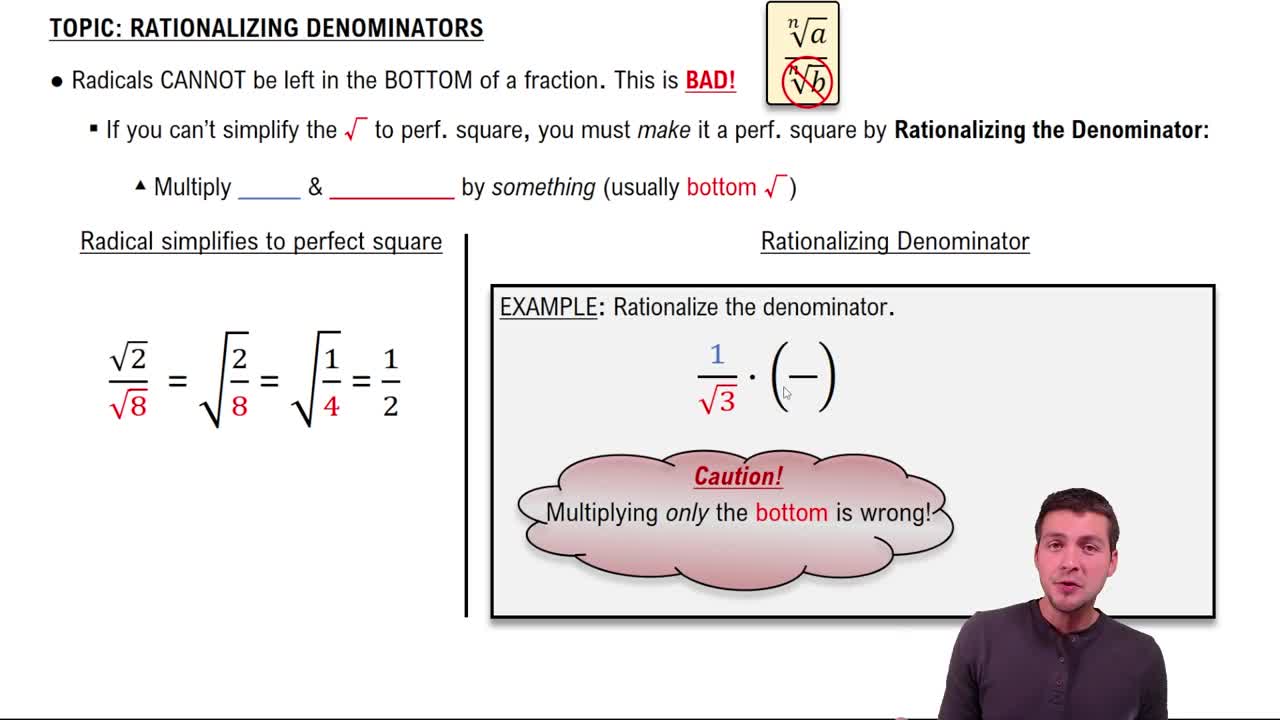
Rationalizing Denominators

Partial Fraction Decomposition

Partial fraction decomposition breaks a complex rational expression into simpler fractions with simpler denominators. Understanding this helps identify the denominators involved and guides the process of clearing fractions by multiplying through by the LCD.
추천 영상:
4:07
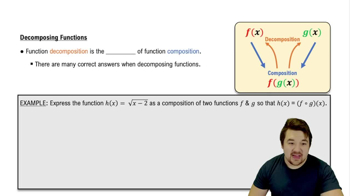
Decomposition of Functions

Multiplying Equations to Clear Fractions

Multiplying both sides of an equation by an appropriate expression removes denominators, converting the equation into a polynomial form. This step is essential to avoid fractions and solve for variables more straightforwardly.
추천 영상:
04:02
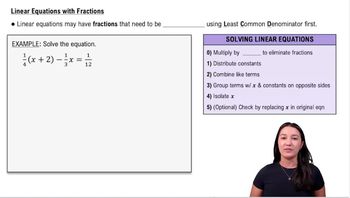
Solving Linear Equations with Fractions