Ch. 5 - Systems and Matrices
Lial - College Algebra 13th Edition
Lial13th EditionCollege AlgebraISBN: 9780136881063당신이 사용하는 게 아니라요?교과서 변경
6장, 문제 73

Use Cramer's rule to solve each system of equations. If D = 0, then use another method to determine the solution set. See Examples 5–7.
(1/2)x + (1/3)y = 2
(3/2)x - (1/2)y = -12

검증된 단계별 안내
1
Write the system of equations in standard form: \[\frac{1}{2}x + \frac{1}{3}y = 2\] \[\frac{3}{2}x - \frac{1}{2}y = -12\]
Identify the coefficients for the variables to form the coefficient matrix: \[A = \begin{bmatrix} \frac{1}{2} & \frac{1}{3} \\ \frac{3}{2} & -\frac{1}{2} \end{bmatrix}\]
Calculate the determinant of matrix \(A\), denoted as \(D\), using the formula: \[D = a_{11}a_{22} - a_{12}a_{21}\] where \(a_{11} = \frac{1}{2}\), \(a_{12} = \frac{1}{3}\), \(a_{21} = \frac{3}{2}\), and \(a_{22} = -\frac{1}{2}\).
If \(D \neq 0\), find determinants \(D_x\) and \(D_y\) by replacing the respective columns of \(A\) with the constants vector: \[D_x = \begin{vmatrix} 2 & \frac{1}{3} \\ -12 & -\frac{1}{2} \end{vmatrix}, \quad D_y = \begin{vmatrix} \frac{1}{2} & 2 \\ \frac{3}{2} & -12 \end{vmatrix}\]
Solve for \(x\) and \(y\) using Cramer's rule: \[x = \frac{D_x}{D}, \quad y = \frac{D_y}{D}\] If \(D = 0\), use another method such as substitution or elimination to find the solution set.

비슷한 문제에 대한 검증된 영상 답변:

이 영상 해법은 위 문제에 도움이 된다고 튜터들이 추천한 것입니다.
영상 길이:
6m
도움이 되었나요?

주요 개념

질문에 올바르게 답하기 위해 반드시 이해해야 하는 핵심 개념들은 다음과 같습니다.

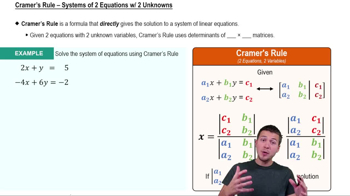
Cramer's Rule

Cramer's Rule is a method for solving systems of linear equations using determinants. For a system of two equations, it involves calculating the determinant of the coefficient matrix (D) and determinants of matrices formed by replacing columns with constants. If D ≠ 0, the system has a unique solution found by dividing these determinants by D.
추천 영상:
가이드 코스
6:54
Cramer's Rule - 2 Equations with 2 Unknowns

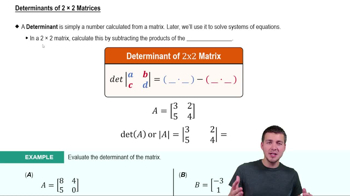
Determinant of a 2x2 Matrix

The determinant of a 2x2 matrix [[a, b], [c, d]] is calculated as ad - bc. This value helps determine if the system has a unique solution (nonzero determinant) or if it is dependent or inconsistent (zero determinant). It is essential for applying Cramer's Rule correctly.
추천 영상:
가이드 코스
4:36
Determinants of 2×2 Matrices

Alternative Methods for Solving Systems When D = 0

If the determinant D equals zero, Cramer's Rule cannot be used because the system may have infinitely many solutions or no solution. In such cases, methods like substitution, elimination, or analyzing the system's consistency are used to find the solution set or determine if no solution exists.
추천 영상:
04:03
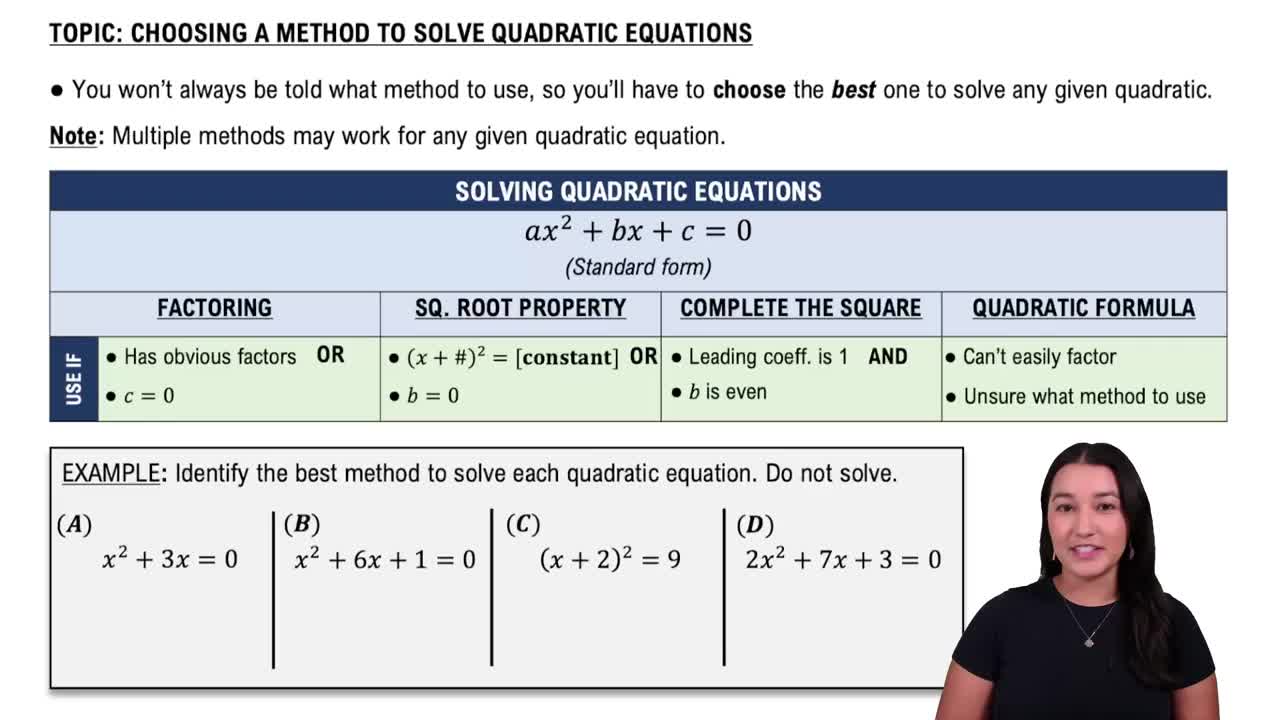
Choosing a Method to Solve Quadratics
관련 실천
교과서 질문

Given A=[4231],B=[510237]A = \(\left\)[ \(\begin{matrix}\) 4 & -2 \\ 3 & 1 \(\end{matrix}\) \(\right\)], \(\quad\) B = \(\left\)[ \(\begin{matrix}\) 5 & 1 \\ 0 & -2 \\ 3 & 7 \(\end{matrix}\) \(\right\)] , and C=[541036]C = \(\left\)[ \(\begin{matrix}\) -5 & 4 & 1 \\ 0 & 3 & 6 \(\end{matrix}\) \(\right\)] , find each product, if possible. See Examples 5–7. AB

57
views
교과서 질문

Perform each operation, if possible.

[258192][3471]\(\left\)[ \(\begin{matrix}\) 2 & 5 & 8 \\ 1 & 9 & 2 \(\end{matrix}\) \(\right\)] - \(\left\)[ \(\begin{matrix}\) 3 & 4 \\ 7 & 1 \(\end{matrix}\) \(\right\)]

98
views
교과서 질문

Solve each system. (Hint: In Exercises 69–72, let 1/x=t1/x = t and 1/y=u1/y = u.)

2x+3y=18\(\frac{2}{x}\)+\(\frac{3}{y}\)=18

4x5y=8\(\frac{4}{x}\)-\(\frac{5}{y}\)=-8

626
views
교과서 질문

Consider the following nonlinear system. Work Exercises 75 –80 in order.

y = | x - 1 |

y = x2 - 4

How is the graph of y = | x - 1 | obtained by transforming the graph of y = | x |?

534
views
교과서 질문

Perform each operation, if possible.

[325][846]+[102]\(\left\)[\(\begin{matrix}\)3\\ 2\\ 5\(\end{matrix}\]\right\)]-\(\left\)[\(\begin{matrix}\)8\\ -4\\ 6\(\end{matrix}\[\right\)]+\(\left\)[\(\begin{matrix}\)1\\ 0\\ 2\(\end{matrix}\]\right\)]

68
views
교과서 질문

Use Cramer's rule to solve each system of equations. If D = 0, then use another method to determine the solution set. See Examples 5–7.

2x - y + 4z = -2

3x + 2y - z = -3

x + 4y - 2z = 17

804
views