The graphs show regions of feasible solutions. Find the maximum and minimum values of each objective function. objective function = 3x + 5y
Ch. 5 - Systems and Matrices

6장, 문제 77
Use Cramer's rule to solve each system of equations. If D = 0, then use another method to determine the solution set. See Examples 5–7.
x + 2y + 3z = 4
4x + 3y + 2z = 1
-x - 2y - 3z = 0
검증된 단계별 안내1
Write the system of equations in matrix form as \(A\mathbf{x} = \mathbf{b}\), where \(A\) is the coefficient matrix, \(\mathbf{x}\) is the column vector of variables, and \(\mathbf{b}\) is the constants vector. For this system, \(A = \begin{bmatrix} 1 & 2 & 3 \\ 4 & 3 & 2 \\ -1 & -2 & -3 \end{bmatrix}\) and \(\mathbf{b} = \begin{bmatrix} 4 \\ 1 \\ 0 \end{bmatrix}\).
Calculate the determinant of the coefficient matrix \(D = \det(A)\). This will tell us if Cramer's rule can be applied. If \(D \neq 0\), the system has a unique solution; if \(D = 0\), we need to use another method.
If \(D \neq 0\), find the determinants \(D_x\), \(D_y\), and \(D_z\) by replacing the respective columns of \(A\) with the vector \(\mathbf{b}\). Specifically, \(D_x\) is the determinant of the matrix formed by replacing the first column of \(A\) with \(\mathbf{b}\), \(D_y\) replaces the second column, and \(D_z\) replaces the third column.
Use Cramer's rule formulas to find the variables: \(x = \frac{D_x}{D}\), \(y = \frac{D_y}{D}\), and \(z = \frac{D_z}{D}\). This gives the unique solution to the system.
If \(D = 0\), the system may have infinitely many solutions or no solution. In that case, use another method such as substitution or elimination to analyze the system further and determine the solution set.

비슷한 문제에 대한 검증된 영상 답변:
이 영상 해법은 위 문제에 도움이 된다고 튜터들이 추천한 것입니다.
영상 길이:
7m도움이 되었나요?
주요 개념
질문에 올바르게 답하기 위해 반드시 이해해야 하는 핵심 개념들은 다음과 같습니다.
Cramer's Rule
Cramer's Rule is a method for solving systems of linear equations using determinants. It applies when the coefficient matrix has a nonzero determinant (D ≠ 0). Each variable is found by replacing the corresponding column in the coefficient matrix with the constants vector and calculating the determinant ratio.
추천 영상:
가이드 코스
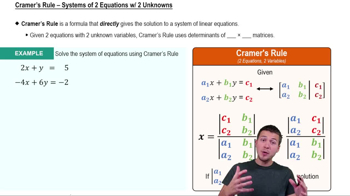
Cramer's Rule - 2 Equations with 2 Unknowns
Determinant and Its Role in Systems of Equations
The determinant of the coefficient matrix indicates whether a unique solution exists. If the determinant (D) is zero, the system may have infinitely many solutions or no solution. Understanding how to compute and interpret the determinant is essential for choosing the correct solving method.
추천 영상:
가이드 코스
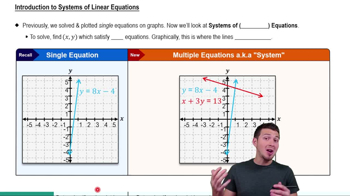
Introduction to Systems of Linear Equations
Alternative Methods for Solving Systems When D = 0
When the determinant is zero, Cramer's Rule cannot be used. Alternative methods include substitution, elimination, or matrix row reduction (Gaussian elimination) to analyze the system's consistency and find solutions or determine if none exist.
추천 영상:
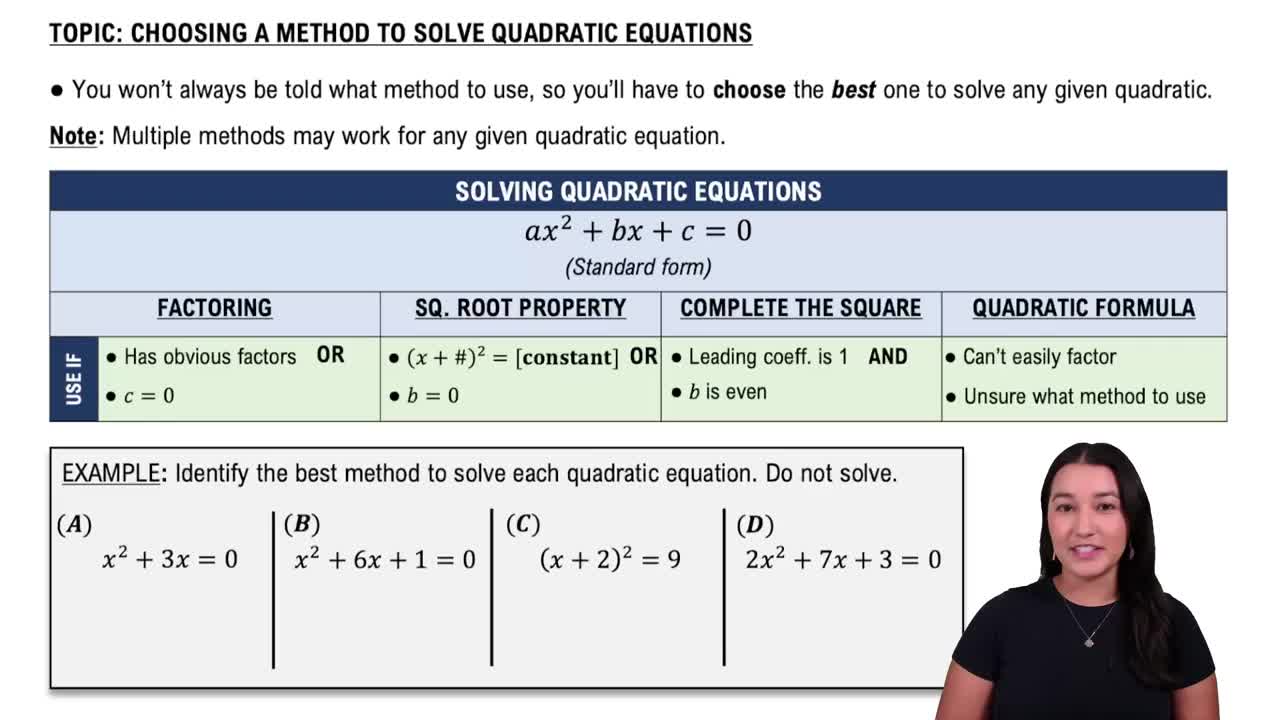
Choosing a Method to Solve Quadratics
관련 실천
교과서 질문
586
views
교과서 질문
Consider the following nonlinear system. Work Exercises 75 –80 in order.
y = | x - 1 |
y = x2 - 4
How is the graph of y = | x - 1 | obtained by transforming the graph of y = | x |?
534
views
교과서 질문
For what value(s) of k will the following system of linear equations have no solution? infinitely many solutions?
x - 2y = 3
-2x + 4y = k
974
views
교과서 질문
Use a system of equations to solve each problem. See Example 8. Find an equation of the line y = ax + b that passes through the points (-2, 1) and (-1, -2).
843
views
교과서 질문
Perform each operation, if possible.
64
views
교과서 질문
Use Cramer's rule to solve each system of equations. If D = 0, then use another method to determine the solution set. See Examples 5–7.
2x - y + 4z = -2
3x + 2y - z = -3
x + 4y - 2z = 17
804
views