Ch. 5 - Systems and Matrices
Lial - College Algebra 13th Edition
Lial13th EditionCollege AlgebraISBN: 9780136881063당신이 사용하는 게 아니라요?교과서 변경
6장, 문제 31

Use the Gauss-Jordan method to solve each system of equations. For systems in two variables with infinitely many solutions, write the solution with y arbitrary. For systems in three variables with infinitely many solutions, write the solution set with z arbitrary.
x + y - 5z = -18
3x - 3y + z = 6
x + 3y - 2z = -13

검증된 단계별 안내
1
Write the system of equations as an augmented matrix. For the system \(x + y - 5z = -18\) \(3x - 3y + z = 6\) \(x + 3y - 2z = -13\), the augmented matrix is: \[\begin{bmatrix} 1 & 1 & -5 & | & -18 \\ 3 & -3 & 1 & | & 6 \\ 1 & 3 & -2 & | & -13 \end{bmatrix}\]
Use row operations to get a leading 1 in the first row, first column (which is already 1 here), and then eliminate the \(x\)-terms in the second and third rows by replacing those rows with suitable combinations. For example, replace row 2 with (row 2) - 3*(row 1), and replace row 3 with (row 3) - (row 1).
Next, focus on the second row to get a leading 1 in the second column. You may need to divide the entire second row by the coefficient of \(y\) in that row after elimination. Then use this leading 1 to eliminate the \(y\)-term in the third row by replacing row 3 with (row 3) - (appropriate multiple of row 2).
After that, get a leading 1 in the third row, third column (for \(z\)), by dividing the third row by the coefficient of \(z\) in that row. Then use this to eliminate the \(z\)-terms in the first and second rows by appropriate row operations.
Once the matrix is in reduced row echelon form (RREF), write the system of equations back from the matrix. If the system has a unique solution, express \(x\), \(y\), and \(z\) explicitly. If there are infinitely many solutions, express the variables in terms of the free variable \(z\) (since the problem specifies \(z\) arbitrary for three variables).

비슷한 문제에 대한 검증된 영상 답변:

이 영상 해법은 위 문제에 도움이 된다고 튜터들이 추천한 것입니다.
영상 길이:
11m
도움이 되었나요?

주요 개념

질문에 올바르게 답하기 위해 반드시 이해해야 하는 핵심 개념들은 다음과 같습니다.

Gauss-Jordan Elimination Method

Gauss-Jordan elimination is a systematic procedure to solve systems of linear equations by transforming the augmented matrix into reduced row-echelon form. This method uses row operations to simplify the matrix, making it easier to identify solutions directly. It extends Gaussian elimination by continuing until each leading coefficient is 1 and all other entries in the pivot columns are zero.
추천 영상:
가이드 코스
6:04
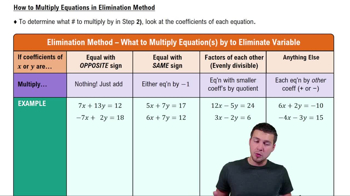
How to Multiply Equations in Elimination Method

Systems of Linear Equations and Solution Types

A system of linear equations can have a unique solution, infinitely many solutions, or no solution. Infinitely many solutions occur when equations are dependent, leading to free variables. Understanding the nature of the solution set helps in expressing solutions parametrically, such as using an arbitrary variable like y or z to represent infinite solutions.
추천 영상:
가이드 코스
4:27
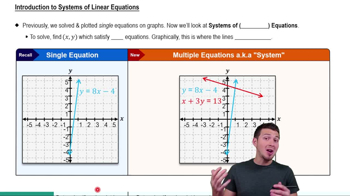
Introduction to Systems of Linear Equations

Parametric Representation of Solutions

When a system has infinitely many solutions, some variables are expressed in terms of free parameters (arbitrary variables). For example, in two-variable systems, y might be arbitrary, and in three-variable systems, z might be arbitrary. This parametric form clearly describes the infinite solution set and helps in interpreting the solution geometrically.
추천 영상:
가이드 코스
8:38
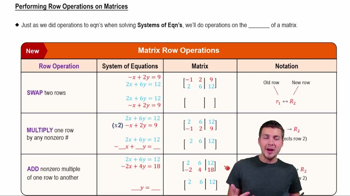
Performing Row Operations on Matrices