Ch. R - Review of Basic Concepts
Lial - College Algebra 13th Edition
Lial13th EditionCollege AlgebraISBN: 9780136881063당신이 사용하는 게 아니라요?교과서 변경
1장, 문제 43

Determine whether each statement is true or false. 9 ∉ {8, 5, 2, 1}

검증된 단계별 안내
1
Understand the notation: The symbol \( \in \) means "is an element of," and \( \notin \) means "is not an element of."
Identify the set given: \( \{8, 5, 2, 1\} \) is a set containing the elements 8, 5, 2, and 1.
Check if the number 9 is in the set: Look through the elements of the set to see if 9 appears.
Since 9 does not appear in the set \( \{8, 5, 2, 1\} \), the statement \( 9 \notin \{8, 5, 2, 1\} \) is true.
Therefore, the statement correctly expresses that 9 is not an element of the set.

비슷한 문제에 대한 검증된 영상 답변:

이 영상 해법은 위 문제에 도움이 된다고 튜터들이 추천한 것입니다.
영상 길이:
47s
도움이 되었나요?

주요 개념

질문에 올바르게 답하기 위해 반드시 이해해야 하는 핵심 개념들은 다음과 같습니다.

Set Membership

Set membership refers to whether an element belongs to a given set. The symbol ∈ denotes 'is an element of,' while ∉ means 'is not an element of.' Understanding this helps determine if a specific number is included in the set.
추천 영상:
05:18
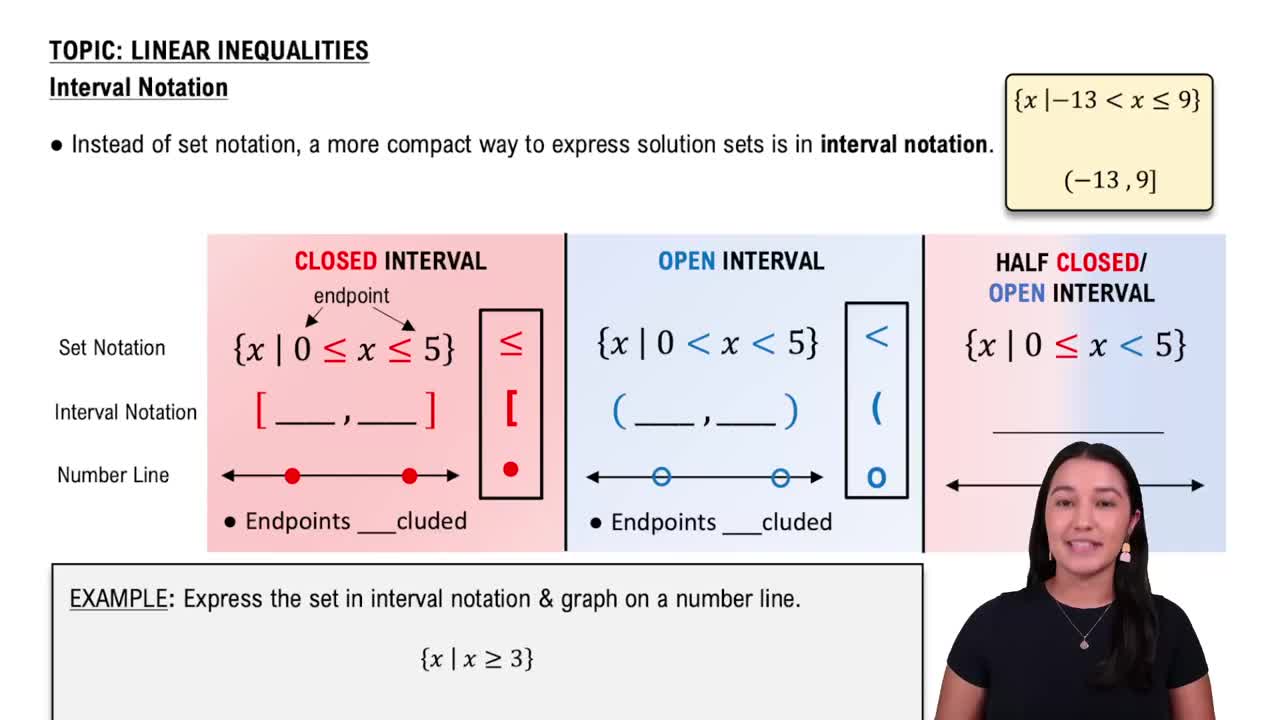
Interval Notation

Set Notation

Set notation uses curly braces {} to list elements of a set. Each element inside the braces is a member of the set. Recognizing this notation is essential to identify which numbers are included in the set.
추천 영상:
05:18
Interval Notation

True or False Statements

Evaluating true or false statements involves verifying the accuracy of a claim based on given information. In this context, it means checking if the element 9 is or is not in the set {8, 5, 2, 1} to determine the statement's truth value.
추천 영상:
가이드 코스
6:57
Classifying Systems of Linear Equations