Ch. R - Review of Basic Concepts
Lial - College Algebra 13th Edition
Lial13th EditionCollege AlgebraISBN: 9780136881063당신이 사용하는 게 아니라요?교과서 변경
1장, 문제 86

Evaluate each expression. (-2)5

검증된 단계별 안내
1
Identify the base and the exponent in the expression \((-2)^5\). Here, the base is \(-2\) and the exponent is \(5\).
Recall that an exponent indicates how many times the base is multiplied by itself. So, \((-2)^5\) means \((-2) \times (-2) \times (-2) \times (-2) \times (-2)\).
Multiply the base step-by-step, keeping track of the sign: multiply the first two \(-2\)s, then multiply the result by the next \(-2\), and so on until all five factors are multiplied.
Remember that multiplying two negative numbers results in a positive number, and multiplying a positive number by a negative number results in a negative number. Use this rule to determine the sign of the final product.
After completing the multiplication, you will have the value of \((-2)^5\). This is the evaluated result of the expression.

비슷한 문제에 대한 검증된 영상 답변:

이 영상 해법은 위 문제에 도움이 된다고 튜터들이 추천한 것입니다.
영상 길이:
1m
도움이 되었나요?

주요 개념

질문에 올바르게 답하기 위해 반드시 이해해야 하는 핵심 개념들은 다음과 같습니다.

Exponents and Powers

An exponent indicates how many times a base number is multiplied by itself. For example, in (-2)^5, the base is -2 and the exponent 5 means multiplying -2 by itself five times.
추천 영상:
04:10
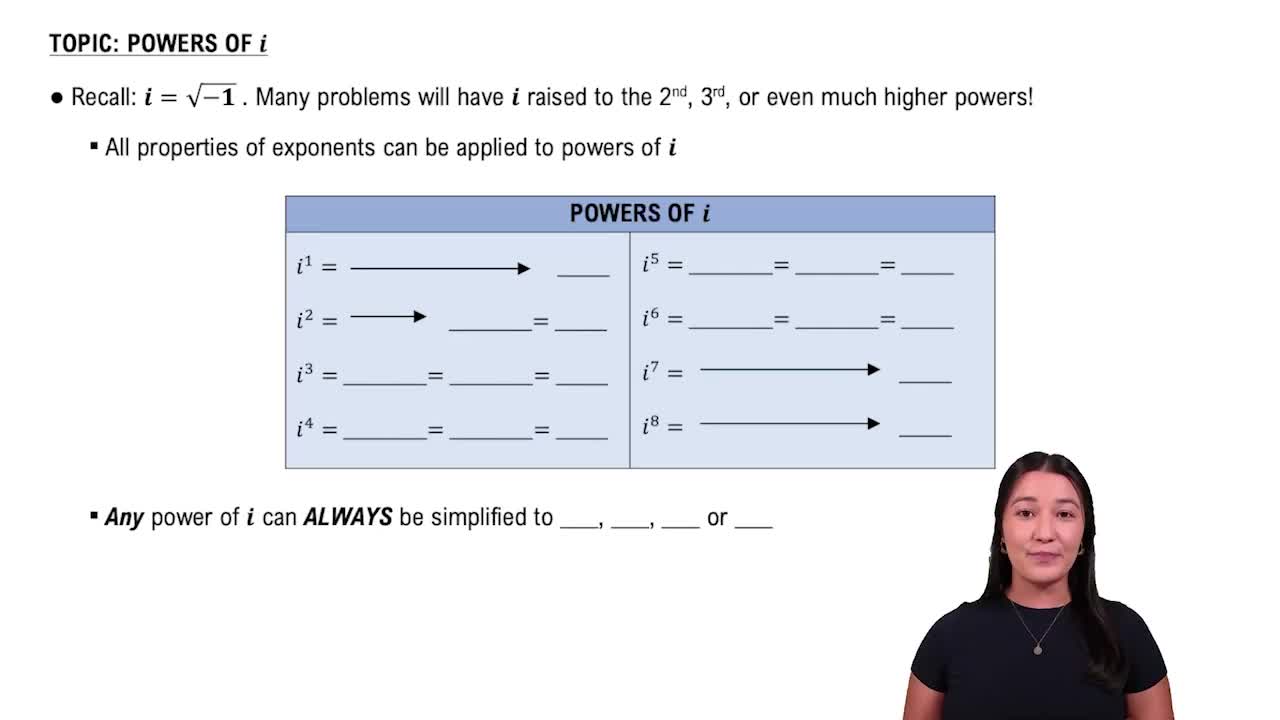
Powers of i

Negative Base with Exponents

When a negative number is raised to a power, the sign of the result depends on whether the exponent is even or odd. An odd exponent keeps the result negative, while an even exponent makes it positive.
추천 영상:
7:39
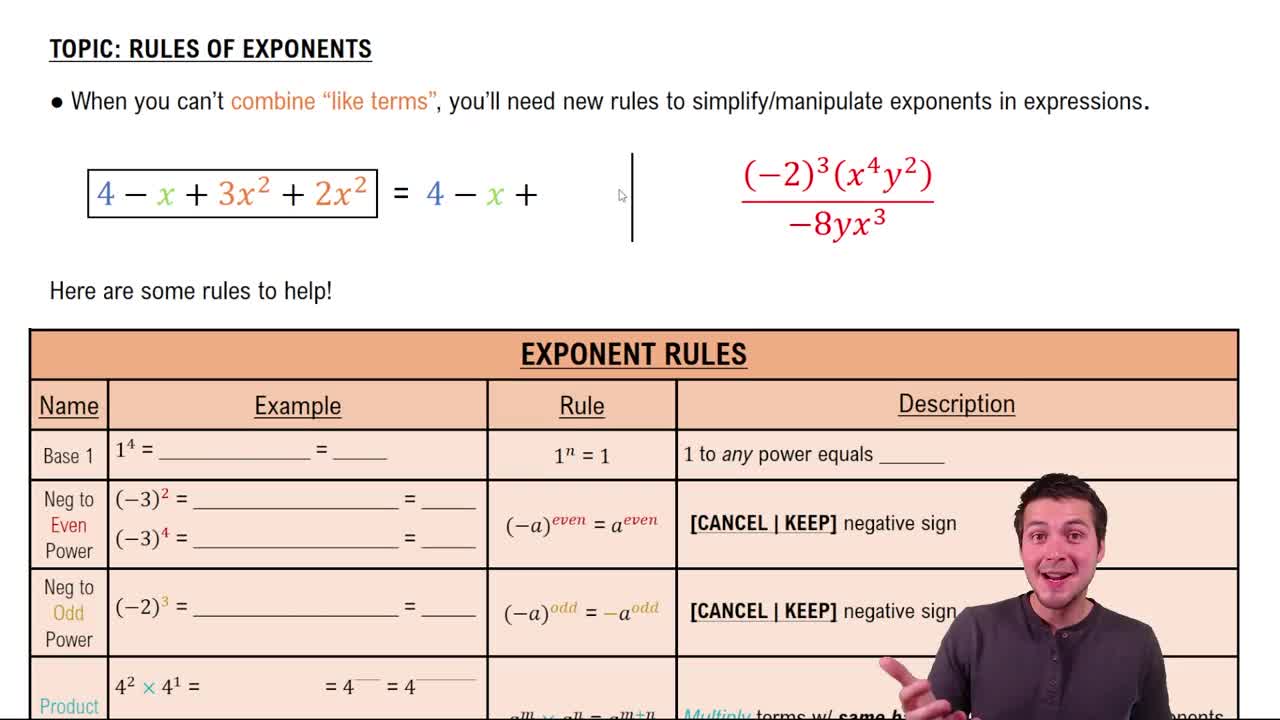
Introduction to Exponent Rules

Order of Operations and Parentheses

Parentheses indicate that the negative sign is part of the base. Without parentheses, the exponent applies only to the number, not the negative sign. Here, (-2)^5 means the entire -2 is raised to the fifth power.
추천 영상:
8:38
Performing Row Operations on Matrices