Ch. R - Review of Basic Concepts
Lial - College Algebra 13th Edition
Lial13th EditionCollege AlgebraISBN: 9780136881063당신이 사용하는 게 아니라요?교과서 변경
1장, 문제 82

Evaluate each expression. -35

검증된 단계별 안내
1
Recognize that the expression is \(-3^5\), which means the exponent applies only to the 3, not the negative sign, because there are no parentheses around \(-3\).
Rewrite the expression as \(-(3^5)\) to clarify the order of operations: the exponent is evaluated first, then the negative sign is applied.
Calculate \(3^5\), which means multiplying 3 by itself 5 times: \(3 \times 3 \times 3 \times 3 \times 3\).
After finding the value of \(3^5\), apply the negative sign to that result to get the final value of the expression.
Write the final expression as \(- (3^5)\) and substitute the calculated value of \(3^5\) to complete the evaluation.

비슷한 문제에 대한 검증된 영상 답변:

이 영상 해법은 위 문제에 도움이 된다고 튜터들이 추천한 것입니다.
영상 길이:
1m
도움이 되었나요?

주요 개념

질문에 올바르게 답하기 위해 반드시 이해해야 하는 핵심 개념들은 다음과 같습니다.

Order of Operations

The order of operations dictates the sequence in which parts of a mathematical expression are evaluated. Exponents are calculated before multiplication or negation unless parentheses indicate otherwise. This ensures consistent and correct evaluation of expressions.
추천 영상:
8:38
Performing Row Operations on Matrices

Exponents and Powers

An exponent indicates how many times a base number is multiplied by itself. For example, 3^5 means 3 × 3 × 3 × 3 × 3. Understanding how to compute powers is essential for evaluating expressions involving exponents.
추천 영상:
04:10
Powers of i

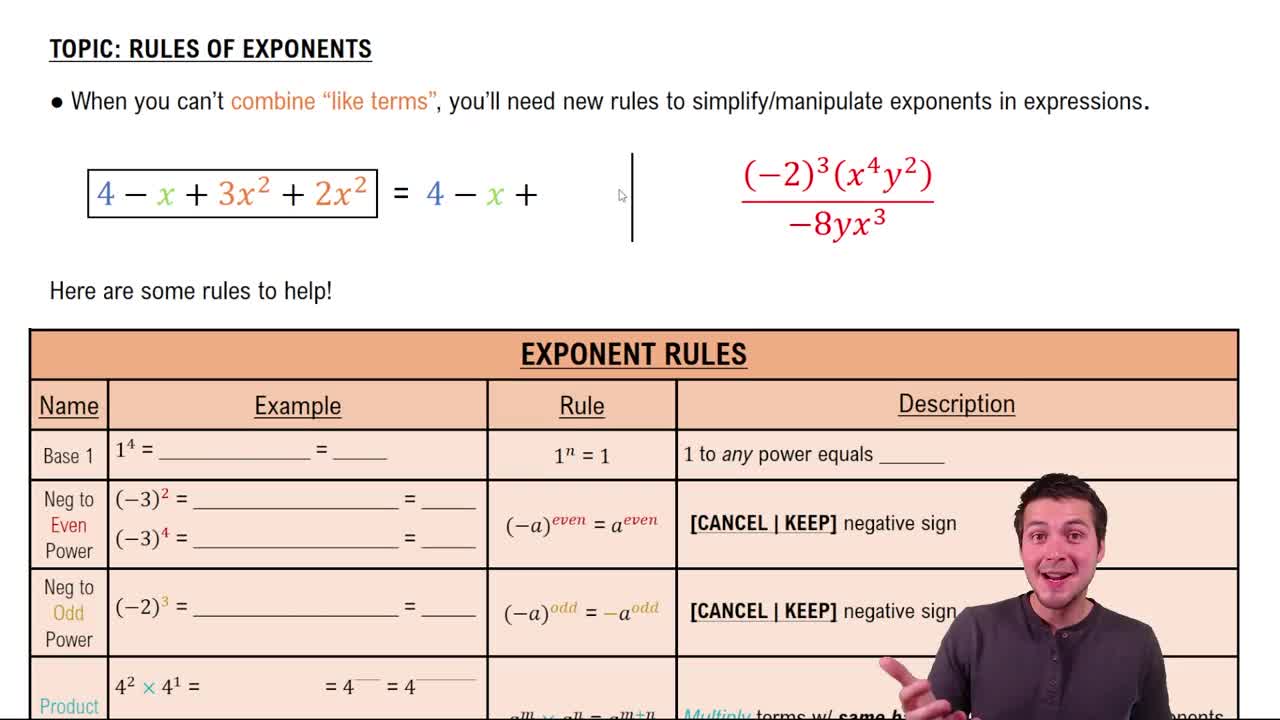
Negative Signs and Exponents

A negative sign in front of a base without parentheses is treated as multiplication by -1 after exponentiation. For example, -3^5 means -(3^5), not (-3)^5. Parentheses change this order, affecting the final result.
추천 영상:
7:39
Introduction to Exponent Rules