Ch. R - Review of Basic Concepts
Lial - College Algebra 13th Edition
Lial13th EditionCollege AlgebraISBN: 9780136881063당신이 사용하는 게 아니라요?교과서 변경
1장, 문제 79

Evaluate each expression. (-4)1/2

검증된 단계별 안내
1
Recognize that the expression \((-4)^{1/2}\) represents the square root of -4, since an exponent of \(\frac{1}{2}\) means taking the square root.
Recall that the square root of a negative number is not a real number, but an imaginary number involving \(i\), where \(i = \sqrt{-1}\).
Rewrite \((-4)^{1/2}\) as \(\sqrt{-4} = \sqrt{4 \times (-1)}\).
Use the property of square roots to separate the factors: \(\sqrt{4 \times (-1)} = \sqrt{4} \times \sqrt{-1}\).
Evaluate \(\sqrt{4} = 2\) and \(\sqrt{-1} = i\), so the expression simplifies to \$2i$.

비슷한 문제에 대한 검증된 영상 답변:

이 영상 해법은 위 문제에 도움이 된다고 튜터들이 추천한 것입니다.
영상 길이:
1m
도움이 되었나요?

주요 개념

질문에 올바르게 답하기 위해 반드시 이해해야 하는 핵심 개념들은 다음과 같습니다.

Rational Exponents

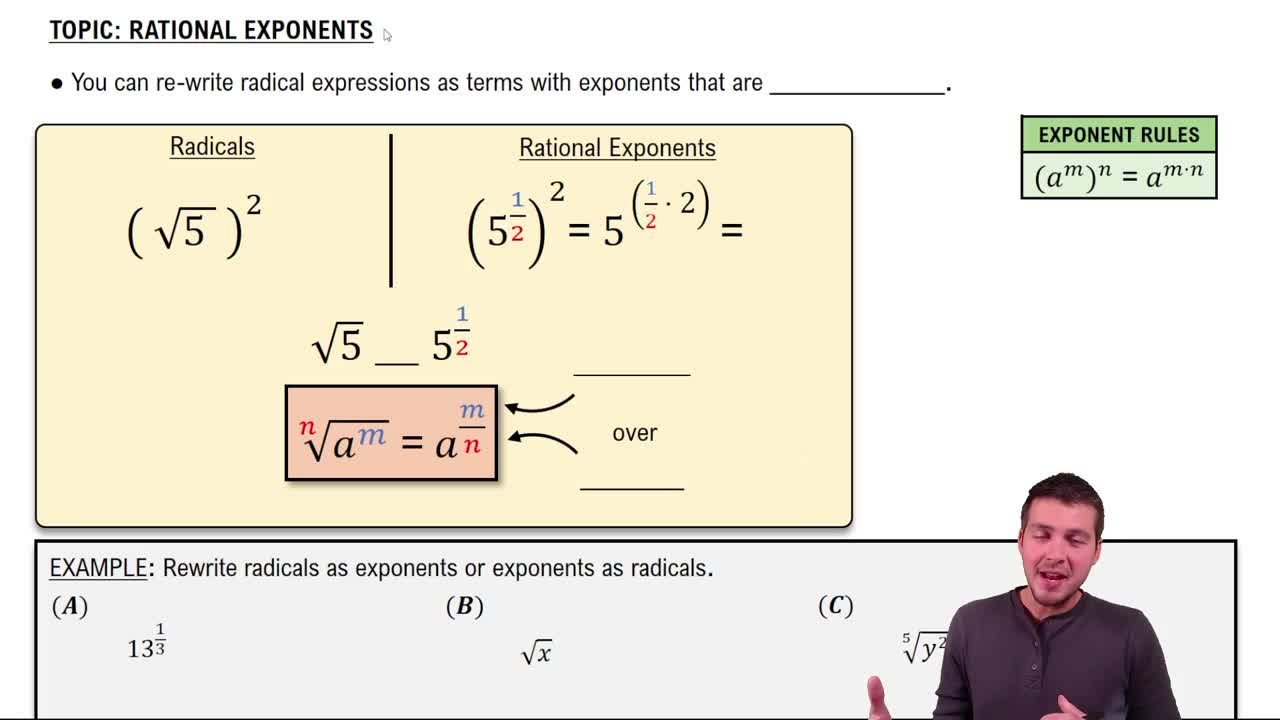
Rational exponents represent roots and powers simultaneously. For example, an exponent of 1/2 means the square root of the base. Understanding how to interpret and manipulate rational exponents is essential for evaluating expressions like (-4)^(1/2).
추천 영상:
04:06
Rational Exponents

Square Roots of Negative Numbers

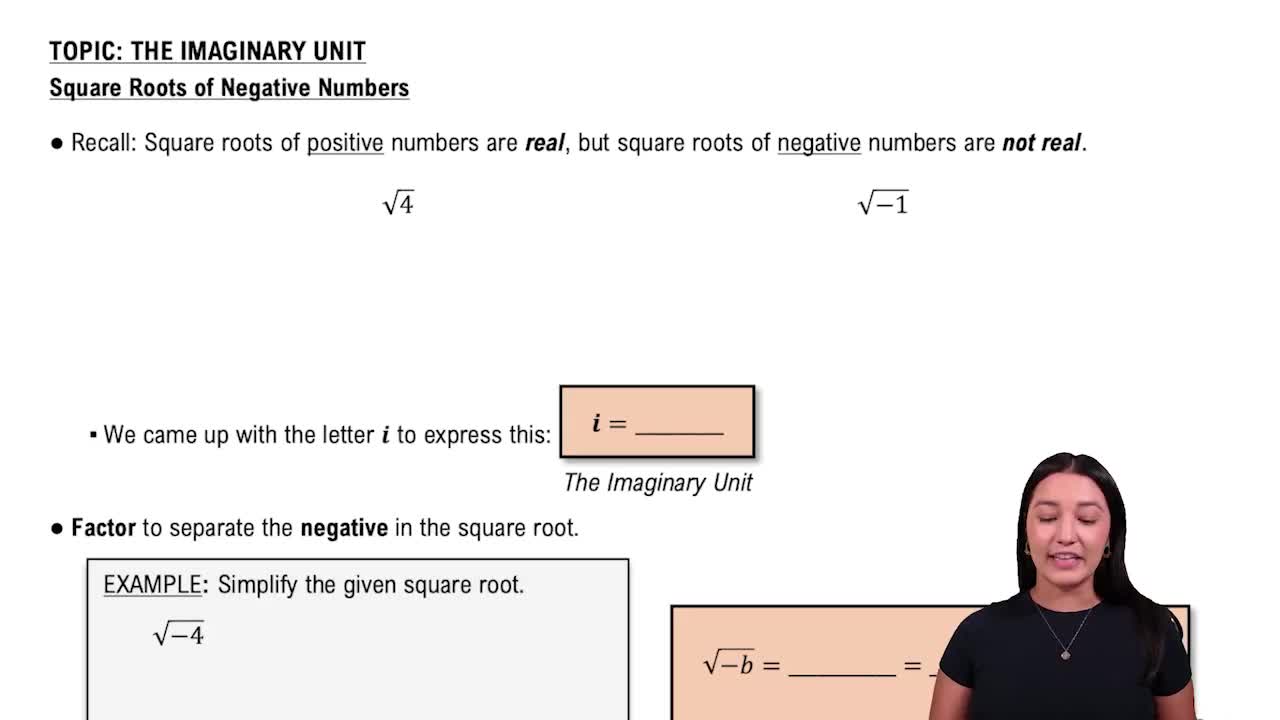
The square root of a negative number is not a real number but an imaginary number. Specifically, the square root of -1 is defined as i, the imaginary unit. This concept is crucial when evaluating expressions like (-4)^(1/2), which involves the square root of a negative number.
추천 영상:
05:02
Square Roots of Negative Numbers

Complex Numbers

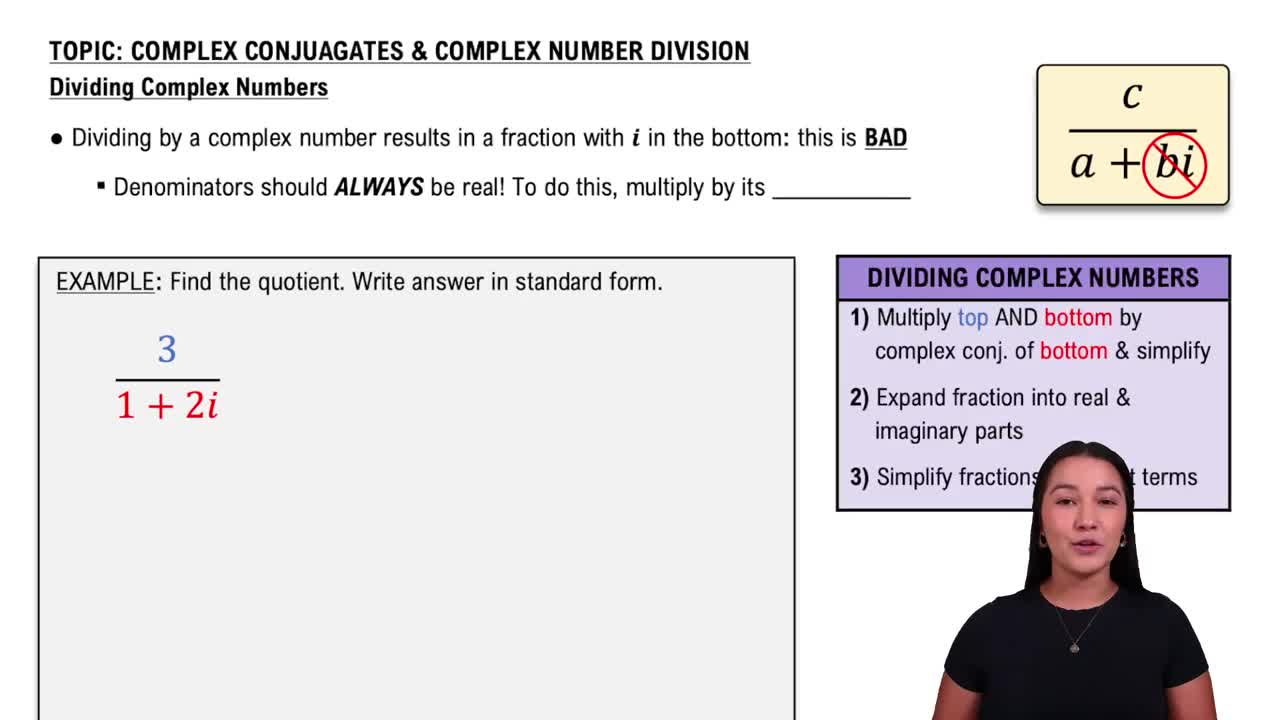
Complex numbers extend the real number system to include imaginary numbers, expressed as a + bi, where i is the imaginary unit. Understanding complex numbers allows one to work with and simplify expressions involving roots of negative numbers, such as (-4)^(1/2) = 2i.
추천 영상:
04:22
Dividing Complex Numbers