Ch. R - Review of Basic Concepts
Lial - College Algebra 13th Edition
Lial13th EditionCollege AlgebraISBN: 9780136881063당신이 사용하는 게 아니라요?교과서 변경
1장, 문제 88

Factor each polynomial. See Example 7. (x-4)3+64

검증된 단계별 안내
1
Recognize that the expression \( (x-4)^3 + 64 \) is a sum of cubes, since \(64\) can be written as \$4^3\(. So the expression is of the form \)a^3 + b^3\( where \)a = (x-4)\( and \)b = 4$.
Recall the sum of cubes factoring formula: \(a^3 + b^3 = (a + b)(a^2 - ab + b^2)\).
Apply the formula by substituting \(a = (x-4)\) and \(b = 4\) into the factors: first factor is \((x-4 + 4)\) and the second factor is \(( (x-4)^2 - (x-4)(4) + 4^2 )\).
Simplify the first factor: \((x-4 + 4)\) simplifies to \(x\). Then expand and simplify the second factor: expand \((x-4)^2\), multiply \((x-4)(4)\), and calculate \$4^2$.
Write the fully factored form as the product of the simplified first factor and the simplified second factor.

비슷한 문제에 대한 검증된 영상 답변:

이 영상 해법은 위 문제에 도움이 된다고 튜터들이 추천한 것입니다.
영상 길이:
3m
도움이 되었나요?

주요 개념

질문에 올바르게 답하기 위해 반드시 이해해야 하는 핵심 개념들은 다음과 같습니다.

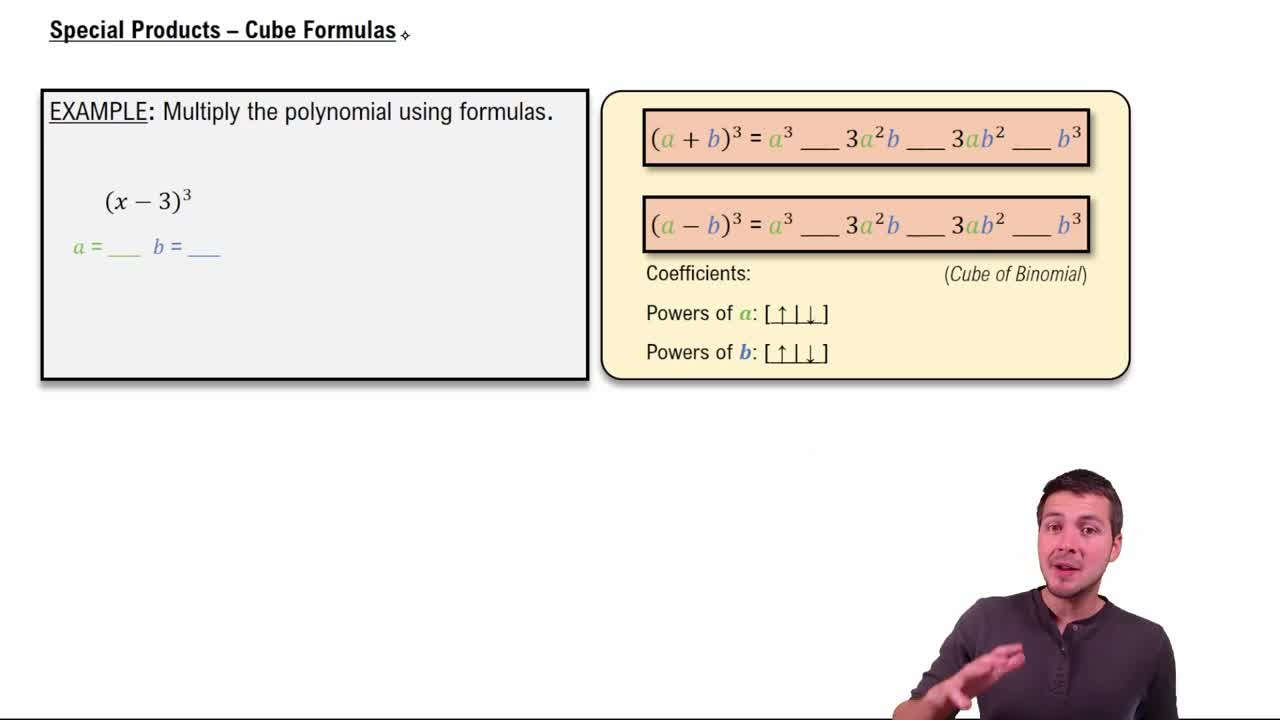
Sum of Cubes Formula

The sum of cubes formula states that a³ + b³ = (a + b)(a² - ab + b²). It is used to factor expressions where two terms are each perfect cubes added together. Recognizing (x - 4)³ + 64 as a sum of cubes allows us to apply this formula directly.
추천 영상:
03:41
Special Products - Cube Formulas

Identifying Perfect Cubes

A perfect cube is a number or expression raised to the third power, such as x³ or 64 (since 64 = 4³). Identifying each term as a perfect cube is essential before applying the sum or difference of cubes formulas in polynomial factoring.
추천 영상:
03:41
Special Products - Cube Formulas

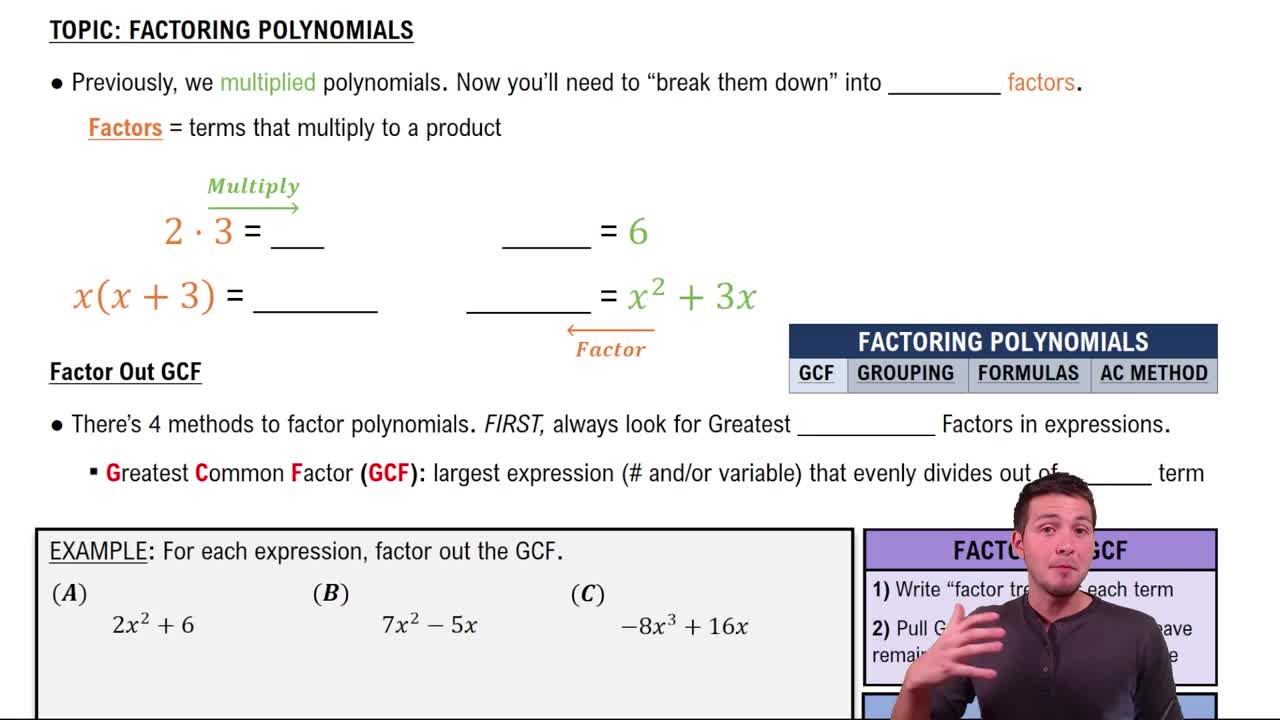
Polynomial Factoring Techniques

Factoring polynomials involves rewriting them as products of simpler polynomials. Techniques include recognizing special patterns like sum/difference of cubes, difference of squares, and factoring by grouping. Mastery of these methods simplifies solving polynomial equations.
추천 영상:
07:30
Introduction to Factoring Polynomials