Ch. R - Review of Basic Concepts
Lial - College Algebra 13th Edition
Lial13th EditionCollege AlgebraISBN: 9780136881063당신이 사용하는 게 아니라요?교과서 변경
1장, 문제 80

Factor each polynomial. See Examples 5 and 6. (b+3)3-27

검증된 단계별 안내
1
Recognize that the expression \( (b+3)^3 - 27 \) is a difference of cubes, since \(27\) can be written as \$3^3$.
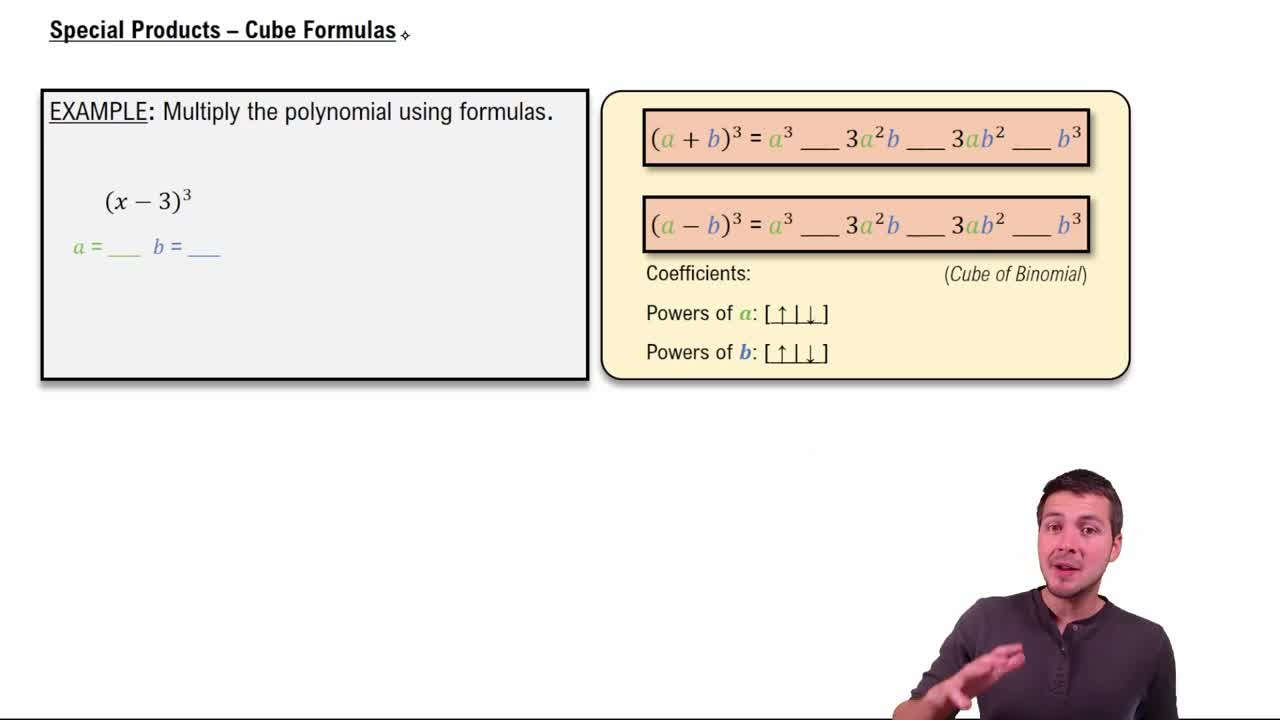
Recall the difference of cubes formula: \(a^3 - b^3 = (a - b)(a^2 + ab + b^2)\).
Identify \(a = (b+3)\) and \(b = 3\) in the expression \( (b+3)^3 - 3^3 \).
Apply the formula: write the factorization as \(((b+3) - 3)((b+3)^2 + (b+3)(3) + 3^2)\).
Simplify each factor: simplify \(((b+3) - 3)\) to \(b\), expand and simplify the quadratic expression inside the second factor.

비슷한 문제에 대한 검증된 영상 답변:

이 영상 해법은 위 문제에 도움이 된다고 튜터들이 추천한 것입니다.
영상 길이:
4m
도움이 되었나요?

주요 개념

질문에 올바르게 답하기 위해 반드시 이해해야 하는 핵심 개념들은 다음과 같습니다.

Difference of Cubes

The difference of cubes formula states that a³ - b³ = (a - b)(a² + ab + b²). It is used to factor expressions where two perfect cubes are subtracted. Recognizing the structure allows for straightforward factoring of cubic expressions.
추천 영상:
03:41
Special Products - Cube Formulas

Identifying Perfect Cubes

To apply the difference of cubes formula, each term must be a perfect cube. This involves recognizing expressions like (b+3)³ and 27, since 27 = 3³. Understanding how to rewrite terms as cubes is essential for correct factoring.
추천 영상:
03:41
Special Products - Cube Formulas

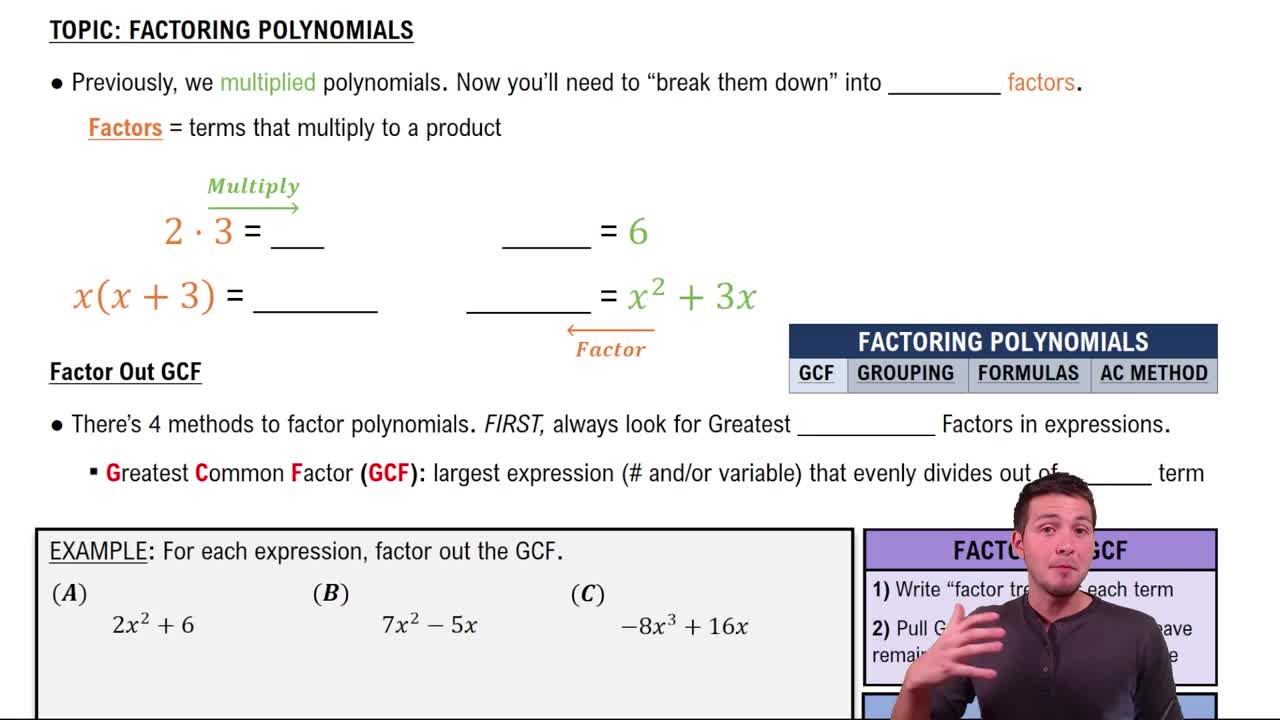
Polynomial Factoring Techniques

Factoring polynomials involves breaking down expressions into simpler factors. Techniques include factoring out common terms, grouping, and special formulas like difference of cubes. Mastery of these methods helps simplify and solve polynomial equations.
추천 영상:
07:30
Introduction to Factoring Polynomials