Ch. R - Review of Basic Concepts
Lial - College Algebra 13th Edition
Lial13th EditionCollege AlgebraISBN: 9780136881063당신이 사용하는 게 아니라요?교과서 변경
1장, 문제 53

Factor each trinomial, if possible. See Examples 3 and 4. 32a2+48ab+18b232a^2+48ab+18b^2

검증된 단계별 안내
1
Identify the trinomial to factor: \(32a^2 + 48ab + 18b^2\).
Look for the greatest common factor (GCF) of all terms. The GCF of 32, 48, and 18 is 2, so factor out 2: \(2(16a^2 + 24ab + 9b^2)\).
Focus on factoring the quadratic trinomial inside the parentheses: \(16a^2 + 24ab + 9b^2\).
Use the method of factoring trinomials where the first term is a perfect square (\(16a^2 = (4a)^2\)) and the last term is a perfect square (\(9b^2 = (3b)^2\)). Check if the middle term \$24ab\( equals \)2 imes 4a imes 3b$.
Since \(24ab = 2 imes 4a imes 3b\), the trinomial inside the parentheses factors as a perfect square: \((4a + 3b)^2\). Therefore, the full factorization is \(2(4a + 3b)^2\).

비슷한 문제에 대한 검증된 영상 답변:

이 영상 해법은 위 문제에 도움이 된다고 튜터들이 추천한 것입니다.
영상 길이:
4m
도움이 되었나요?

주요 개념

질문에 올바르게 답하기 위해 반드시 이해해야 하는 핵심 개념들은 다음과 같습니다.

Factoring Trinomials

Factoring trinomials involves expressing a quadratic expression with three terms as a product of two binomials. This process often requires finding two numbers that multiply to the product of the leading coefficient and the constant term, and add to the middle coefficient.
추천 영상:
6:29
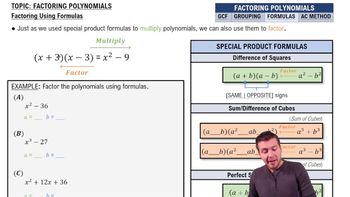
Factor Using Special Product Formulas

Greatest Common Factor (GCF)

The Greatest Common Factor is the largest expression that divides all terms of a polynomial. Factoring out the GCF simplifies the trinomial, making it easier to factor further or identify special products.
추천 영상:
5:57
Graphs of Common Functions

Multiplying and Adding to Factor

When factoring trinomials with a leading coefficient other than 1, you multiply the first and last coefficients, then find two numbers that multiply to this product and add to the middle coefficient. These numbers help split the middle term for factoring by grouping.
추천 영상:
04:15
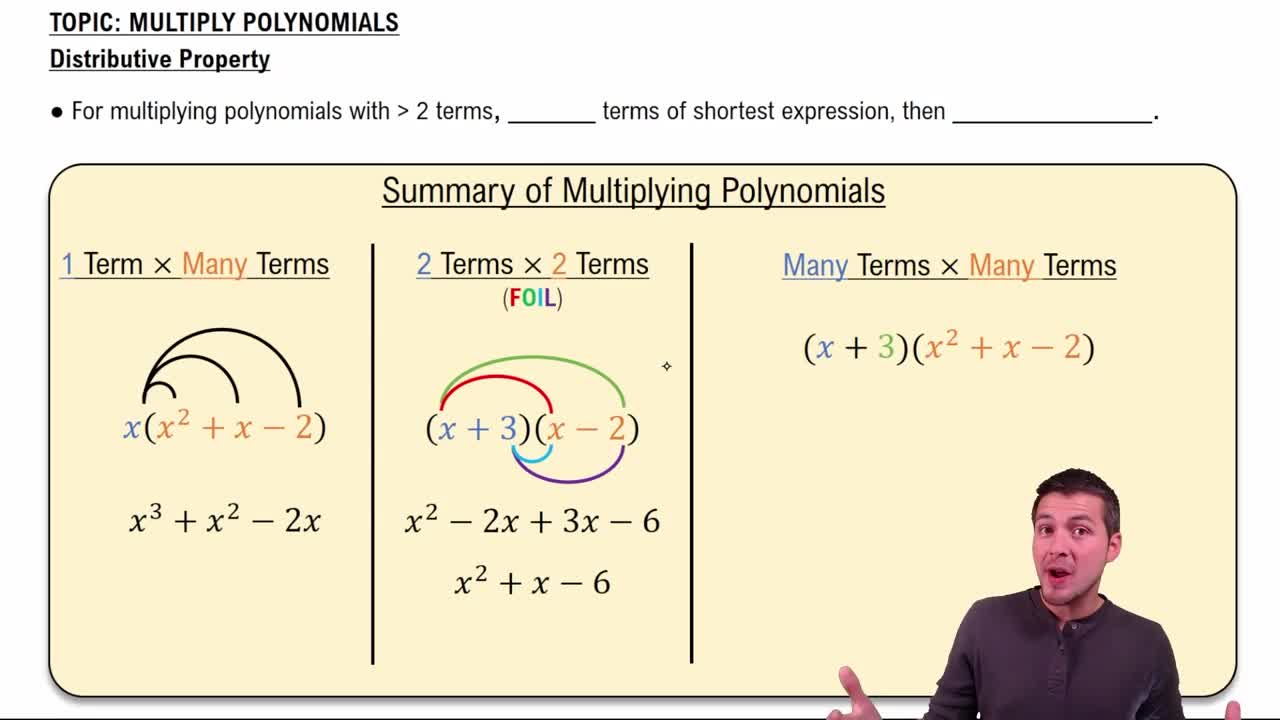
Multiply Polynomials Using the Distributive Property