Ch. R - Review of Basic Concepts
Lial - College Algebra 13th Edition
Lial13th EditionCollege AlgebraISBN: 9780136881063당신이 사용하는 게 아니라요?교과서 변경
1장, 문제 21

Factor out the greatest common factor from each polynomial. See Example 1. 2(a+b)+4m(a+b)

검증된 단계별 안내
1
Identify the terms in the expression: \(2(a+b)\) and \(4m(a+b)\).
Look for the greatest common factor (GCF) shared by both terms. Notice that both terms contain the binomial factor \((a+b)\).
Also, consider the numerical coefficients: 2 and 4. The GCF of 2 and 4 is 2.
Combine the GCF of the coefficients and the common binomial factor to get the overall GCF: \(2(a+b)\).
Factor out \(2(a+b)\) from each term, rewriting the expression as \(2(a+b)(1 + 2m)\).

비슷한 문제에 대한 검증된 영상 답변:

이 영상 해법은 위 문제에 도움이 된다고 튜터들이 추천한 것입니다.
영상 길이:
2m
도움이 되었나요?

주요 개념

질문에 올바르게 답하기 위해 반드시 이해해야 하는 핵심 개념들은 다음과 같습니다.

Greatest Common Factor (GCF)

The Greatest Common Factor is the largest expression that divides each term of a polynomial without leaving a remainder. Identifying the GCF helps simplify polynomials by factoring out common numerical coefficients and variable expressions shared by all terms.
추천 영상:
5:57
Graphs of Common Functions

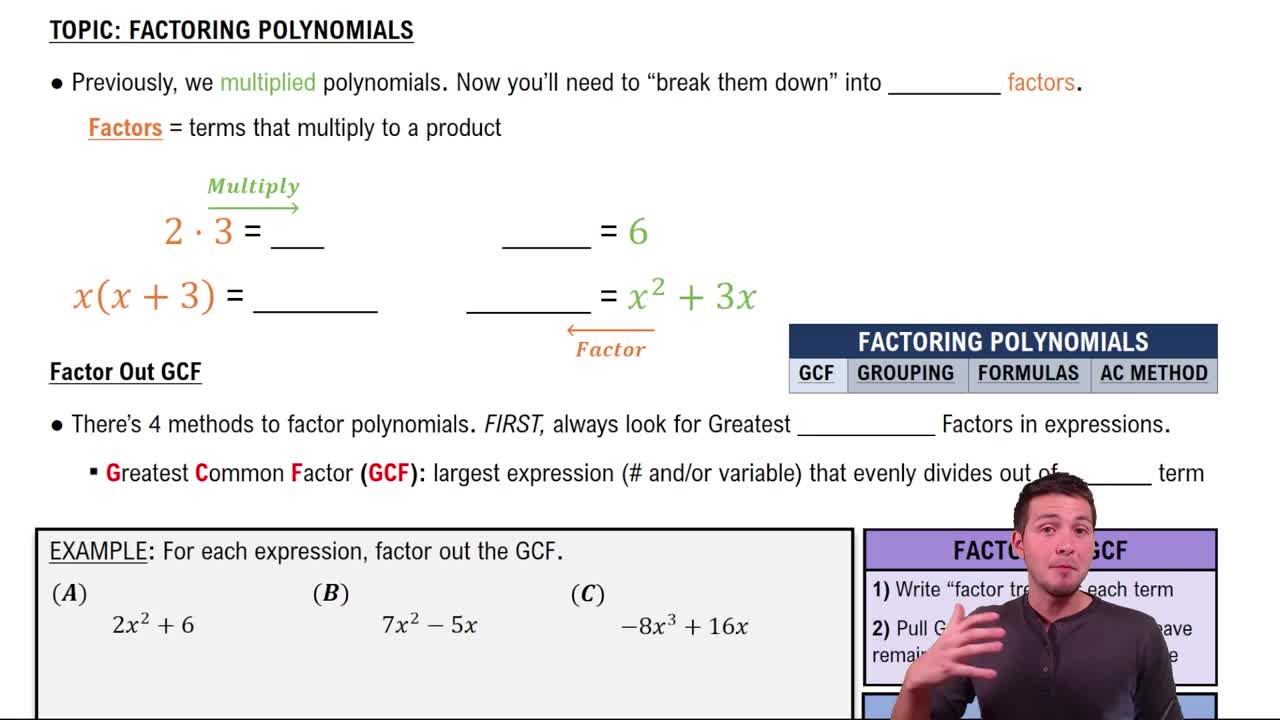
Factoring Polynomials

Factoring polynomials involves rewriting a polynomial as a product of its factors. This process simplifies expressions and solves equations by breaking down complex polynomials into simpler multiplicative components.
추천 영상:
가이드 코스
07:30
Introduction to Factoring Polynomials

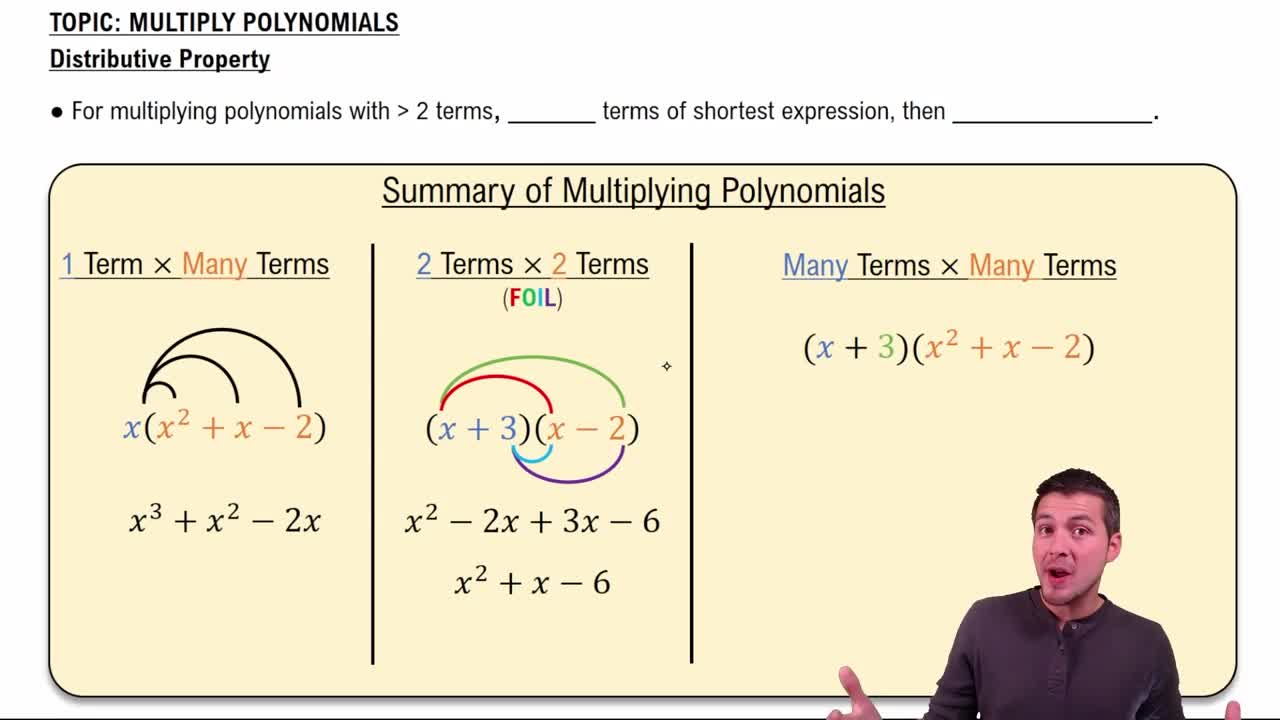
Distributive Property

The distributive property states that a(b + c) = ab + ac. It is used in reverse during factoring to extract the common factor from terms, transforming a sum into a product, which is essential for factoring out the GCF.
추천 영상:
가이드 코스
04:15
Multiply Polynomials Using the Distributive Property