Ch. R - Review of Basic Concepts
Lial - College Algebra 13th Edition
Lial13th EditionCollege AlgebraISBN: 9780136881063당신이 사용하는 게 아니라요?교과서 변경
1장, 문제 45

Find each sum or difference. 9/10 - (-4/3)

검증된 단계별 안내
1
Identify the problem as a subtraction of two fractions: \(\frac{9}{10} - \left(-\frac{4}{3}\right)\).
Recognize that subtracting a negative fraction is equivalent to adding its positive counterpart, so rewrite the expression as \(\frac{9}{10} + \frac{4}{3}\).
Find the least common denominator (LCD) of the two fractions. The denominators are 10 and 3, so the LCD is the least common multiple of 10 and 3.
Convert each fraction to an equivalent fraction with the LCD as the denominator by multiplying numerator and denominator appropriately.
Add the numerators of the equivalent fractions and write the sum over the common denominator: \(\frac{\text{new numerator}}{\text{LCD}}\).

비슷한 문제에 대한 검증된 영상 답변:

이 영상 해법은 위 문제에 도움이 된다고 튜터들이 추천한 것입니다.
영상 길이:
2m
도움이 되었나요?

주요 개념

질문에 올바르게 답하기 위해 반드시 이해해야 하는 핵심 개념들은 다음과 같습니다.

Adding and Subtracting Fractions

To add or subtract fractions, they must have a common denominator. This allows you to combine the numerators directly while keeping the denominator the same. If denominators differ, find the least common denominator (LCD) first.
추천 영상:
5:56
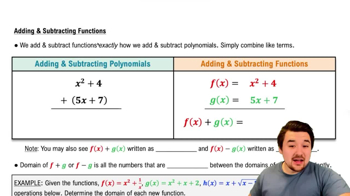
Adding & Subtracting Functions

Subtracting Negative Numbers

Subtracting a negative number is equivalent to adding its positive counterpart. For example, a - (-b) becomes a + b. This rule simplifies expressions and helps avoid sign errors.
추천 영상:
03:18
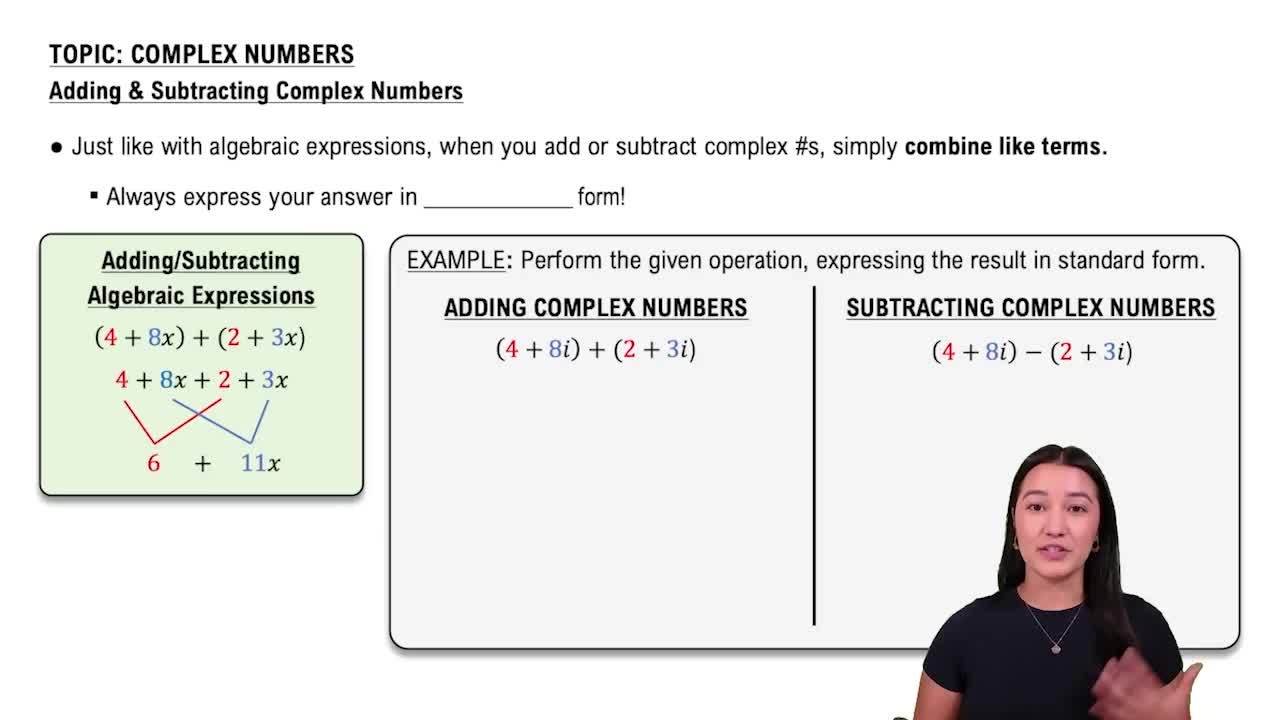
Adding and Subtracting Complex Numbers

Finding the Least Common Denominator (LCD)

The LCD is the smallest number that both denominators divide into evenly. It is used to rewrite fractions with different denominators into equivalent fractions with the same denominator, enabling addition or subtraction.
추천 영상:
가이드 코스
03:42
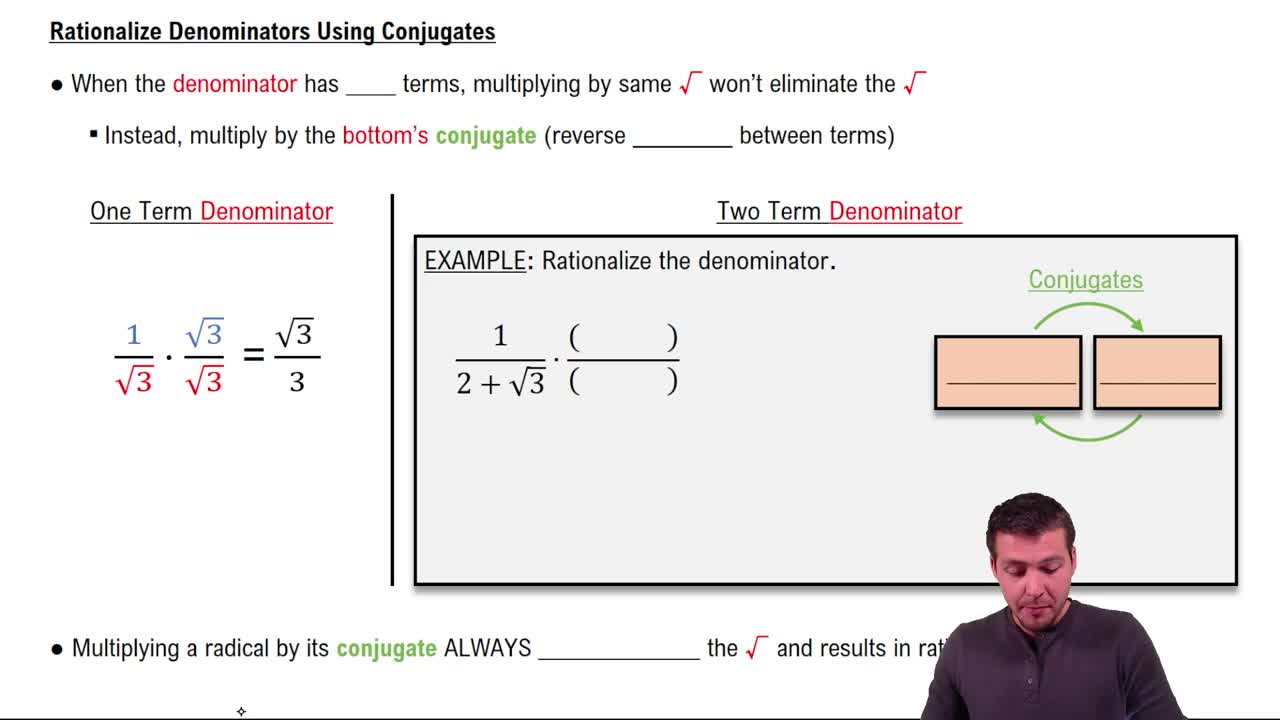
Rationalizing Denominators Using Conjugates