Ch. R - Review of Basic Concepts
Lial - College Algebra 13th Edition
Lial13th EditionCollege AlgebraISBN: 9780136881063당신이 사용하는 게 아니라요?교과서 변경
1장, 문제 35

Match each expression in Column I with its equivalent expression in Column II. Choices may be used once, more than once, or not at all.

검증된 단계별 안내
1
Recall the zero exponent rule: For any nonzero number \(a\), \(a^0 = 1\). This will help evaluate expressions like \$6^0\(, \)(-6)^0$, etc.
Evaluate each expression in Column I using the zero exponent rule and paying attention to the placement of the negative sign:
a. \$6^0$: Since 6 is nonzero, \(6^0 = 1\).
b. \(-6^0\): Here, the exponent applies only to 6, so \(6^0 = 1\), then apply the negative sign outside, so \(-6^0 = -1\).
c. \((-6)^0\): The entire quantity \(-6\) is raised to the zero power, so \((-6)^0 = 1\).
d. \(-(-6)^0\): First evaluate \((-6)^0 = 1\), then apply the negative sign outside, so \(-(-6)^0 = -1\).
Match each evaluated result with the options in Column II: 0, 1, -1, 6, -6.

비슷한 문제에 대한 검증된 영상 답변:

이 영상 해법은 위 문제에 도움이 된다고 튜터들이 추천한 것입니다.
영상 길이:
36s
도움이 되었나요?

주요 개념

질문에 올바르게 답하기 위해 반드시 이해해야 하는 핵심 개념들은 다음과 같습니다.

Zero Exponent Rule

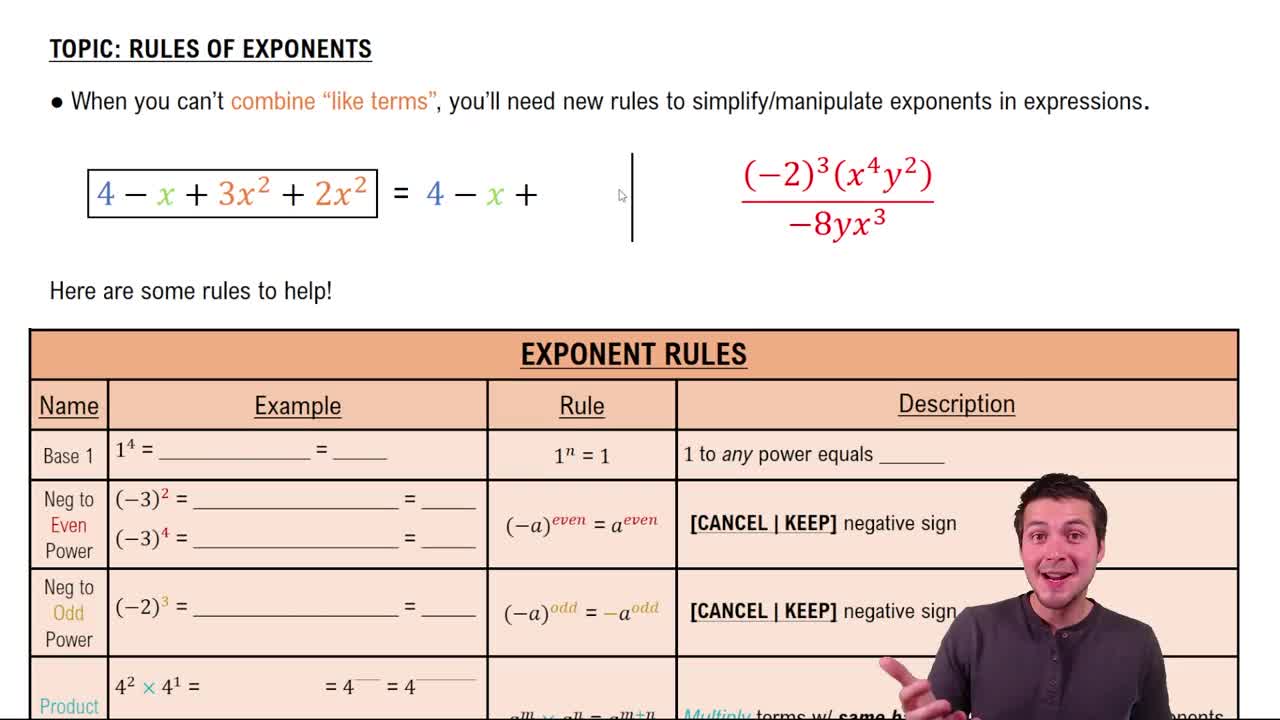
Any nonzero base raised to the zero power equals 1. For example, 6^0 = 1 and (-6)^0 = 1. This rule is fundamental for simplifying expressions involving exponents.
추천 영상:
가이드 코스
7:39
Introduction to Exponent Rules

Order of Operations with Exponents and Negatives

When evaluating expressions like -6^0, the exponent applies before the negative sign. So, 6^0 is evaluated first (which is 1), then the negative sign is applied, resulting in -1.
추천 영상:
가이드 코스
7:39
Introduction to Exponent Rules

Parentheses Affecting Exponentiation

Parentheses change the base of the exponent. For example, (-6)^0 means the entire -6 is raised to zero, giving 1, while -6^0 means the negative of 6^0, which is -1. Understanding this distinction is key.
추천 영상:
6:13
Exponential Functions