Simplify each rational expression. Assume all variable expressions represent positive real numbers. (Hint: Use factoring and divide out any common factors as a first step.) [2(2x-3)1/3 - (x-1)(2x-3)-2/3] / [(2x-2)-2/3]
Ch. R - Review of Basic Concepts

1장, 문제 100
Perform each division. See Examples 9 and 10.
검증된 단계별 안내1
Identify the given expression to divide: \(\frac{3x^3 - 2x + 5}{x - 3}\). This is a polynomial division problem where the numerator is a cubic polynomial and the denominator is a linear polynomial.
Set up the polynomial long division by writing \(3x^3 - 2x + 5\) (the dividend) under the division bar and \(x - 3\) (the divisor) outside the division bar.
Divide the leading term of the dividend, \$3x^3\(, by the leading term of the divisor, \)x\(, to find the first term of the quotient. This gives \)3x^2$.
Multiply the entire divisor \(x - 3\) by this term \$3x^2$ and subtract the result from the dividend. Then bring down the next terms to form a new polynomial.
Repeat the process: divide the leading term of the new polynomial by \(x\), multiply the divisor by this result, subtract, and continue until the degree of the remainder is less than the degree of the divisor.

비슷한 문제에 대한 검증된 영상 답변:
이 영상 해법은 위 문제에 도움이 된다고 튜터들이 추천한 것입니다.
영상 길이:
5m도움이 되었나요?
주요 개념
질문에 올바르게 답하기 위해 반드시 이해해야 하는 핵심 개념들은 다음과 같습니다.
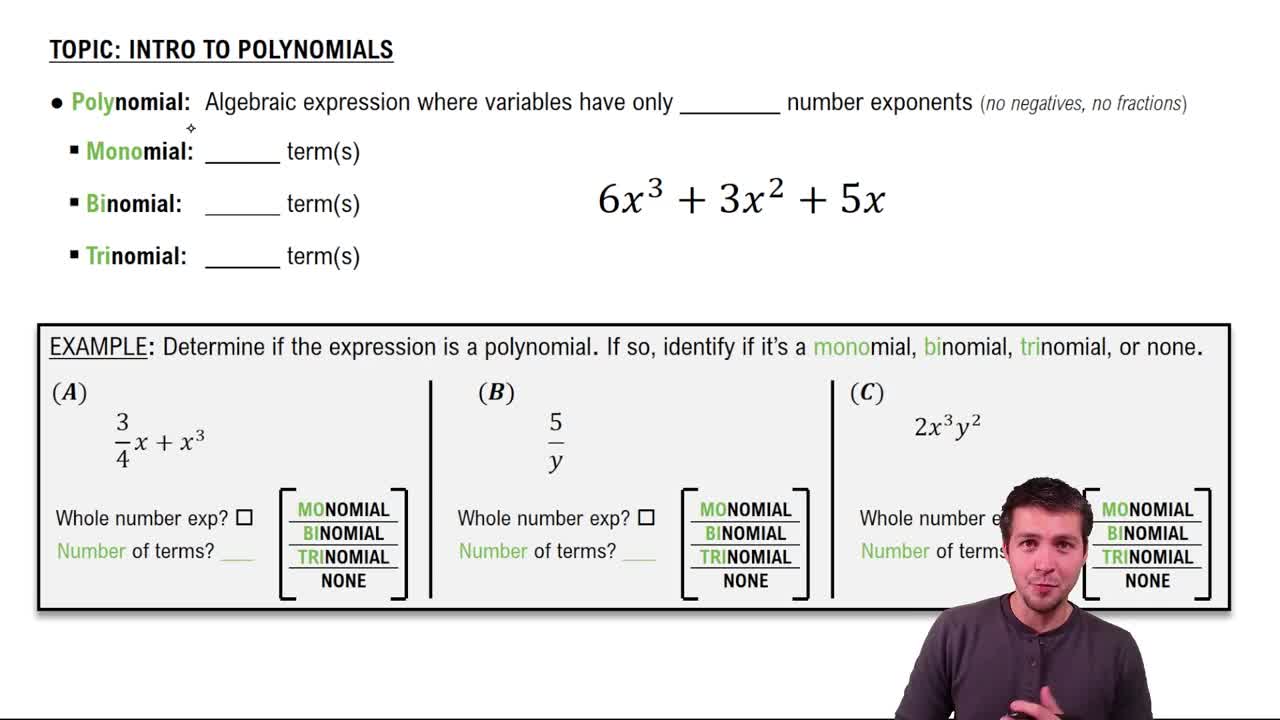
Polynomial Long Division
Polynomial long division is a method used to divide a polynomial by another polynomial of lower degree, similar to numerical long division. It involves dividing the leading term of the dividend by the leading term of the divisor, multiplying, subtracting, and repeating until the remainder has a lower degree than the divisor.
추천 영상:
Introduction to Polynomials
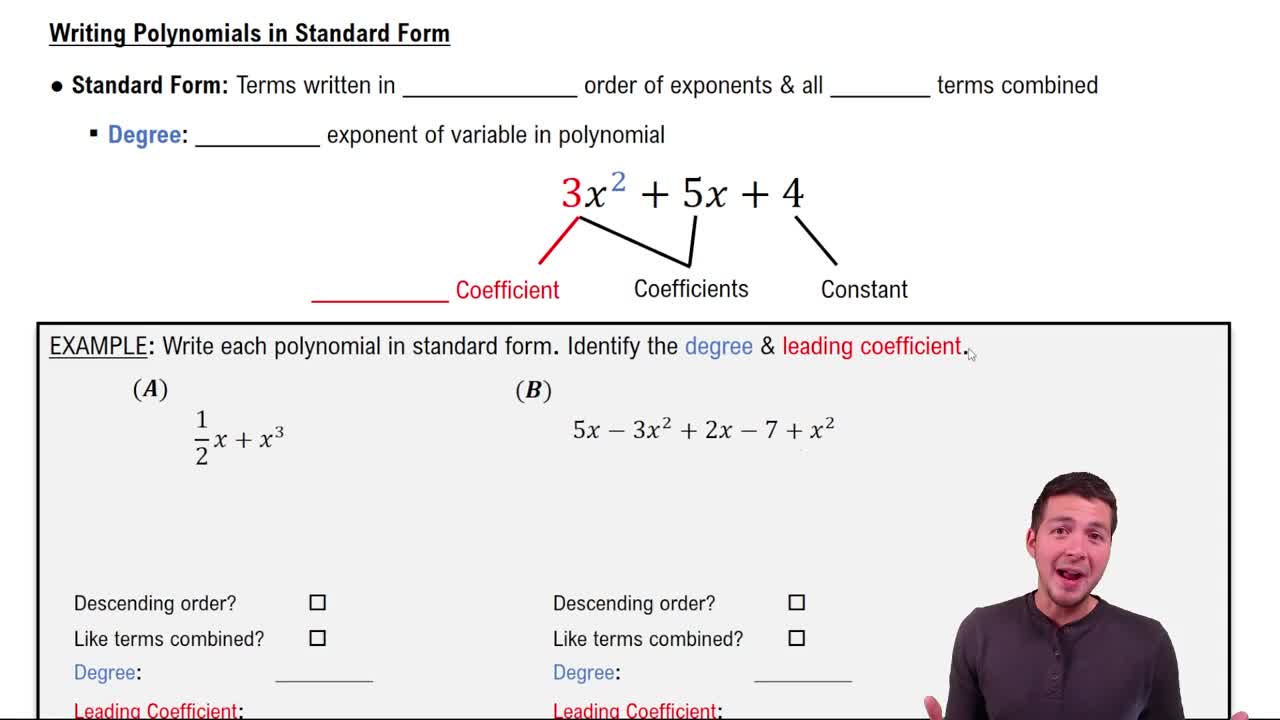
Degree of a Polynomial
The degree of a polynomial is the highest power of the variable in the expression. Understanding the degree helps determine the steps in division and when to stop, as the division process continues until the remainder's degree is less than the divisor's degree.
추천 영상:
Standard Form of Polynomials
Remainder and Quotient in Polynomial Division
When dividing polynomials, the result consists of a quotient and possibly a remainder. The quotient is the polynomial obtained from the division, and the remainder is what is left over, having a degree less than the divisor. The original expression can be written as divisor × quotient + remainder.
추천 영상:
Introduction to Polynomials
관련 실천
교과서 질문
640
views
교과서 질문
Add or subtract as indicated. 3.87 + 15 + 2.9
1000
views
교과서 질문
Let U = {0, 1, 2, 3, 4, 5, 6, 7, 8, 9, 10, 11, 12, 13}, M = {0, 2, 4, 6, 8}, N = {1, 3, 5, 7, 9, 11, 13}, Q = {0, 2, 4, 6, 8, 10, 12}, and R = {0, 1, 2, 3, 4}.Use these sets to find each of the following. Identify any disjoint sets. (R ∪ N) ∩ M′
970
views
교과서 질문
Add or subtract as indicated. 32.56 + 47.356 + 1.8
1013
views
교과서 질문
Simplify each expression. Write answers without negative exponents. Assume all variables represent positive real numbers. (x2/3)2/(x2)7/3
680
views
교과서 질문
Perform the indicated operations. Assume all variables represent positive real numbers. ∜32 + 3∜2
882
views