Ch. R - Review of Basic Concepts
Lial - College Algebra 13th Edition
Lial13th EditionCollege AlgebraISBN: 9780136881063당신이 사용하는 게 아니라요?교과서 변경
1장, 문제 117

Perform the indicated operations. Assume all variables represent positive real numbers. 4√3(√7 - 2√11)

검증된 단계별 안내
1
Identify the expression to simplify: \(4\sqrt{3}(\sqrt{7} - 2\sqrt{11})\).
Apply the distributive property (also known as the distributive law of multiplication over subtraction) to multiply \(4\sqrt{3}\) by each term inside the parentheses separately: \(4\sqrt{3} \times \sqrt{7}\) and \(4\sqrt{3} \times (-2\sqrt{11})\).
Multiply the coefficients (numbers outside the radicals) together: for the first term, multiply 4 by 1 (since \(\sqrt{7}\) has an implied coefficient of 1), and for the second term, multiply 4 by -2.
Multiply the radicals by using the property \(\sqrt{a} \times \sqrt{b} = \sqrt{a \times b}\): for the first term, calculate \(\sqrt{3} \times \sqrt{7} = \sqrt{21}\), and for the second term, calculate \(\sqrt{3} \times \sqrt{11} = \sqrt{33}\).
Combine the results from the previous steps to write the expression as \(4\sqrt{21} - 8\sqrt{33}\).

비슷한 문제에 대한 검증된 영상 답변:

이 영상 해법은 위 문제에 도움이 된다고 튜터들이 추천한 것입니다.
영상 길이:
1m
도움이 되었나요?

주요 개념

질문에 올바르게 답하기 위해 반드시 이해해야 하는 핵심 개념들은 다음과 같습니다.

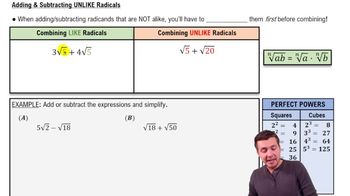
Simplifying Radicals

Simplifying radicals involves expressing square roots in their simplest form by factoring out perfect squares. For example, √12 can be simplified to 2√3 because 12 = 4 × 3 and √4 = 2. This process helps in making multiplication and addition of radicals easier.
추천 영상:
5:48
Adding & Subtracting Unlike Radicals by Simplifying

Distributive Property

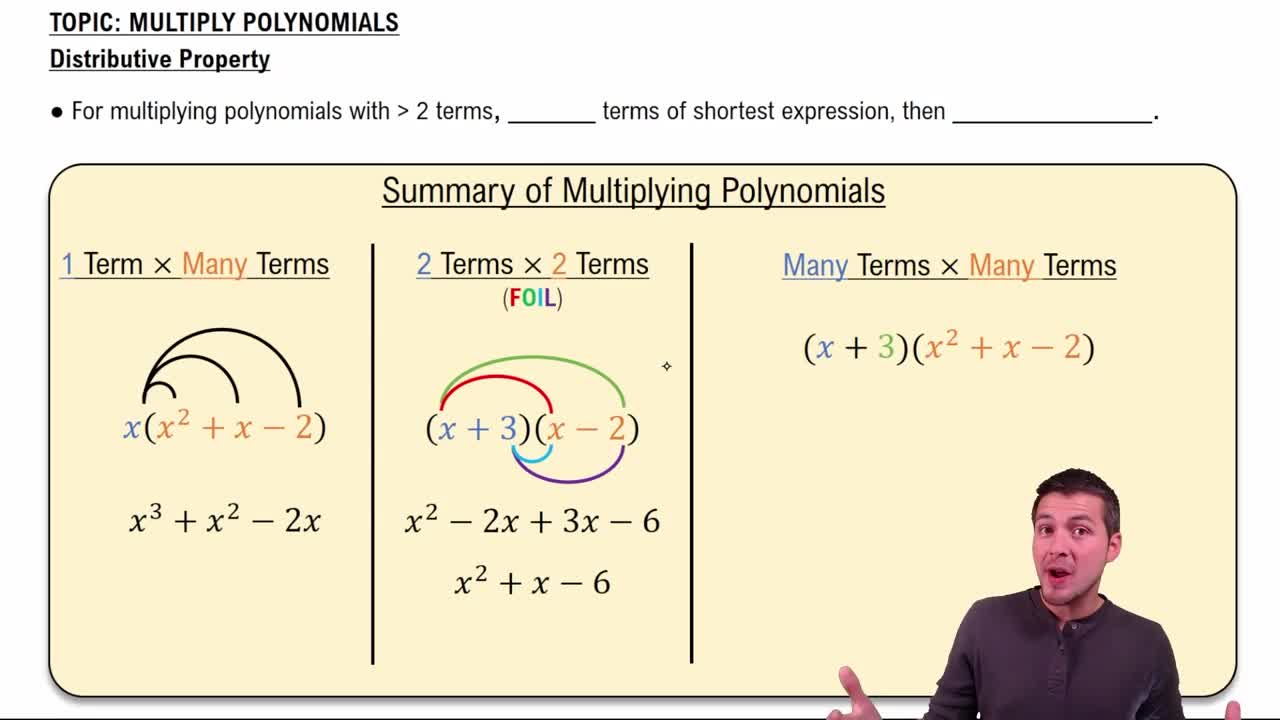
The distributive property states that a(b + c) = ab + ac. It allows you to multiply a single term by each term inside a parenthesis separately. In this problem, 4√3 is multiplied by both √7 and -2√11 individually before combining the results.
추천 영상:
04:15
Multiply Polynomials Using the Distributive Property

Multiplying Radicals

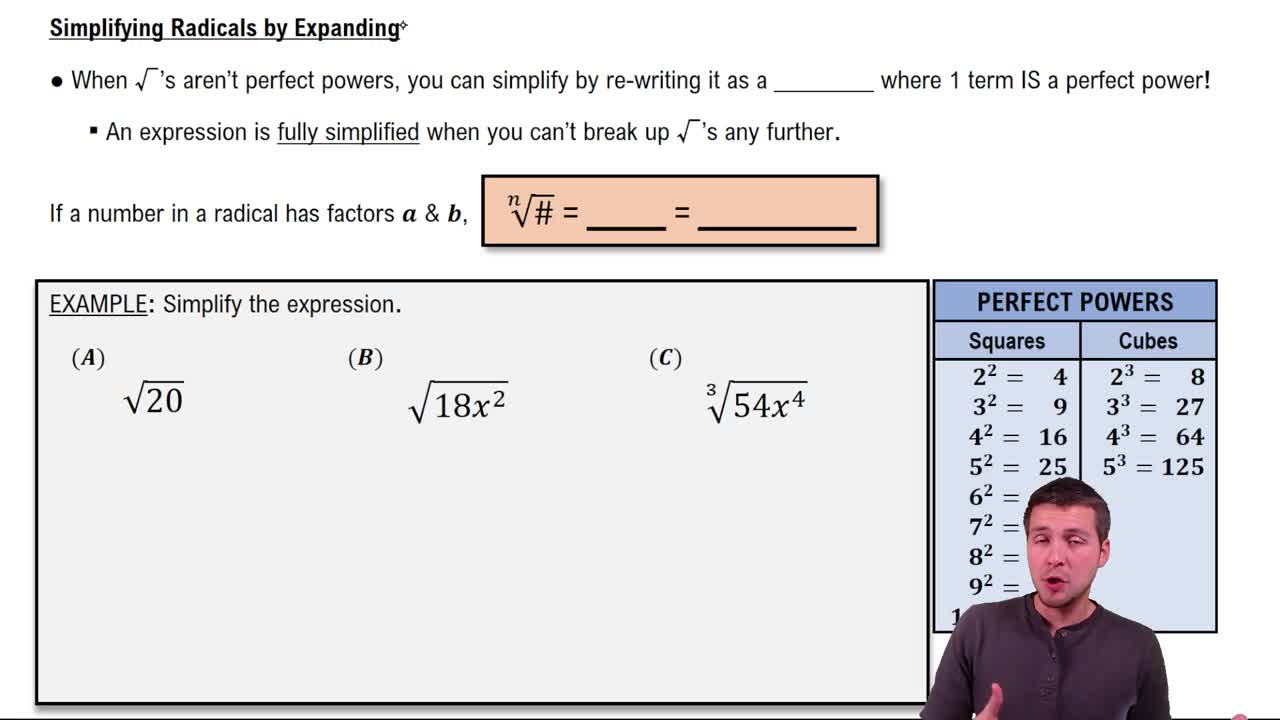
When multiplying radicals with the same index, multiply the numbers inside the radicals together under a single radical. For example, √a × √b = √(ab). This rule is used to multiply 4√3 by √7 and by 2√11 by combining the radicands before simplifying.
추천 영상:
05:20
Expanding Radicals