Let U = {0, 1, 2, 3, 4, 5, 6, 7, 8, 9, 10, 11, 12, 13}, M = {0, 2, 4, 6, 8}, N = {1, 3, 5, 7, 9, 11, 13}, Q = {0, 2, 4, 6, 8, 10, 12}, and R = {0, 1, 2, 3, 4}.Use these sets to find each of the following. Identify any disjoint sets. {x | x ∈ M and x ∈ Q}
Ch. R - Review of Basic Concepts

1장, 문제 107
Perform the indicated operations. Assume all variables represent positive real numbers.
검증된 단계별 안내1
Rewrite the given expression by expressing the radicals with fractional exponents. Recall that the fourth root of a variable is the variable raised to the power of \( \frac{1}{4} \). So, \( \sqrt[4]{x} = x^{\frac{1}{4}} \) and \( \sqrt[4]{xy} = (xy)^{\frac{1}{4}} \).
Express each term using fractional exponents:
First term: \( 3 \sqrt[4]{x^{5} y} = 3 (x^{5} y)^{\frac{1}{4}} = 3 x^{\frac{5}{4}} y^{\frac{1}{4}} \)
Second term: \( 2 x \sqrt[4]{x y} = 2 x (x y)^{\frac{1}{4}} = 2 x \cdot x^{\frac{1}{4}} y^{\frac{1}{4}} = 2 x^{1 + \frac{1}{4}} y^{\frac{1}{4}} = 2 x^{\frac{5}{4}} y^{\frac{1}{4}} \).
Now, rewrite the expression as:
\( 3 x^{\frac{5}{4}} y^{\frac{1}{4}} - 2 x^{\frac{5}{4}} y^{\frac{1}{4}} \).
Since both terms have the same variables with the same exponents, factor out the common term \( x^{\frac{5}{4}} y^{\frac{1}{4}} \):
\( (3 - 2) x^{\frac{5}{4}} y^{\frac{1}{4}} \).
Simplify the coefficients inside the parentheses to get the simplified expression in terms of fractional exponents or, if preferred, rewrite back to radical form.

비슷한 문제에 대한 검증된 영상 답변:
이 영상 해법은 위 문제에 도움이 된다고 튜터들이 추천한 것입니다.
영상 길이:
4m도움이 되었나요?
주요 개념
질문에 올바르게 답하기 위해 반드시 이해해야 하는 핵심 개념들은 다음과 같습니다.
Radical Expressions and Roots
Radical expressions involve roots such as square roots, cube roots, and fourth roots. Understanding how to interpret and simplify expressions with radicals, like the fourth root (∜), is essential. For example, ∜x means the fourth root of x, which is x raised to the power of 1/4.
추천 영상:
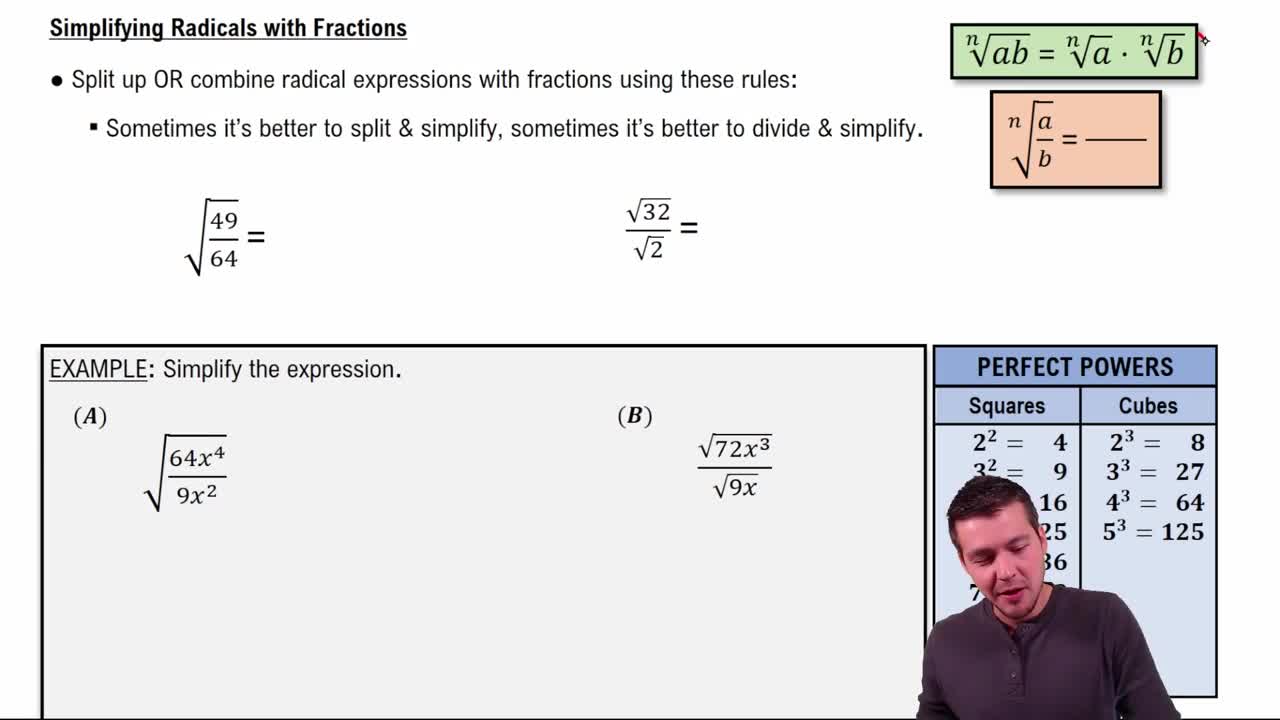
Radical Expressions with Fractions
Properties of Exponents
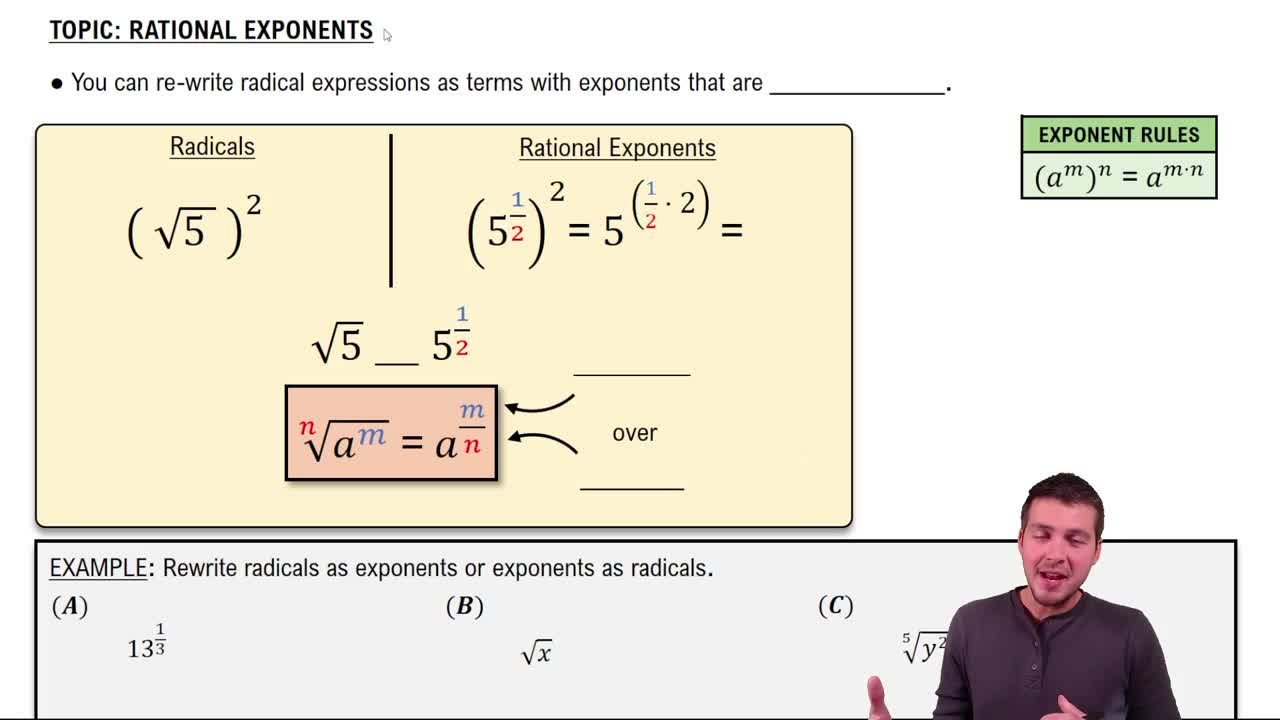
Exponents rules allow us to simplify expressions involving powers and roots by rewriting radicals as fractional exponents. For instance, ∜x⁵ can be written as x^(5/4). Knowing how to add, subtract, multiply, and divide expressions with exponents is key to combining like terms.
추천 영상:
Rational Exponents
Combining Like Terms with Radicals
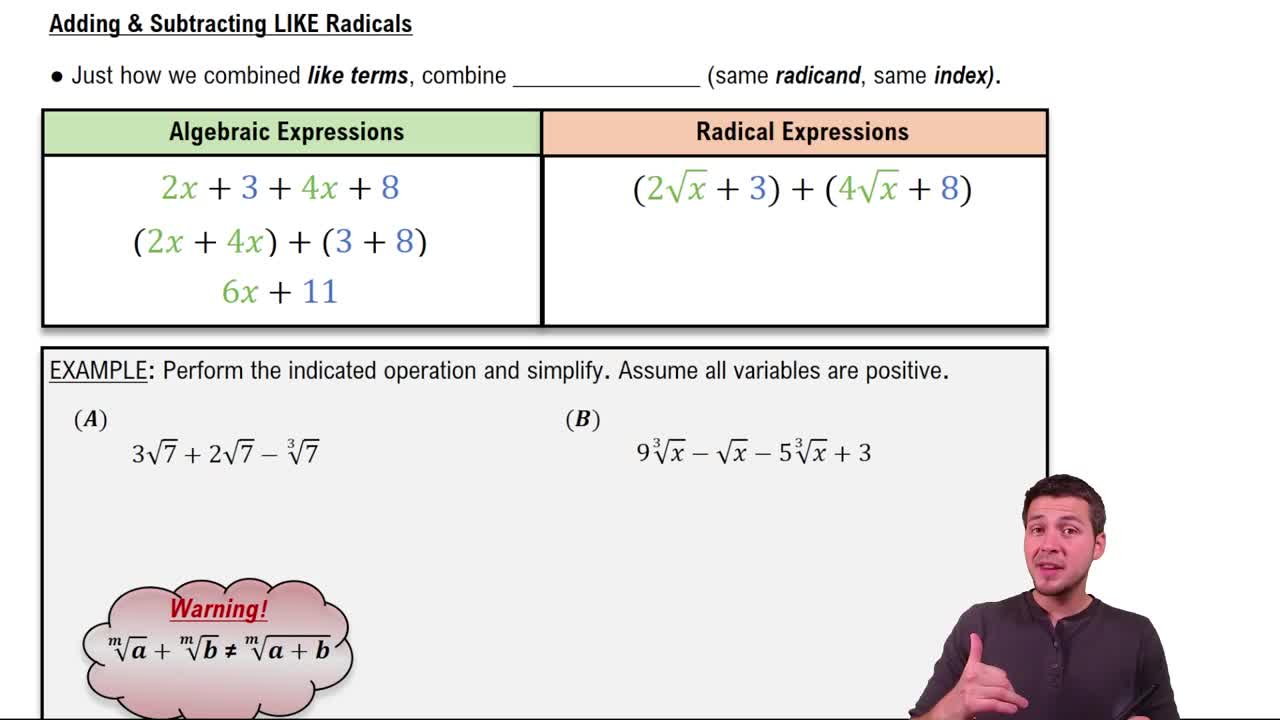
To perform operations like addition or subtraction on radical expressions, the terms must have the same radical part (like terms). This means the variables and their exponents under the root must match. Simplifying each term to a common radical form helps identify like terms for combination.
추천 영상:
Adding & Subtracting Like Radicals
관련 실천
교과서 질문
948
views
교과서 질문
Factor by any method. See Examples 1–7. 64+(3x+2)3
1119
views
교과서 질문
Let U = {0, 1, 2, 3, 4, 5, 6, 7, 8, 9, 10, 11, 12, 13}, M = {0, 2, 4, 6, 8}, N = {1, 3, 5, 7, 9, 11, 13}, Q = {0, 2, 4, 6, 8, 10, 12}, and R = {0, 1, 2, 3, 4}.Use these sets to find each of the following. Identify any disjoint sets. {x | x ∈ U, x ∉ R}
991
views
교과서 질문
Evaluate each expression for , , and .
865
views
교과서 질문
Multiply or divide as indicated. 22.41 × 33
1054
views
교과서 질문
Simplify each expression. Write answers without negative exponents. Assume all variables represent positive real numbers. (z1/3z-2/3z1/6)/(z-1/6)3
1190
views
