Ch. R - Review of Basic Concepts
Lial - College Algebra 13th Edition
Lial13th EditionCollege AlgebraISBN: 9780136881063당신이 사용하는 게 아니라요?교과서 변경
1장, 문제 19

Use set notation, and list all the elements of each set. {12, 13, 14,..., 20}

검증된 단계별 안내
1
Identify the set given: {12, 13, 14, ..., 20}. This set includes all integers starting from 12 up to 20.
Understand that the ellipsis (...) means the set contains all consecutive integers between the first and last numbers listed.
List all the elements explicitly by writing out each integer from 12 to 20: 12, 13, 14, 15, 16, 17, 18, 19, 20.
Write the set in set notation by enclosing all these elements in curly braces: {12, 13, 14, 15, 16, 17, 18, 19, 20}.
Confirm that the set includes only these integers and no others, as the problem specifies the range from 12 to 20.

비슷한 문제에 대한 검증된 영상 답변:

이 영상 해법은 위 문제에 도움이 된다고 튜터들이 추천한 것입니다.
영상 길이:
2m
도움이 되었나요?

주요 개념

질문에 올바르게 답하기 위해 반드시 이해해야 하는 핵심 개념들은 다음과 같습니다.

Set Notation

Set notation is a way to describe a collection of distinct objects, called elements, using curly braces {}. Elements inside the braces are listed or described by a rule. For example, {1, 2, 3} lists elements explicitly, while {x | x > 0} describes elements by a condition.
추천 영상:
05:18
Interval Notation

Listing Elements of a Set

Listing elements means writing out all members of a set explicitly. When given a range or pattern, you identify each element that fits the criteria and write them separated by commas inside braces. For example, {12, 13, 14, ..., 20} means all integers from 12 to 20 inclusive.
추천 영상:
5:20
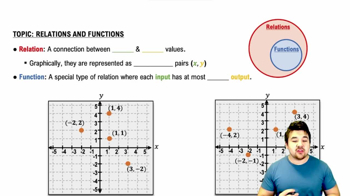
Relations and Functions

Understanding Ellipsis (...) in Sets

The ellipsis (...) indicates a continuation of a pattern in a set. It shows that elements follow a sequence without listing every element. To list all elements, you replace the ellipsis with the missing elements that continue the pattern, ensuring the set is complete.
추천 영상:
03:42
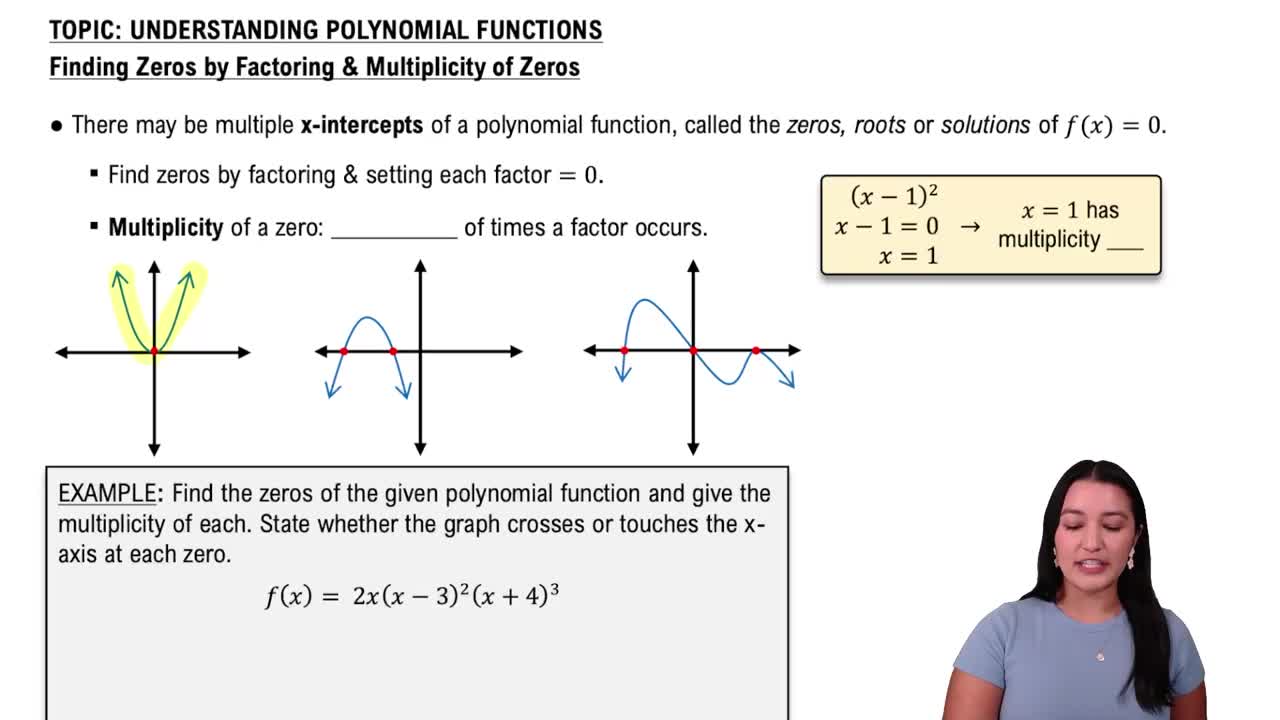
Finding Zeros & Their Multiplicity