Ch. R - Review of Basic Concepts
Lial - College Algebra 13th Edition
Lial13th EditionCollege AlgebraISBN: 9780136881063당신이 사용하는 게 아니라요?교과서 변경
1장, 문제 57

Use the rules for radicals to perform the indicated operations. Assume all variable expressions represent positive real numbers. ∛ 7x • ∛ 2y

검증된 단계별 안내
1
Recall the rule for multiplying radicals with the same index: \( \sqrt[n]{a} \times \sqrt[n]{b} = \sqrt[n]{a \times b} \). In this problem, both radicals are cube roots (index 3).
Write the product of the cube roots as a single cube root: \( \sqrt[3]{7x} \times \sqrt[3]{2y} = \sqrt[3]{(7x)(2y)} \).
Multiply the expressions inside the cube root: \( (7x)(2y) = 14xy \).
Rewrite the expression as \( \sqrt[3]{14xy} \), which is the simplified form of the product.
Since all variables represent positive real numbers, no further simplification or absolute value considerations are needed.

비슷한 문제에 대한 검증된 영상 답변:

이 영상 해법은 위 문제에 도움이 된다고 튜터들이 추천한 것입니다.
영상 길이:
1m
도움이 되었나요?

주요 개념

질문에 올바르게 답하기 위해 반드시 이해해야 하는 핵심 개념들은 다음과 같습니다.

Properties of Radicals

Radicals represent roots of numbers or expressions. The cube root (∛) of a number is the value that, when cubed, returns the original number. Understanding how to manipulate radicals, especially nth roots, is essential for simplifying and performing operations with them.
추천 영상:
05:20
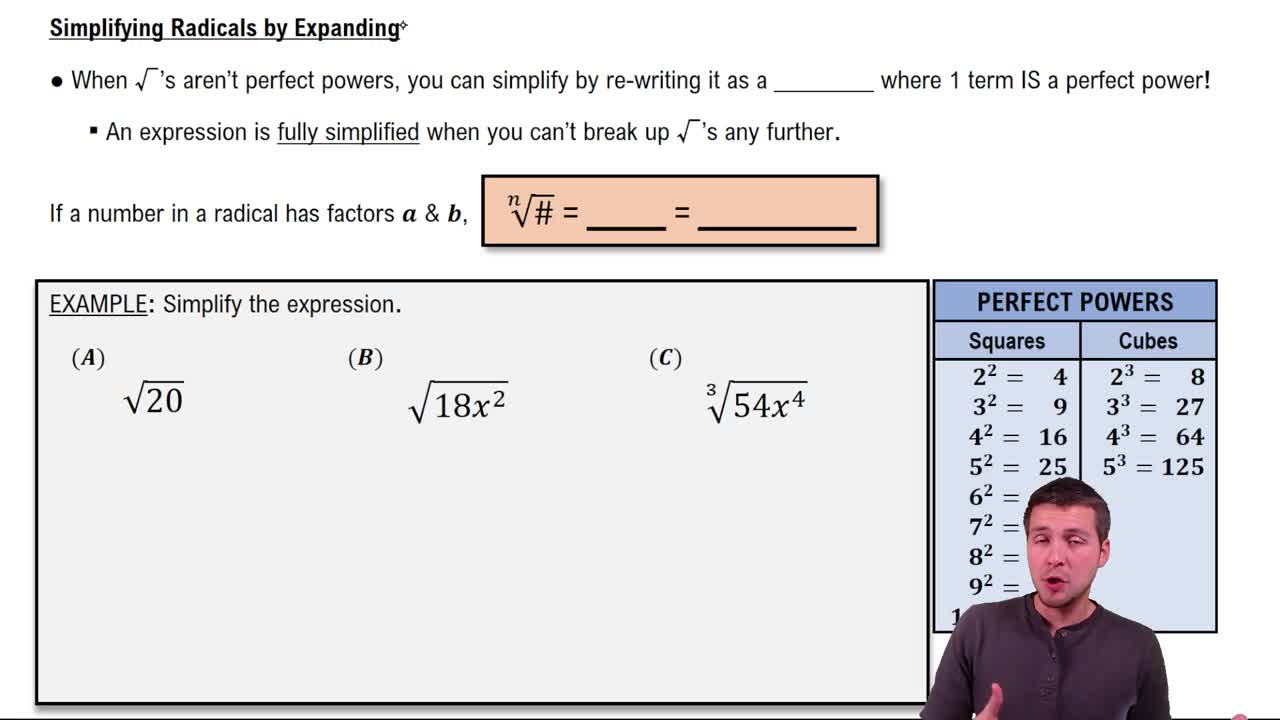
Expanding Radicals

Multiplication of Radicals with the Same Index

When multiplying radicals that have the same root index, you can multiply the radicands (the expressions inside the radical) together under a single radical. For example, ∛a × ∛b = ∛(a × b). This property simplifies the multiplication of radical expressions.
추천 영상:
06:44
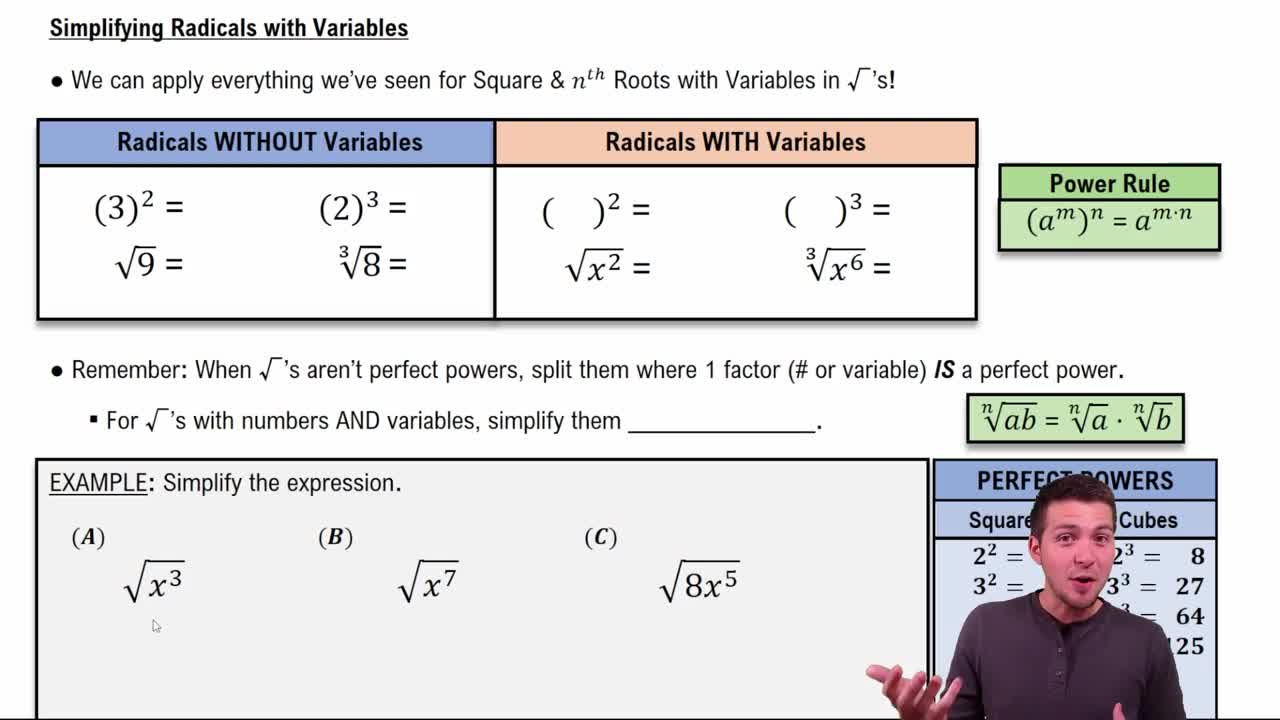
Radical Expressions with Variables

Assumption of Positive Real Numbers

Assuming all variables represent positive real numbers allows us to avoid considering absolute values or complex numbers when simplifying radicals. This assumption ensures that the operations and simplifications follow standard rules without additional restrictions.
추천 영상:
03:31
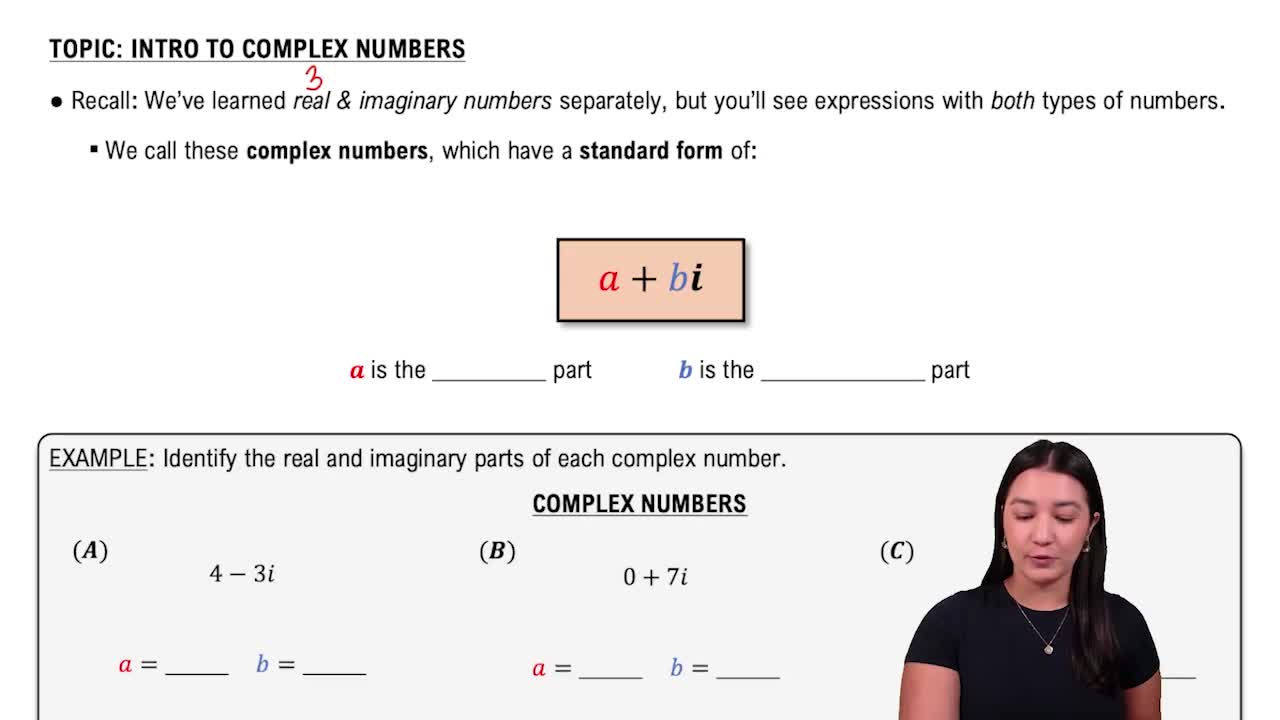
Introduction to Complex Numbers