Skip to main content
Financial Accounting
나의 코스
배우기
시험 준비
AI 튜터
학습 가이드
플래시카드
탐험해 보세요
앱을 사용해 보세요
나의 코스
배우기
시험 준비
AI 튜터
학습 가이드
플래시카드
탐험해 보세요
앱을 사용해 보세요
뒤로
Introduction to Ratios definitions
1 학생이 이 점이 도움이 되었다고 느꼈습니다
카드를 뒤집기 위해 탭할 수 있습니다.
Ratio
카드를 뒤집기 위해 탭할 수 있습니다.
👆
Ratio
A numerical comparison showing how many units of one quantity exist for each unit of another, often expressed as a decimal or fraction.
진행 상황 추적
컨트롤 버튼이 '내비게이션' 모드로 변경되었습니다.
1/15
관련 플래시카드
관련 실천
추천 영상
Introduction to Ratios quiz #1
Introduction to Ratios
40 용어
Introduction to Ratios
14. Financial Statement Analysis
10 문제점
주제
Ratios: Earnings Per Share (EPS)
14. Financial Statement Analysis
10 문제점
주제
14. Financial Statement Analysis
15 주제
15 문제점
장
VideoThumbView.guidedCourse
08:33
Introduction to Ratios
1344
views
46
rank
이 집합의 용어 (15)
하이드의 정의
Ratio
A numerical comparison showing how many units of one quantity exist for each unit of another, often expressed as a decimal or fraction.
Financial Analysis
The process of evaluating financial data to make informed decisions about a company's performance and prospects.
Liquidity Ratio
A measure indicating a company's ability to meet short-term obligations using its most liquid assets.
Solvency Ratio
An indicator of a company's capacity to meet long-term debts and financial commitments.
Financial Leverage Ratio
A metric assessing the extent to which a company uses borrowed funds to finance its assets.
Efficiency Ratio
A calculation that evaluates how effectively a company utilizes its assets or manages its liabilities.
Profitability Ratio
A tool for measuring how much profit a company generates relative to sales, assets, or equity.
Market Value Ratio
A comparison involving a company's stock price and other financial figures to assess investment attractiveness.
Numerator
The top part of a fraction or ratio, representing the quantity being compared per unit of the denominator.
Denominator
The bottom part of a fraction or ratio, indicating the reference unit for the comparison.
Benchmarking
The practice of comparing a company's ratios to those of competitors or industry averages to gauge performance.
Threshold
A specific value or limit used to interpret whether a ratio signals acceptable or concerning performance.
Book Value
The value of an asset or equity as recorded on the balance sheet, often based on historical cost.
Market Price
The current value at which a company's stock is traded in the open market, reflecting investor sentiment.
Industry Average
A standard or mean value of a particular ratio calculated across multiple companies within the same sector.
 뒤로뒤로
뒤로뒤로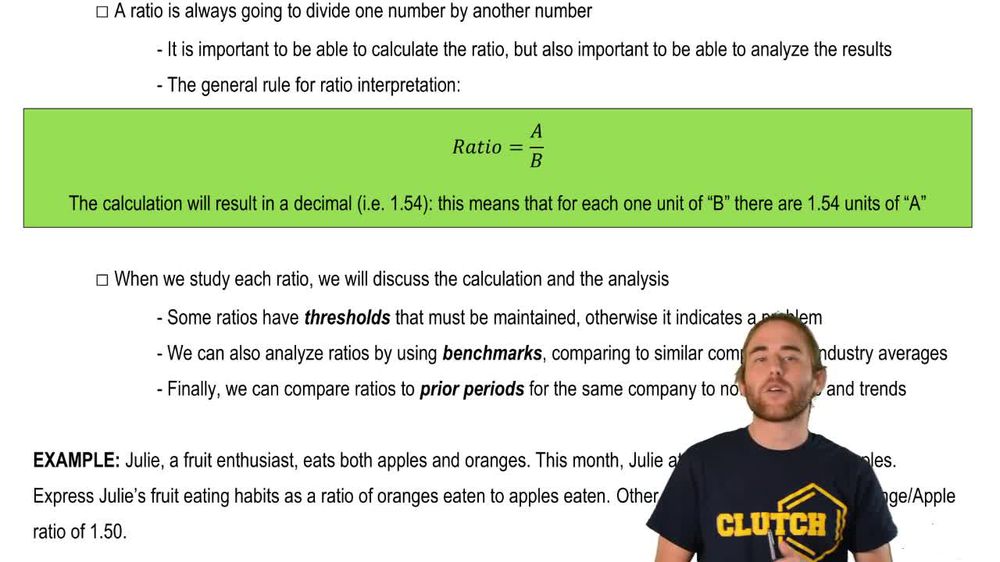
 08:33
08:33