Skip to main content
Financial Accounting
나의 코스
배우기
시험 준비
AI 튜터
학습 가이드
플래시카드
탐험해 보세요
앱을 사용해 보세요
나의 코스
배우기
시험 준비
AI 튜터
학습 가이드
플래시카드
탐험해 보세요
앱을 사용해 보세요
뒤로
Perpetual Inventory - Purchasing Summary definitions
카드를 뒤집기 위해 탭할 수 있습니다.
Perpetual Inventory System
카드를 뒤집기 위해 탭할 수 있습니다.
👆
Perpetual Inventory System
A method where inventory records are updated continuously for each purchase and sale, providing real-time inventory balances.
진행 상황 추적
컨트롤 버튼이 '내비게이션' 모드로 변경되었습니다.
1/13
관련 플래시카드
관련 실천
추천 영상
Perpetual Inventory - Purchasing Summary quiz
Perpetual Inventory - Purchasing Summary
15 용어
Perpetual Inventory - Purchasing Summary
4. Merchandising Operations
9 문제점
주제
Periodic Inventory - Purchases
4. Merchandising Operations
10 문제점
주제
4. Merchandising Operations
14 주제
14 문제점
장
VideoThumbView.guidedCourse
06:37
Perpetual Inventory:Purchasing Summary
1218
views
47
rank
이 집합의 용어 (13)
하이드의 정의
Perpetual Inventory System
A method where inventory records are updated continuously for each purchase and sale, providing real-time inventory balances.
Inventory Account
A ledger account tracking the value of goods held for sale, reflecting increases and decreases from purchases and sales.
Beginning Balance
The amount of inventory on hand at the start of an accounting period, serving as the starting point for calculations.
Purchases
Additions to inventory during a period, representing goods acquired for resale and increasing the inventory account.
Purchase Discounts
Reductions in the cost of inventory received for early payment to suppliers, decreasing the inventory account.
Purchase Returns and Allowances
Deductions from inventory for goods returned to suppliers or price reductions for defective items, lowering inventory value.
Cost of Goods Sold
The expense representing the cost of inventory sold during a period, reducing the inventory account.
Ending Balance
The final value of inventory remaining at the end of a period after accounting for all additions and subtractions.
T-Account
A visual tool used to represent increases (debits) and decreases (credits) in an account, aiding in inventory calculations.
Debits
Entries on the left side of a T-account, typically representing increases to asset accounts like inventory.
Credits
Entries on the right side of a T-account, usually indicating decreases to asset accounts such as inventory.
Accounts Payable
A liability account for amounts owed to suppliers, not directly affecting inventory calculations in this context.
Base Equation
A formula used to determine ending inventory: Beginning Balance + Purchases - (Discounts + Returns + COGS) = Ending Balance.
 뒤로뒤로
뒤로뒤로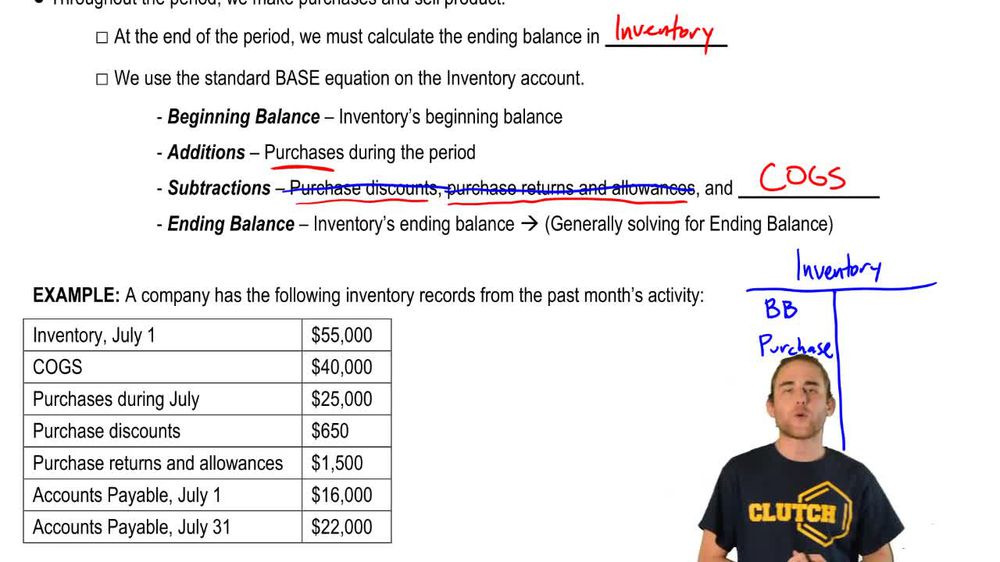
 06:37
06:37