Skip to main content
Financial Accounting
나의 코스
배우기
시험 준비
AI 튜터
학습 가이드
플래시카드
탐험해 보세요
앱을 사용해 보세요
나의 코스
배우기
시험 준비
AI 튜터
학습 가이드
플래시카드
탐험해 보세요
앱을 사용해 보세요
뒤로
Time Value of Money Equations quiz #2
카드를 뒤집기 위해 탭할 수 있습니다.
What is the main reason for discounting future cash flows?
카드를 뒤집기 위해 탭할 수 있습니다.
👆
What is the main reason for discounting future cash flows?
To determine their value in today's terms, accounting for the opportunity to earn interest.
진행 상황 추적
컨트롤 버튼이 '내비게이션' 모드로 변경되었습니다.
1/40
관련 플래시카드
관련 실천
추천 영상
Time Value of Money Equations definitions
Time Value of Money Equations
15 용어
Time Value of Money Equations quiz #1
Time Value of Money Equations
40 용어
Time Value of Money Equations quiz #3
Time Value of Money Equations
40 용어
Time Value of Money Equations
10. Time Value of Money
10 문제점
주제
Using Time Value of Money Tables
10. Time Value of Money
10 문제점
주제
10. Time Value of Money
2 주제
15 문제점
장
VideoThumbView.guidedCourse
05:53
Annuity
806
views
16
rank
VideoThumbView.guidedCourse
05:55
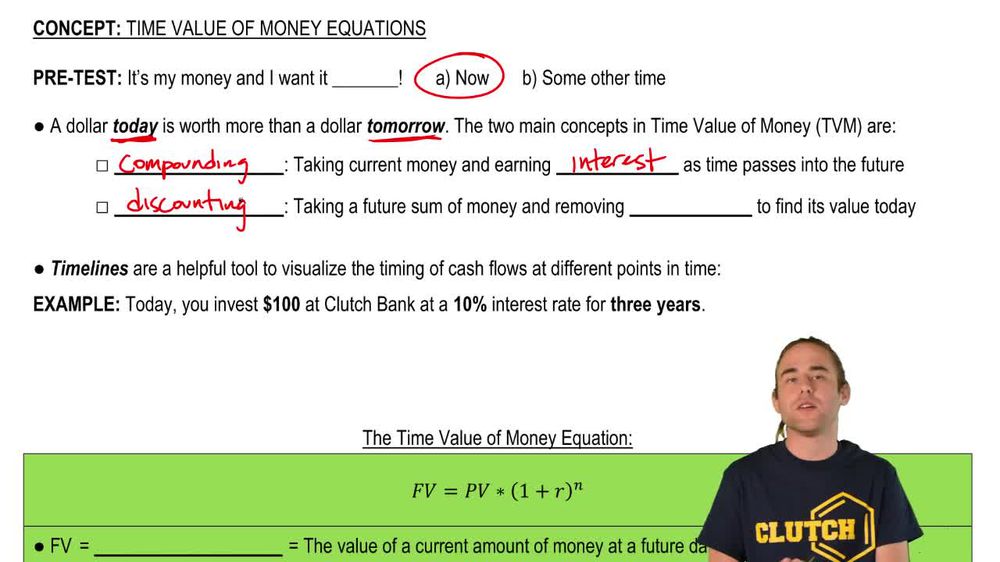
Time Value of Money and Using Timelines
1739
views
38
rank
1
comments
VideoThumbView.guidedCourse
04:37
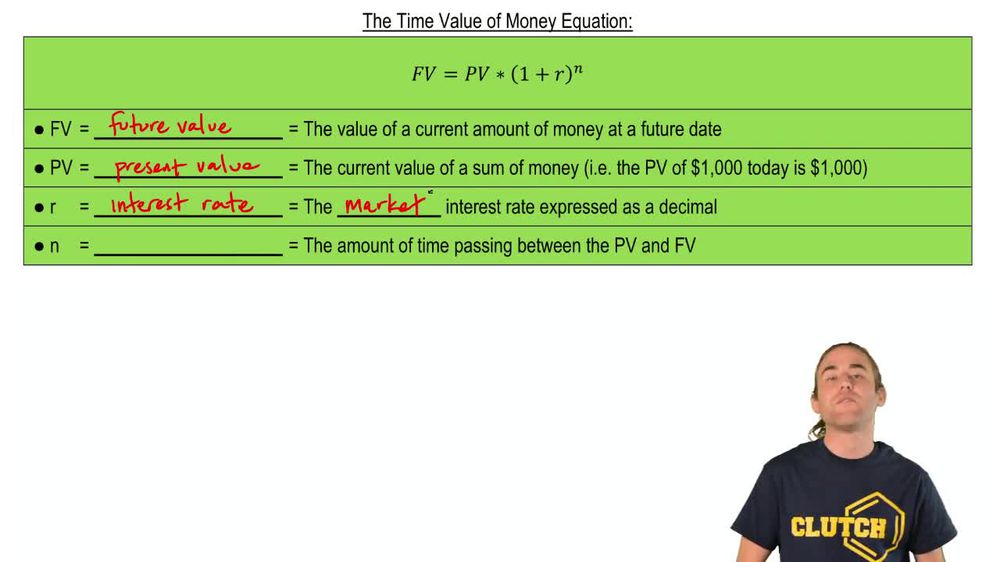
Time Value of Money Equation:Future Value
1095
views
20
rank
이 집합의 용어 (40)
하이드의 정의
What is the main reason for discounting future cash flows?
To determine their value in today's terms, accounting for the opportunity to earn interest.
If you receive \$5,000 every year for 3 years, what information do you need to find the present value?
You need the interest rate and the number of periods to use the present value table or formula.
What is the effect of a higher interest rate on the present value of a future sum?
A higher interest rate decreases the present value of a future sum.
What is the effect of a longer time period on the present value of a future sum?
A longer time period decreases the present value of a future sum.
How does the time value of money apply to bonds payable?
It is used to determine the present value of future bond payments to price the bond.
What is the main purpose of using the time value of money equation in accounting?
To calculate the present or future value of cash flows for decision-making and financial reporting.
What is the present value of \$2,000 to be received in 2 years at a 5% interest rate?
PV = \(2,000 / (1.05)^2 ≈ \)1,814.06.
What is the future value of \$1,200 invested for 5 years at 6% interest?
FV = \$1,200 × (1.06)^5 ≈ \$1,606.47.
Why do we use the market interest rate in time value of money calculations?
Because it reflects the current rate available in the market, ensuring accurate valuation.
What is the present value of an ordinary annuity of \$1,000 per year for 4 years at 7% interest?
Use the present value annuity table for 4 periods at 7% to find the factor, then multiply by \$1,000.
What is the main difference between present value and future value?
Present value is the value today; future value is the value at a future date after interest is applied.
How does the time value of money help in comparing different investment options?
It allows you to compare the present values of future cash flows from different investments.
What is the present value of \$500 to be received in 1 year at a 12% interest rate?
PV = \(500 / (1.12) ≈ \)446.43.
What is the future value of \$800 invested for 2 years at 9% interest?
FV = \$800 × (1.09)^2 ≈ \$950.32.
What is the present value of an annuity if the payments are not equal or not at regular intervals?
It is not considered an annuity, so the present value must be calculated for each payment separately.
Why is the exponent 'n' important in the time value of money formula?
It determines how many times interest is compounded, affecting the total amount.
What is the present value of \$1,500 to be received in 4 years at a 6% interest rate?
PV = \(1,500 / (1.06)^4 ≈ \)1,188.44.
What is the future value of \$2,000 invested for 3 years at 5% interest?
FV = \$2,000 × (1.05)^3 ≈ \$2,315.25.
How do you determine the number of periods (n) in a time value of money problem?
Count the number of compounding intervals, usually years, between the present and future dates.
What is the present value of \$10,000 to be received in 5 years at an 8% interest rate?
PV = \(10,000 / (1.08)^5 ≈ \)6,805.83.
What is the future value of \$3,000 invested for 2 years at 7% interest?
FV = \$3,000 × (1.07)^2 ≈ \$3,429.90.
What is the present value of an ordinary annuity of \$2,500 per year for 3 years at 10% interest?
Use the present value annuity table for 3 periods at 10% to find the factor, then multiply by \$2,500.
What is the main benefit of using present value tables for annuities?
They simplify the calculation by providing a factor to multiply by the payment amount.
What is the present value of \$4,000 to be received in 2 years at a 9% interest rate?
PV = \(4,000 / (1.09)^2 ≈ \)3,367.35.
What is the future value of \$1,500 invested for 4 years at 6% interest?
FV = \$1,500 × (1.06)^4 ≈ \$1,893.57.
What is the present value of an ordinary annuity of \$1,200 per year for 5 years at 8% interest?
Use the present value annuity table for 5 periods at 8% to find the factor, then multiply by \$1,200.
What is the effect of increasing the interest rate on the future value of an investment?
Increasing the interest rate increases the future value of an investment.
What is the effect of increasing the number of periods on the future value of an investment?
Increasing the number of periods increases the future value due to more compounding.
What is the present value of \$7,000 to be received in 3 years at a 7% interest rate?
PV = \(7,000 / (1.07)^3 ≈ \)5,712.13.
What is the future value of \$2,500 invested for 5 years at 5% interest?
FV = \$2,500 × (1.05)^5 ≈ \$3,193.06.
What is the present value of an ordinary annuity of \$3,000 per year for 4 years at 9% interest?
Use the present value annuity table for 4 periods at 9% to find the factor, then multiply by \$3,000.
What is the main reason for using the time value of money in accounting?
To accurately value future cash flows for financial reporting and decision-making.
What is the present value of \$6,000 to be received in 2 years at a 10% interest rate?
PV = \(6,000 / (1.10)^2 ≈ \)4,958.68.
What is the future value of \$4,000 invested for 3 years at 8% interest?
FV = \$4,000 × (1.08)^3 ≈ \$5,039.36.
What is the present value of an ordinary annuity of \$2,000 per year for 6 years at 6% interest?
Use the present value annuity table for 6 periods at 6% to find the factor, then multiply by \$2,000.
What is the present value of \$8,000 to be received in 4 years at a 5% interest rate?
PV = \(8,000 / (1.05)^4 ≈ \)6,577.89.
What is the future value of \$5,000 invested for 2 years at 12% interest?
FV = \$5,000 × (1.12)^2 ≈ \$6,272.00.
What is the present value of an ordinary annuity of \$1,500 per year for 3 years at 7% interest?
Use the present value annuity table for 3 periods at 7% to find the factor, then multiply by \$1,500.
What is the present value of \$9,000 to be received in 5 years at a 6% interest rate?
PV = \(9,000 / (1.06)^5 ≈ \)6,728.13.
What is the future value of \$2,200 invested for 4 years at 9% interest?
FV = \$2,200 × (1.09)^4 ≈ \$3,110.13.
 뒤로뒤로
뒤로뒤로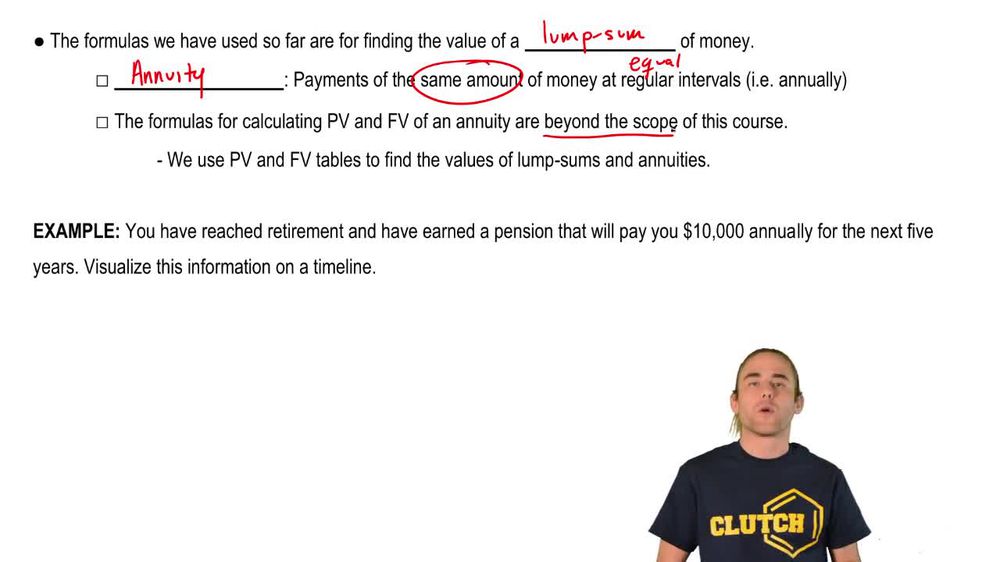
 05:53
05:53