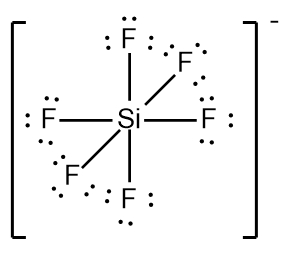
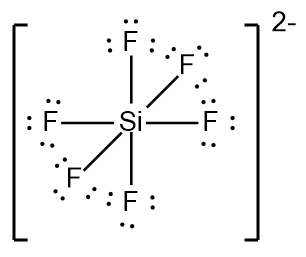
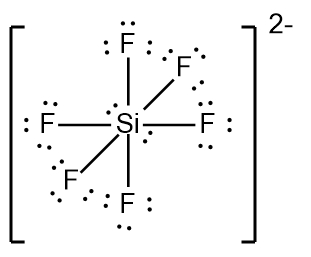
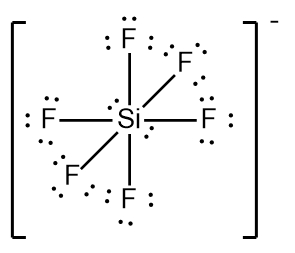
Metalloids can sometimes adopt the bonding preferences of similar nonmetals. Based on your knowledge of expanded octets, draw the Lewis Dot Structure for the following ion, SiF62–.
A
B
C
D
1 댓글
검증된 단계별 안내
1
Identify the central atom in the ion, which is silicon (Si) in this case.
Determine the total number of valence electrons available. Silicon has 4 valence electrons, and each fluorine atom has 7 valence electrons. Since there are 6 fluorine atoms, the total from fluorine is 6 * 7 = 42. Additionally, the 2- charge indicates 2 extra electrons, making the total 4 + 42 + 2 = 48 valence electrons.
Place the silicon atom in the center and arrange the six fluorine atoms around it. Connect each fluorine atom to the silicon atom with a single bond. Each bond uses 2 electrons, so 6 bonds use 12 electrons, leaving 36 electrons.
Distribute the remaining electrons to satisfy the octet rule for each fluorine atom. Each fluorine needs 8 electrons (including the bonding pair), so place 6 electrons (3 lone pairs) around each fluorine. This uses up all 36 remaining electrons.
Verify the structure by checking that all atoms have a complete octet and that the total number of electrons used matches the number calculated initially. The silicon atom can have an expanded octet, which is satisfied in this structure.




 검증된 단계별 안내

