Skip to main content
General Chemistry
나의 코스
배우기
시험 준비
AI 튜터
학습 가이드
교과서적 해결책
플래시카드
탐험해 보세요
앱을 사용해 보세요
나의 코스
배우기
시험 준비
AI 튜터
학습 가이드
교과서적 해결책
플래시카드
탐험해 보세요
앱을 사용해 보세요
뒤로
Arrhenius Equation quiz
카드를 뒤집기 위해 탭할 수 있습니다.
What does the Arrhenius equation describe in chemistry?
카드를 뒤집기 위해 탭할 수 있습니다.
👆
What does the Arrhenius equation describe in chemistry?
It describes how temperature affects the rate constant (k) of a chemical reaction.
진행 상황 추적
컨트롤 버튼이 '내비게이션' 모드로 변경되었습니다.
1/15
관련 플래시카드
관련 실천
추천 영상
Arrhenius Equation definitions
Arrhenius Equation
10 용어
Arrhenius Equation quiz #1
Arrhenius Equation
9 용어
Arrhenius Equation
15. Chemical Kinetics
7 문제점
주제
Jules
Rate Law
15. Chemical Kinetics
7 문제점
주제
Jules
15. Chemical Kinetics - Part 1 of 3
5 주제
12 문제점
장
Jules
15. Chemical Kinetics - Part 2 of 3
4 주제
11 문제점
장
Jules
15. Chemical Kinetics - Part 3 of 3
4 주제
11 문제점
장
Jules
VideoThumbView.guidedCourse
01:20
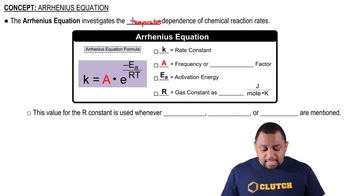
Arrhenius Equation
7353
views
73
rank
2
comments
VideoThumbView.guidedCourse
01:58
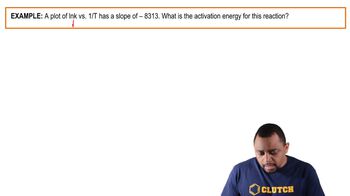
Linear Form of Arrhenius Equation Example
4748
views
48
rank
1
comments
VideoThumbView.guidedCourse
02:36
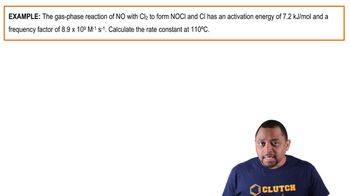
Rate Constant Calculation Example
6178
views
72
rank
4
comments
이 집합의 용어 (15)
하이드의 정의
What does the Arrhenius equation describe in chemistry?
It describes how temperature affects the rate constant (k) of a chemical reaction.
Write the standard form of the Arrhenius equation.
The standard form is k = A * e^(-Ea/RT).
What does the variable 'A' represent in the Arrhenius equation?
'A' is the frequency factor, also called the pre-exponential or Arrhenius factor.
What is the meaning of 'Ea' in the Arrhenius equation?
'Ea' stands for activation energy, which is the energy barrier that must be overcome for a reaction to occur.
What value and units are used for the gas constant 'R' in the Arrhenius equation?
R is 8.314 J/(mol·K) when discussing speed, energy, or velocity.
How does increasing temperature affect the rate constant k according to the Arrhenius equation?
Increasing temperature causes the rate constant k to increase.
When do you use the two-point form of the Arrhenius equation?
You use it when you have two rate constants and two temperatures for a reaction.
Write the two-point form of the Arrhenius equation.
The two-point form is ln(k2/k1) = -Ea/R * (1/T2 - 1/T1).
What do k1 and k2 represent in the two-point Arrhenius equation?
k1 is the initial rate constant and k2 is the final rate constant.
What is the purpose of the linear form of the Arrhenius equation?
It is used to determine the activation energy (Ea) from a plot of ln(k) versus 1/T.
How is the Arrhenius equation rearranged to fit the straight-line equation y = mx + b?
ln(k) is y, -Ea/R is the slope m, 1/T is x, and ln(A) is the intercept b.
What does the slope of a plot of ln(k) versus 1/T represent?
The slope is equal to -Ea/R.
What is plotted on the x-axis and y-axis in the linear form of the Arrhenius equation?
1/T is plotted on the x-axis and ln(k) on the y-axis.
Why might you see two different versions of the two-point Arrhenius equation?
Because the order of temperatures and the sign of Ea can be switched, but both forms give the same answer.
What is the main use of the Arrhenius equation in chemical kinetics?
It is used to relate the rate constant to temperature and activation energy, helping predict how reaction rates change with temperature.
 뒤로뒤로
뒤로뒤로
 01:20
01:20