Skip to main content
General Chemistry
나의 코스
배우기
시험 준비
AI 튜터
학습 가이드
교과서적 해결책
플래시카드
탐험해 보세요
앱을 사용해 보세요
나의 코스
배우기
시험 준비
AI 튜터
학습 가이드
교과서적 해결책
플래시카드
탐험해 보세요
앱을 사용해 보세요
뒤로
Average Rate of Reaction quiz
카드를 뒤집기 위해 탭할 수 있습니다.
What does the average rate of a chemical reaction measure?
카드를 뒤집기 위해 탭할 수 있습니다.
👆
What does the average rate of a chemical reaction measure?
It measures the change in concentration of a reactant or product over a period of time.
진행 상황 추적
컨트롤 버튼이 '내비게이션' 모드로 변경되었습니다.
1/15
관련 플래시카드
관련 실천
추천 영상
Average Rate of Reaction definitions
Average Rate of Reaction
12 용어
Average Rate of Reaction quiz #1
Average Rate of Reaction
10 용어
Average Rate of Reaction
15. Chemical Kinetics
6 문제점
주제
Jules
Stoichiometric Rate Calculations
15. Chemical Kinetics
4 문제점
주제
Jules
15. Chemical Kinetics - Part 1 of 3
5 주제
12 문제점
장
Jules
15. Chemical Kinetics - Part 2 of 3
4 주제
11 문제점
장
Jules
15. Chemical Kinetics - Part 3 of 3
4 주제
11 문제점
장
Jules
VideoThumbView.guidedCourse
02:03
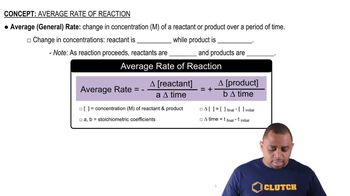
Average Rate of Reaction
8635
views
127
rank
VideoThumbView.guidedCourse
02:42
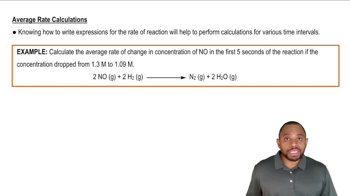
Average Rate Calculation Example
7121
views
122
rank
5
comments
VideoThumbView.guidedCourse
01:34
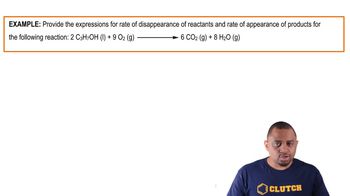
Rate Expressions Example
7701
views
132
rank
2
comments
이 집합의 용어 (15)
하이드의 정의
What does the average rate of a chemical reaction measure?
It measures the change in concentration of a reactant or product over a period of time.
How is the sign of the rate different for reactants and products?
The rate is negative for reactants (since they are consumed) and positive for products (since they are formed).
What is the general formula for the average rate of reaction?
Rate = change in concentration / change in time.
How do you calculate the change in concentration for a substance?
Change in concentration is final concentration minus initial concentration.
What do the brackets [ ] around a chemical species represent?
They represent the concentration of that species, usually in molarity.
In the rate expression, what does 'a' represent for reactants?
'a' is the stoichiometric coefficient of the reactant from the balanced chemical equation.
How is the rate of disappearance of a reactant expressed mathematically?
It is expressed as -1/a × (change in concentration of reactant / change in time).
How is the rate of appearance of a product expressed mathematically?
It is expressed as +1/b × (change in concentration of product / change in time), where b is the stoichiometric coefficient.
Why is the rate of reactant consumption negative?
Because reactants are being used up, so their concentration decreases over time.
Why is the rate of product formation positive?
Because products are being formed, so their concentration increases over time.
What does the change in time (Δt) represent in the rate equation?
It is the final time minus the initial time over which the concentration change is measured.
How are stoichiometric coefficients used in rate expressions?
They adjust the rate expressions so that the rate of disappearance of reactants equals the rate of appearance of products.
What is the relationship between the rates of reactant disappearance and product appearance?
When adjusted for stoichiometric coefficients, the rates are equal in magnitude but opposite in sign.
Why is it important to use a balanced chemical equation when calculating average rates?
Because the stoichiometric coefficients ensure the correct relationship between the rates of all species involved.
What does the average rate tell us about a chemical reaction?
It tells us how quickly reactants are consumed or products are formed over a specific time interval.
 뒤로뒤로
뒤로뒤로
 02:03
02:03